fse_sim#
- blochsim.fse_sim()[source]#
Simulate a fast spin echo train.
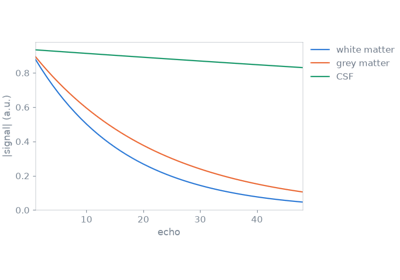
Fast (turbo) spin echo: an excitation followed by a train of refocusing pulses, with one echo sampled midway between each pair, simulated with extended phase graphs. The train is played twice by default so that the recorded echoes start from the longitudinal magnetization left by the previous train. Wraps
FSESimulator.- Parameters:
flip (array-like) – Refocusing flip angles, in degrees, one per echo; their number is the echo train length.
ESP (float) – Echo spacing, in ms.
T1 (float or array-like) – Longitudinal relaxation time, in ms.
T2 (float or array-like) – Transverse relaxation time, in ms.
phases (float or array-like, default=0.0) – Refocusing RF phases, in degrees; scalar or one per echo.
TR (float or array-like, default=1e6) – Repetition time, in ms, setting the longitudinal recovery between trains. The default is effectively full recovery.
exc_flip (float, default=90.0) – Excitation flip angle, in degrees.
exc_phase (float, default=90.0) – Excitation RF phase, in degrees.
diff (str or tuple of str, default=None) – Names of the properties to differentiate with respect to.
Nonereturns the signal alone.B1 (float or array-like, default=1.0) – Transmit field, as a fraction of the nominal flip angle.
M0 (float or array-like, default=1.0) – Equilibrium magnetization.
states (int, default=10) – Configuration orders retained by the extended-phase-graph simulation.
device (str or torch.device, default=None) – Device to run on.
Nonefollows the inputs.**values – Any further property or protocol argument of the simulator, such as
B0orB1, passed tosimulate(). Arguments given asNoneare dropped.
- Returns:
signal (complex array-like) – Signal of shape
(..., len(flip)), where...is the broadcast shape of the tissue properties.jacobian (same array type as
signal) – Derivatives of the signal with respect todiff, of shape(..., len(diff), len(flip)). Returned only whendiffis given; a single name omits thelen(diff)axis.