
Note
Go to the end to download the full example code.
3D stack-of-blades gradient echo#

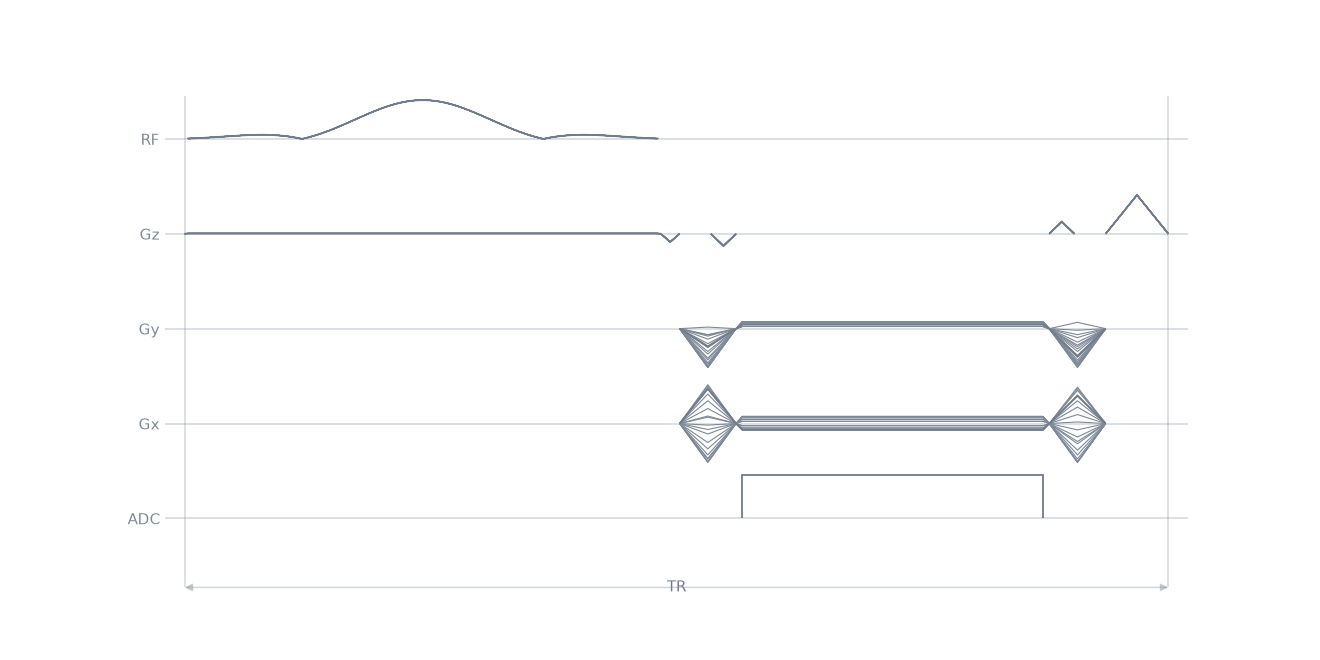
A slab-selective spoiled excitation is followed by one line from a rotating in-plane PROPELLER blade with Cartesian partition encoding. Gradient and RF spoiling suppress residual transverse coherence. TR, flip angle, and TE determine contrast. The overlapping blade centres support motion-robust 3D structural imaging.
Sixteen-line blades#
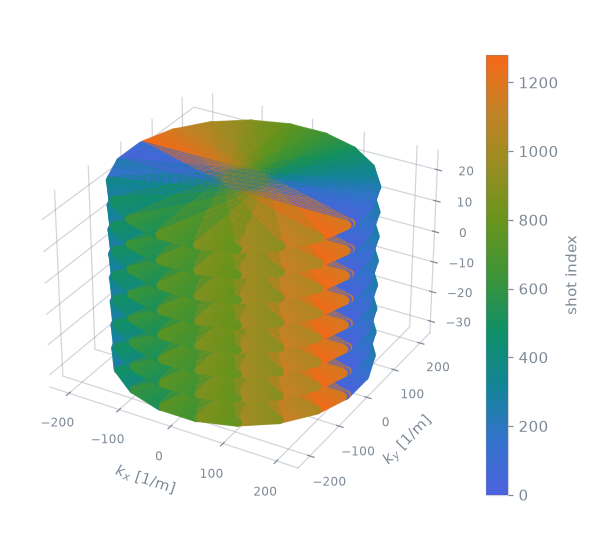
Sixteen lines per blade, at every partition.
import pypulseqpp as pp
from pypulseqpp.sequences import gre_stack_of_blades3D_sequence

baseline = gre_stack_of_blades3D_sequence(
    n=96, n_z=8, blade_width=16, tr=None, n_dummy=0
)
print(f"{baseline.num_blocks} blocks, {baseline.duration()[0]:.2f} s")
6400 blocks, 8.04 s
Sequence diagram#
Sampling order#
The blades of every partition, over the three k-space axes.
pp.plot.plot_kspace(baseline, color_by="shot")
Wider blades#
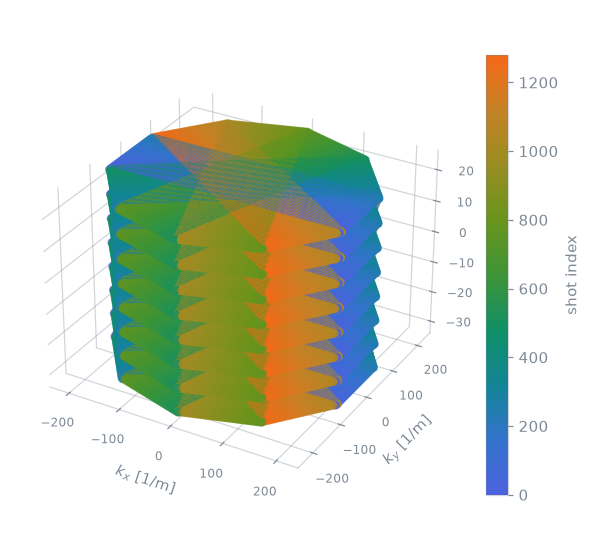
Increasing blade width reduces the number of blade orientations and increases the shared central-k-space region.
alternative = gre_stack_of_blades3D_sequence(
    n=96, n_z=8, blade_width=32, tr=None, n_dummy=0
)
                   blocks  duration (s)  acquisitions
16 lines             6400          8.04          1280
32 lines             6400          8.04          1280
pp.plot.plot_kspace(alternative, color_by="shot")
Total running time of the script: (0 minutes 8.963 seconds)