

BssfpReadout2D#
- class pypulseqpp.sequences.BssfpReadout2D[source]#
Bases:
SequenceModuleSlice-selective balanced SSFP, phase-encoded along y.
fovandmatrixtake two values, readout first.Every axis is balanced between consecutive RF centres. The slice rephasers belong to that balance and are built here, so
rfandgzcome from an excitation built withrephase=False.The module’s blocks are excitation, acquisition, rewind. The caller plays each shot as the previous shot’s rewind, excitation and acquisition, and writes the transients: the half-flip pulse (
rfat half amplitude, opposite in phase to the first excitation) followed bywait_prepwithgz_prepin place of the first rewind; and a last rewind block to ramp down.- Parameters:
system (pypulseqpp.Opts) – System limits.
rf (RfEvent) – The excitation.
gz (GradEvent, default=None) – Its selection gradient without a rephaser, played in the excitation block;
Nonefor a hard pulse.fov (float or sequence of float) – Field of view per encoded axis, readout first (m).
matrix (int or sequence of int) – Matrix size per encoded axis, readout first.
tr (float, default=None) – Repetition time (s).
Noneis as short as possible; a longer TR is added evenly either side of the echo, so TE stays at TR/2.half_flip_prep (bool, default=True) – Build
wait_prepfor the half-flip preparation. Requires the acquisition block after the echo to be at least as long as the excitation block after the pulse centre. False when the caller ramps the signal in with dummy repetitions.oversampling (float, default=1.0) – Readout oversampling: the sample spacing in k-space is
1 / (oversampling * fov).readout_bandwidth_hz (float, default=250000.0) – Requested ADC sampling rate (Hz);
bandwidth_hzis the rate achieved on the ADC and gradient rasters.labels (sequence of str, default=None) – Labels set to 0 on the acquisition block, to be changed per shot by the caller.
trigger (TriggerEvent or DigitalOutputEvent, default=None) – Event armed on the rewind block.
bridge (bool, default=False) – Join the blocks of a slice on the slice axis, 2D with a trapezoidal
gzonly: the ramps of the selection plateau run through zero to a fraction of its amplitude where the excitation block meets the rewind before it and the acquisition after it, and the rephasers end and start there. No join between two repetitions then has every gradient at rest, so a scanner that prepares a segment between blocks at rest plays the slice as one, at every repetition time: a longertrlengthens the acquisition and rewind blocks, which carry the read and phase lobes from one end to the other. The windows either side of the excitation hold the bridged rephasers andgz_close, so the shortest repetition can differ by a few rasters from that of a slice axis that rests. The caller opens a bridged slice withgz_openin place ofgzand closes it withgz_closein place ofgz_rew; a rewind withgz_closefollowed by an excitation withgz_openrests the slice between two repetitions, each of the same duration.
- Attributes:
rf (RfEvent) – The excitation, replayed every repetition with the phase and amplitude the loop sets.
gz (GradEvent) – Its selection gradient, if one was given.
gx, gx_rew (GradEvent) –
gxramps up from zero, prephases and holds the readout plateau to the end of the acquisition block;gx_rewramps down from the plateau and rewinds the read axis.gy_pre, gy_rew (TrapEvent) – In-plane encode at its largest step, and the same negated, to be scaled per shot.
gz_pre, gz_rew (TrapEvent) – Slice rephasers:
gz_prein the acquisition block after the pulse,gz_rewin the rewind block before the next pulse. Absent for a hard pulse.bridged (bool) – Whether the blocks of a slice join on the slice axis.
gz_open, gz_close (GradEvent) – Bridged only: the selection gradient of an excitation block that opens from rest, and the rephaser of a rewind that starts and ends at rest and rephases
gz_open. They open and close a slice, and rest it between two of its repetitions.gz_partition, gz_partition_rew (TrapEvent) – Partition encode at its largest step, and the same negated, sharing the window of
gz_preandgz_rewrespectively. 3D only.adc (AdcEvent) – The acquisition window, spanning the readout plateau.
adc_labels (LabelSetEvent or list of LabelSetEvent) – One per name in
labels.prep_labels, train_labels, end_labels (list of LabelSetEvent) –
ONCEset to 1, 0 and 2, for the half-flip block, the block after it and the final rewind.wait_prep (DelayEvent) – Delay after the half-flip block, which places the half-flip pulse half a repetition before the first excitation. Absent with
half_flip_prep=False.gz_prep (TrapEvent) – Slice rephaser played with
wait_prep: the two rephasers of a repetition in one lobe, so that the slice axis is balanced from the half-flip pulse to the first excitation. None without a selection gradient; absent withhalf_flip_prep=False.tr, te (float) – Repetition and echo time (s);
teis always half oftr.bandwidth_hz (float) – Achieved ADC sampling rate (Hz).
n_samples (int) – ADC samples per repetition.
delta_kx (float) – K-space sample spacing along the readout (1/m).
readout_duration (float) – Duration of the sampling window (s).
- Raises:
ValueError – If a size or rate is out of range, the
half_flip_prepcondition fails, the requested TR is shorter than the module can achieve, orbridgeis asked of a 3D readout or of agzthat is not a trapezoid.
Examples
>>> import pypulseqpp.sequences as design
>>> import pypulseqpp as pp
>>> system = pp.Opts()
>>> excitation = design.SpatialSelectiveExcitation(
...     system, 40.0, 5e-3, 1e-3, rephase=False
... )
>>> readout = design.BssfpReadout2D(
...     system, excitation.rf, excitation.gz,
...     fov=(0.28, 0.28), matrix=(64, 64), readout_bandwidth_hz=50_000,
... )
>>> readout.te == readout.tr / 2
True
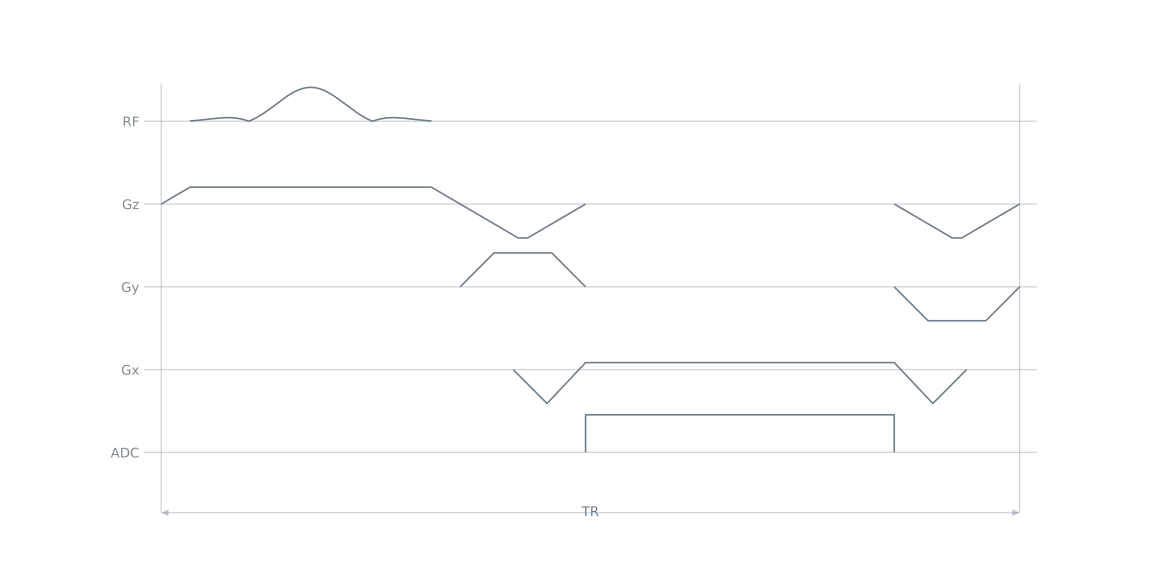
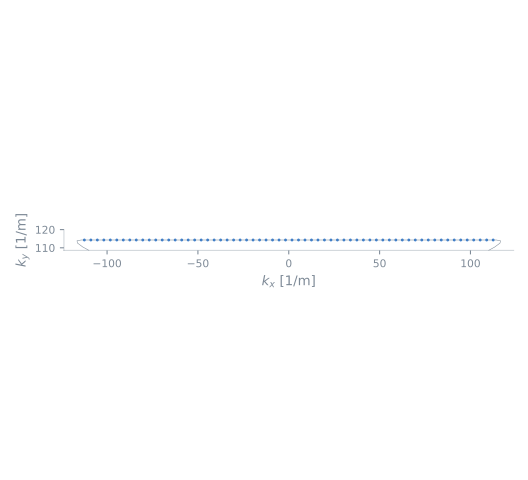
One repetition and the line it reads. The net gradient area on every axis is zero over the repetition, the condition that defines a balanced acquisition:
Methods
Build the module's block layout; implemented by the subclass. |
|
Publish events from the caller's locals and register keyword aliases. |
|
Publish named events, whether or not they were added to a block. |
Attributes