
BssfpReadout3D#
- class pypulseqpp.sequences.BssfpReadout3D[source]#
Bases:
SequenceModuleSlab-selective balanced SSFP, encoded along y and z.
fovandmatrixtake three values, readout first. Add each scaled partition encode to the slice rephaser whose window it shares (gz_partitiontogz_pre,gz_partition_rewtogz_rew), for example withpypulseqpp.add_gradients(), rather than playing it alone.Every axis is balanced between consecutive RF centres. The slice rephasers are part of that balance and are built here, so pass an excitation built with
rephase=False.The module’s blocks are excitation, acquisition, rewind. A loop plays each shot as the previous shot’s rewind, excitation, acquisition, and writes the transients itself: the half-flip pulse (
rfat half amplitude, opposite in phase to the first excitation) thenwait_prep;wait_rewindwithgz_rewin place of the first rewind; and a last rewind block to ramp down.- Parameters:
system (pypulseqpp.Opts) – System limits.
rf (RfEvent) – The excitation.
gz (GradEvent, default=None) – Its selection gradient without a rephaser, played in the excitation block.
Nonefor a hard pulse.fov (float or sequence of float) – Field of view (m), per encoded axis, readout first.
matrix (int or sequence of int) – Matrix size, per encoded axis.
tr (float, default=None) – Repetition time (s).
Noneis as short as possible; a longer one is padded evenly either side of the echo, so TE stays at TR/2.half_flip_prep (bool, default=True) – Publish
wait_prep. This requires the acquisition block after the echo to be at least as long as the excitation block after the pulse centre. Turn it off to ramp the train in with dummy repetitions.oversampling (float, default=1.0) – Read oversampling.
readout_bandwidth_hz (float, default=250000.0) – Requested ADC sampling rate (Hz).
bandwidth_hzreports the achieved raster-compatible rate.labels (sequence of str, default=None) – Counters emitted on the acquisition block.
trigger (event, default=None) – A trigger or digital output armed on the rewind block.
- Attributes:
rf (RfEvent) – The excitation, replayed every repetition with the phase and amplitude the loop sets.
gz (GradEvent) – Its selection gradient, if one was given.
gx, gx_rew (GradEvent) –
gxramps up from zero, prephases and holds the readout plateau to the end of the acquisition block;gx_rewramps down from the plateau and rewinds the read axis.gy_pre, gy_rew (TrapEvent) – In-plane encode at its largest step, and the same negated, to be scaled per shot.
gz_pre, gz_rew (TrapEvent) – The slice rephasers:
gz_prein the acquisition block after the pulse,gz_rewin the rewind block before the next one. Absent for a hard pulse.gz_partition, gz_partition_rew (TrapEvent) – Partition encode at its largest step, and the same negated, sharing the window of
gz_preandgz_rewrespectively. 3D only.adc (AdcEvent) – The acquisition window, spanning the readout plateau.
adc_labels (LabelSetEvent or list of LabelSetEvent) – One per name in
labels; a bare event when there is one.prep_labels, train_labels, end_labels (list of LabelSetEvent) –
ONCEset to 1, 0 and 2, for the half-flip block, the block after it and the final rewind.wait_prep (DelayEvent) – Played after the half-flip block; with the
wait_rewindblock it puts the half-flip pulse half a repetition before the first excitation. Absent underhalf_flip_prep=False.wait_rewind (DelayEvent) – The rewind block’s duration, for the first repetition.
tr, te (float) – Repetition and echo time (s);
teis always half oftr.bandwidth_hz (float) – Achieved ADC sampling rate (Hz).
n_samples (int) – Samples per repetition.
delta_kx (float) – Read-axis k-space step (1/m).
readout_duration (float) – Sampling window (s).
- Raises:
ValueError – If a size or rate is out of range, the
half_flip_prepcondition fails, or the requested TR is shorter than the module can achieve.
Examples
>>> import pypulseqpp.sequences as design
>>> import pypulseqpp as pp
>>> system = pp.Opts()
>>> excitation = design.SpatialSelectiveExcitation(
...     system, 25.0, 0.12, 1e-3, is_slab=True, rephase=False
... )
>>> readout = design.BssfpReadout3D(
...     system, excitation.rf, excitation.gz,
...     fov=(0.28, 0.28, 0.12), matrix=(64, 64, 32),
...     readout_bandwidth_hz=50_000,
... )
>>> readout.gz_partition.channel, readout.gz_pre.channel
('z', 'z')
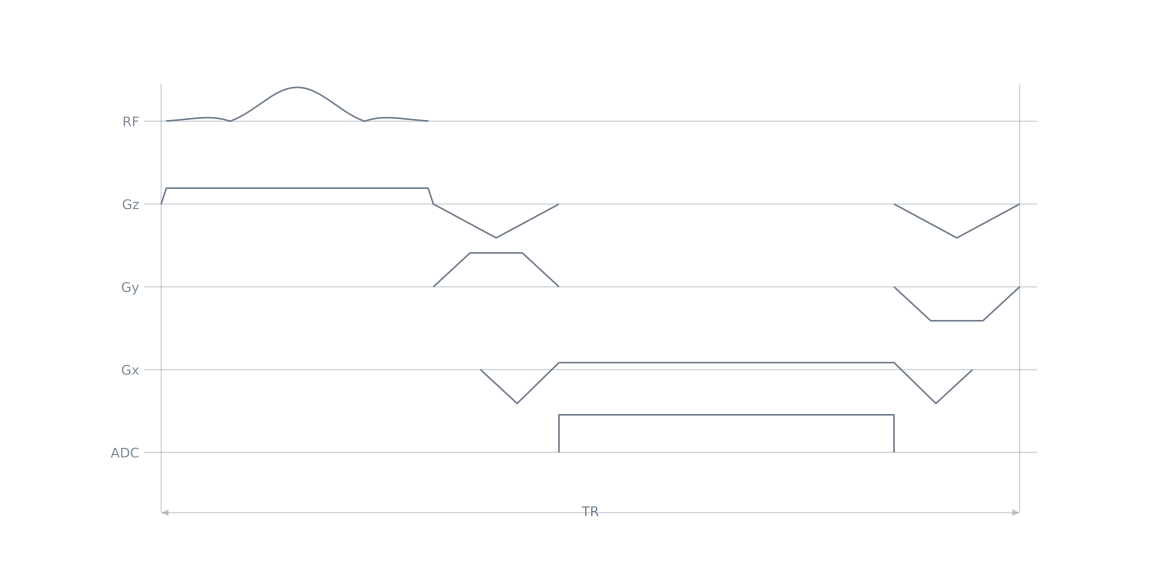
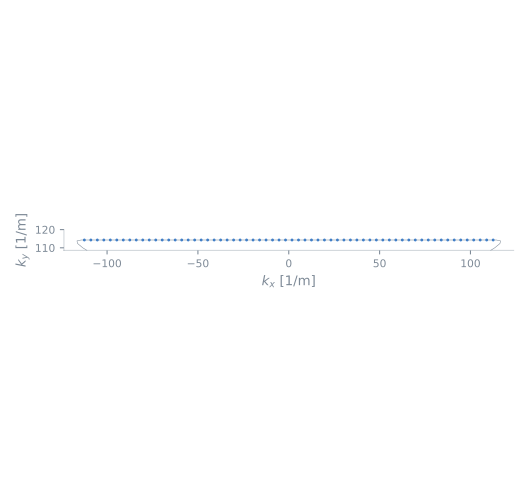
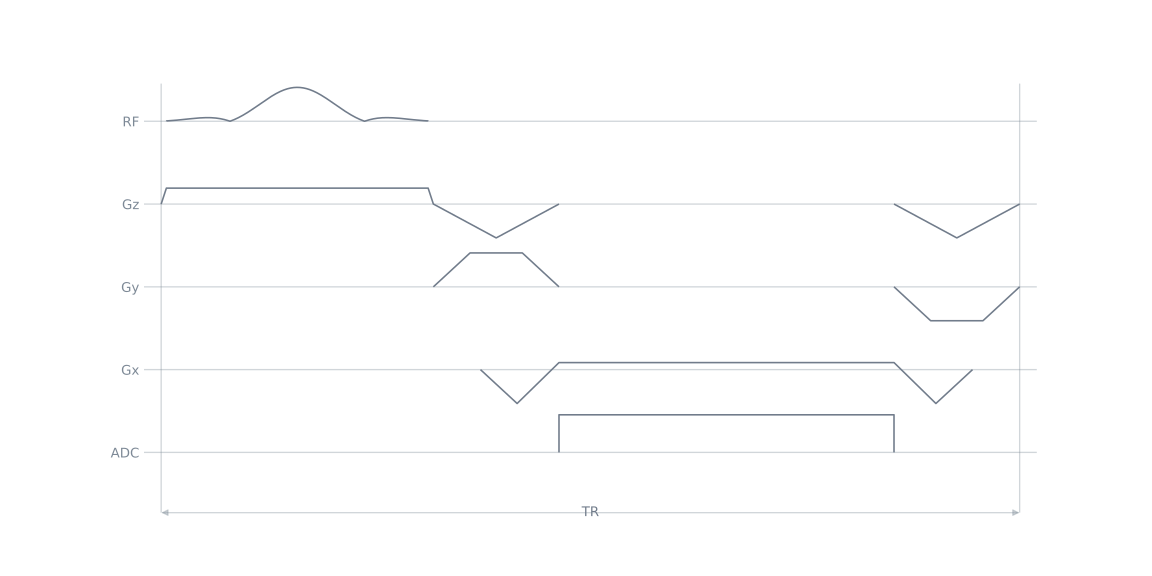
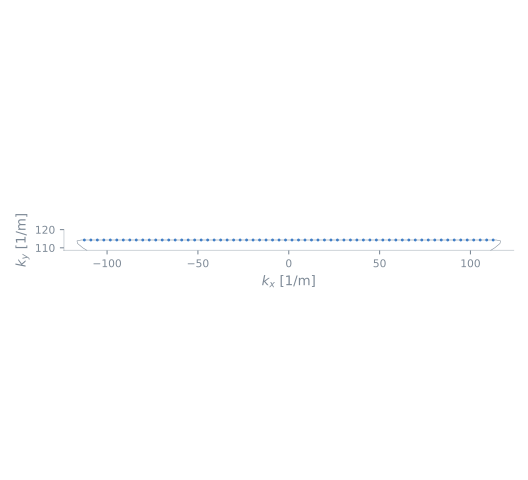
One repetition of the slab acquisition. The partition encode is published separately and is not played in the layout drawn here:
Methods
Build the module's block layout; implemented by the subclass. |
|
Publish events from the caller's locals and register keyword aliases. |
|
Publish named events without requiring prior block registration. |
Attributes