
FatSaturation#
- class pypulseqpp.sequences.FatSaturation[source]#
Bases:
RfModuleSLR fat saturation with a three-axis spoiler and optional spatial selection.
Position and orientation place the selection band at construction. NOPOS and NOROT are set on entry and cleared on exit so subsequent FOV placement leaves the band unchanged. Position is specified in millimetres along the channel axes; the RF frequency offset remains in ppm.
- Parameters:
system (pypulseqpp.Opts) – System limits.
freq_offset_ppm (float, default=FAT_SHIFT_PPM) – Fat offset from water (ppm). Carried on the pulse as a ppm offset rather than as hertz, so the interpreter resolves it against the field the scan actually runs at.
flip_angle_deg (float, default=110.0) – Saturation flip angle (degrees).
bandwidth_hz (float, default=250.0) – Spectral passband (Hz). With
time_bw_productit fixes the pulse duration, which istime_bw_product / bandwidth_hz.time_bw_product (float, default=2.0) – Time-bandwidth product.
thickness_m (float, default=None) – Band thickness (m).
Nonesaturates the whole transmit volume, which is the usual fat saturation and the only form that needs no gradient.axis ({'z', 'x', 'y'}, default='z') – Band normal, before
orientationturns it.position_mm (sequence of float, default=None) –
(dx, dy, dz)offset of the band from the isocentre, along the channel axes, in millimetres. Needsthickness_m.orientation (array_like or scipy.spatial.transform.Rotation, default=None) – A
(3, 3)matrix, or a rotation, taking the channel axes to the axes the band lies on: the band’s own rotation. Needsthickness_m.use_rotation_extension (bool, default=True) – Encode the orientation as a
ROTATIONSextension rather than rotating the gradient waveforms. OnlyTrueis implemented; seeTransformFOV.spoiling_cycles (float, default=4.0) – Cycles of dephasing each spoiler axis winds across
voxel_size_m.voxel_size_m (float, default=0.001) – Length the dephasing is counted over (m).
- Attributes:
rf_prep (RfEvent) – The saturation pulse, as placed.
gz (GradEvent) – Its selection gradient. Only when
thickness_mwas given, and named for the channel axis it is drawn on whateveraxiswas.gx_spoil, gy_spoil, gz_spoil (GradEvent) – Closing spoiler on all three axes.
prep_labels (list of LabelSetEvent) –
NOPOSandNOROT, set on the first block.reset_labels (list of LabelSetEvent) – The same two cleared, on the last.
freq_offset_ppm (float, default=FAT_SHIFT_PPM) – The fat offset the pulse carries (ppm).
freq_offset_hz (float) – What that comes to at
system.B0(Hz), for reference; the pulse itself is field-independent.
- Raises:
ValueError – If a bandwidth, thickness or voxel size is not positive,
axisis not a gradient channel, the spoiler was asked for zero cycles, or a position or orientation was given for a band that has no thickness.
Examples
>>> import pypulseqpp.sequences as design
>>> import pypulseqpp as pp
>>> fatsat = design.FatSaturation(pp.Opts(B0=3.0))
>>> len(fatsat.blocks), round(fatsat.freq_offset_hz)
(2, -441)
>>> [event.type for event in fatsat.blocks[0]]
['rf', 'labelset', 'labelset']
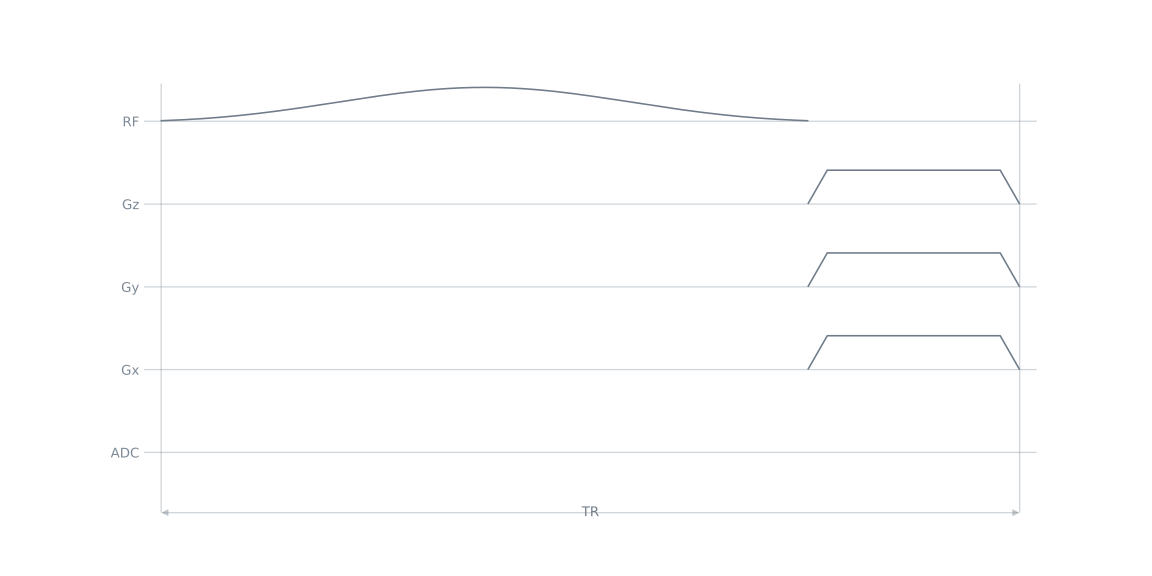
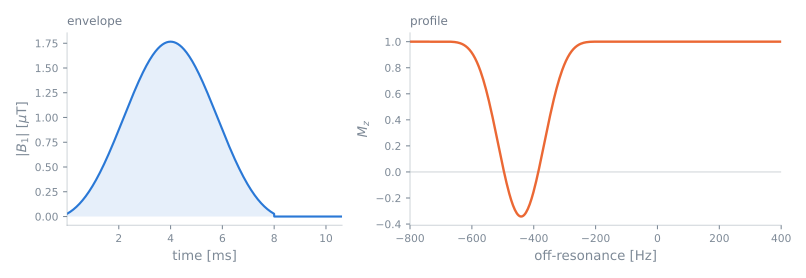
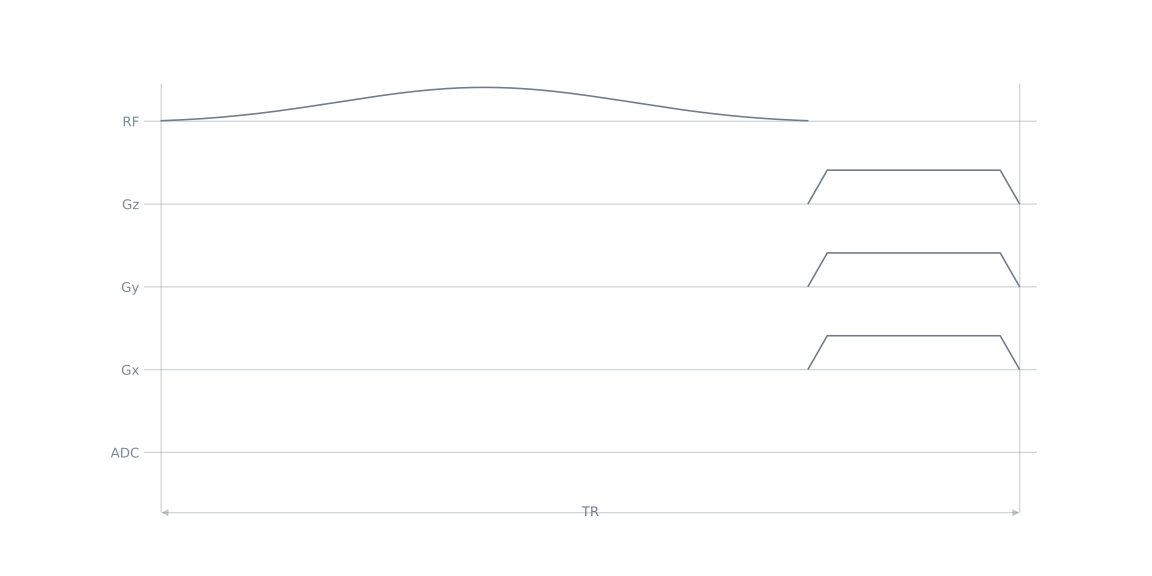
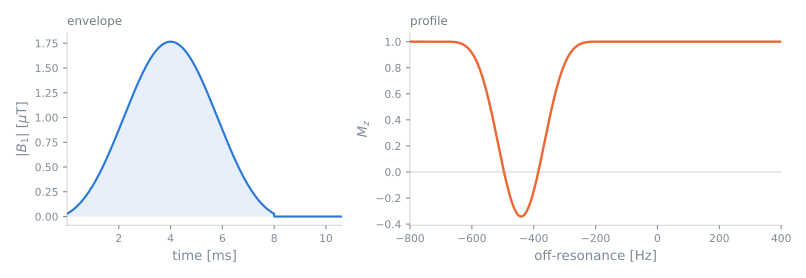
The pulse with its spoiler, and the longitudinal magnetization left across the spectrum. The band sits at the fat resonance for the field the module was designed at, and water at zero offset is untouched:
Methods
Build the module's block layout; implemented by the subclass. |
|
Publish events from the caller's locals and register keyword aliases. |
|
Publish named events without requiring prior block registration. |
|
Simulate this module's pulse across off-resonance. |
Attributes