
T1T2Preparation#
- class pypulseqpp.sequences.T1T2Preparation[source]#
Bases:
T2PreparationT2 preparation with storage on -z to initiate T1 recovery.
final_tipis fixed to'down', and passing it raisesValueError. The acquisition loop supplies the recovery interval.- Parameters:
system (pypulseqpp.Opts) – System limits.
echo_time_s (float) – Preparation echo time (s), first pulse centre to last.
n_refocus (int, default=2) – Adiabatic refocusing pulses, spread evenly through the echo time. Must be even; see above.
half_passage_duration_s (float, default=0.004) – Duration of each half passage (s).
refocusing_duration_s (float, default=0.01024) – Duration of each refocusing pulse (s).
adiabaticity (int, default=8) – Sweep-rate margin over the adiabatic condition, for every pulse.
dwell_s (float, default=1e-05) – RF raster (s).
spoiling_cycles (float, default=4.0) – Cycles of dephasing the closing spoiler winds across
voxel_size_mon each axis. Zero omits the spoiler block.voxel_size_m (float, default=0.001) – Length the dephasing is counted over (m).
labels (sequence of str, default=None) – Counters set to 0 on the first pulse’s block.
- Attributes:
rf_prep (RfEvent) – The half passage that tips down.
rf_ref (RfEvent) – The refocusing pulse; every repeat plays this one event.
rf_store (RfEvent) – The reverse half passage that stores what is left.
wait_first, wait_inner, wait_last (DelayEvent) – The gaps before the first refocusing pulse, between refocusing pulses, and before
rf_store. Each is absent when its gap is zero, andwait_innerwhen there is one refocusing pulse.gx_spoil, gy_spoil, gz_spoil (GradEvent) – The closing spoiler.
prep_labels (LabelSetEvent or list of LabelSetEvent) – One per name in
labels.echo_time (float) – The preparation echo time achieved on the block raster (s).
- Raises:
ValueError – If
final_tipis not'up'or'down',n_refocusis not a positive even number, a size is out of range, or the echo time is shorter than the pulses themselves.
Examples
>>> import pypulseqpp.sequences as design
>>> import pypulseqpp as pp
>>> prep = design.T1T2Preparation(pp.Opts(), 50e-3)
>>> prep.final_tip
'down'
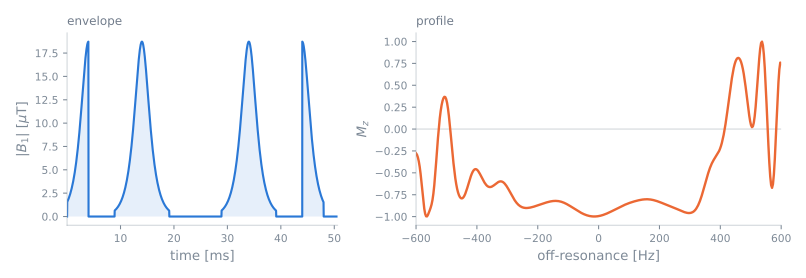
The same module storing on
-z, so the readout that follows samples an inversion recovery as well as a T2 decay: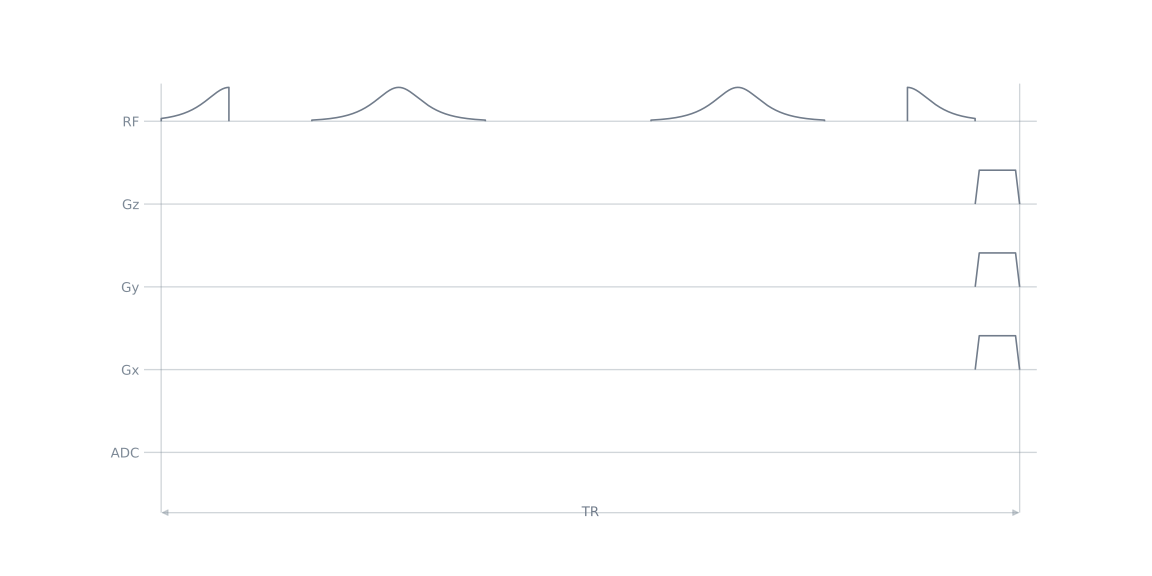
Methods
Build the module's block layout; implemented by the subclass. |
|
Publish events from the caller's locals and register keyword aliases. |
|
Publish named events without requiring prior block registration. |
|
Simulate this module's pulse across off-resonance. |
Attributes