
2D PROPELLER gradient echo#
- Family:
Gradient echo
- Dimensionality:
2D, multi-slice
- Sampling:
PROPELLER blades
- Readout:
One line of one blade per repetition, RF-spoiled
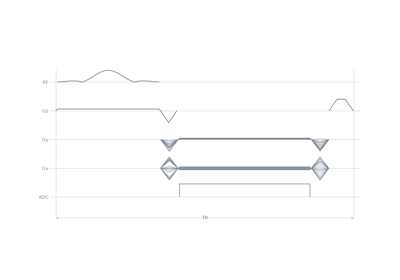
RF-spoiled, multi-slice 2D PROPELLER gradient echo: one blade line per repetition.
Prescription#
- pypulseqpp.sequences.gre_propeller2D_sequence()#
RF-spoiled, multi-slice 2D PROPELLER gradient echo: one blade line per repetition.
A blade is
blade_widthCartesian lines centred on k = 0, and every blade is the same lines turned by a rotation extension. The Nyquist set isceil(pi * n / (2 * blade_width))blades spread evenly over half a turn; everyry-th of them is played, in order, each line by line. Slices are dealt into packets, and ordered within one, asgre2D_sequencedeals them. Every acquisition carries its line asLIN, its blade asSEGand its slice asSLC.- Parameters:
plot (bool, default=False) – Draw the finished sequence in SeqEyes.
test_report (bool, default=False) – Print a report on the finished sequence.
write_seq (bool, default=False) – Write the sequence to a .seq file.
seq_filename (str, default=None) – Where to write it;
<NAME>.seqwhen omitted.system (pypulseqpp.Opts, default=None) – System limits, held under the application’s
MAX_GRADandMAX_SLEW.fov (float, default=0.22) – Isotropic in-plane field of view (m).
n (int, default=128) – In-plane matrix size.
n_slices (int, default=1) – Number of slices.
slice_thickness (float, default=0.005) – Slice thickness (m).
slice_spacing (float, default=0.0) – Gap between adjacent slices (m); zero is contiguous.
flip_angle_deg (float, default=12.0) – Excitation flip angle (degrees).
te (float | None, default=0.008) – Echo time (s).
Noneis as short as the readout admits.tr (float | None, default=0.25) – Repetition time between successive excitations of one slice (s).
Noneis as short as possible, and puts every slice in one packet.readout_bandwidth_hz (float, default=250000.0) – Requested receiver bandwidth (Hz).
ry (int, default=1) – Angular undersampling: one blade in every
ryof the Nyquist set is played.n_dummy (int, default=16) – Non-acquiring repetitions, at the first blade’s angle, before each packet.
blade_width (int, default=16) – Phase-encode lines per blade, at most
n.
- Returns:
The designed sequence.
- Return type:
- Raises:
ValueError – If
ryis below one,blade_widthis outside[1, n], or the TR cannot hold one slice.
Examples
>>> from pypulseqpp import sequences
>>> seq = sequences.gre_propeller2D_sequence(n=32, blade_width=8, tr=None)
>>> seq.check_timing()[0]
True
Designed and drawn#
See also#
Other gradient echo sequences: gre2D_sequence, gre3D_sequence, gre_multiecho2D_sequence, gre_multiecho3D_sequence, gre_radial2D_sequence, gre_stack_of_stars3D_sequence, gre_spiral2D_sequence, gre_stack_of_spirals3D_sequence, gre_stack_of_blades3D_sequence.
The same sampling in another family: se_propeller2D_sequence.
Every shipped sequence is listed in the catalogue.