Architecture#
TL;DR
Two services: design calls on the scanner host, the reconstruction proxy on the reconstruction computer.
Each design is stored once, under the SHA-256 of what it depends on, and never modified.
The interpreter only presents, plays and streams; pypulseqpp designs and your plugin’s engine reconstructs.
You write a sequence plugin and a recon plugin. The design calls answer each protocol edit, design and check the sequence, and store it. The proxy receives each series, completes it from the stored design and runs your recon plugin. Lesson 1 of the Course runs one acquisition through both on the virtual scanner.
Capabilities#
Answers the interpreter’s design calls, one command per call or through a warm server.
Code:
pulserver design,pulserver.host. Tests: a forwarded call replies as the call answered in its own process; a crashing plugin fails only its call; a call is answered while another runs (test_design_server.py).Keeps, under a warm server, what a call worked out for the calls after it: replies, the RF a plugin lists, the slew rate of a request, the pulses pypulseqpp designed.
Code:
pulserver.host._memo. Tests: a kept validation is replied without evaluating again; the RF a plugin lists is evaluated once for every call; generate starts at the slew rate another call validated; a design lowered further drops the kept validation; the children of a warm server share what they keep; a pulse design is kept for the calls after the one that made it; a pulse designed through pypulseqpp is the same kept or not (test_design_memo.py).Identifies a design by the SHA-256 of its plugin, sources, the Python files and versions of pypulseqpp and pulserver, limits, VOP file and resolved protocol.
Code:
design_identity(). Tests: one resolved protocol is one design; an edited plugin is another design of the same protocol; a package file replaced in place is another design of the same protocol; a design is one of the VOP file contents its SAR ratios came from (test_design_service.py).Designs a request once, whether it arrives as typed or as resolved.
Code:
design_identity(). Test: a request is generated once whether or not it resolves to itself (test_design_service.py).Identifies an imported Pulseq chain by its files and the prescription it is imported at.
Code:
pulserver design import. Test: importing the same files at the same prescription is one design (test_design_service.py).Gives each design a 72-bit identifier that travels in three float32 fields of the raw-data header.
Code:
design_id(). Tests: a design identifier is three integers a float32 holds exactly; a design identifier holding another identity is refused (test_design_service.py).Writes a design whole or not at all, once, and never modifies it.
Code:
pulserver.host. Tests: a design being written is invisible until it is whole; two processes designing one protocol at once store it once; a stored design holds the files its manifest records and no other (test_design_service.py).Keeps one design per scan, and prunes whole scans least recently used first.
Code:
DesignStore,prune(). Tests: a design committed to a scan replaces the scan’s previous design; pruning removes the scans unused for longest first; a scan whose design is found again is used again; pruning keeps a scan used within the day whatever the limits (test_design_service.py).Pushes each design to a proxy on another computer, which stores it only if every file matches the manifest.
Code:
DesignIntake. Tests: a generation pushes the design it replies; the intake refuses a tampered bundle with the reason (test_design_push.py).Reads each design once on the reconstruction side and keeps the most recently read.
Code:
DesignCache. Tests: the least recently read design is read again when next named; a series naming no stored design is refused (test_proxy.py).Writes a log of each call and each reconstruction, including the output of the processes it spawns.
Code:
pulserver.host. Tests: a call naming a log file appends its outcome there (test_design_server.py); a logfile collects log output warnings and spawned children (test_logs.py).
Division of responsibility#
The interpreter shows the protocol, plays the IR cache and streams the raw data. It holds no sequence or reconstruction logic.
pypulseqpp designs the sequence; any Pulseq tool can supply an imported chain instead.
The reconstruction engine is whatever your recon plugin imports, usually bartorch.
Method#
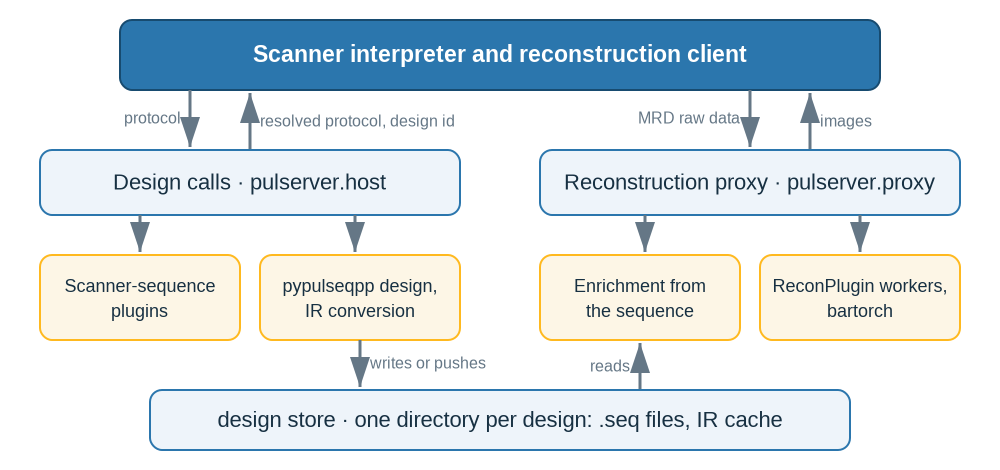
The two services between the scanner and the engines, and the design store they share.#
The two services between the scanner and the engines, and the design store they share.#
Acquisition flow#
Each protocol edit: the call evaluates it with your plugin and replies with the achieved values and scan time (Protocol resolution).
Scan preparation: the call designs, checks (Safety checks), converts (PulSeg representation) and stores, and replies with the identifier.
Acquisition: the client streams MRD; the header names the design and the configuration names the recon plugin.
Reconstruction: the proxy completes the stream from the design (MRD enrichment) and runs your plugin in a worker (Reconstruction plugins and calibration context).
Design identity#
No design call keeps state; the store is all that persists. A changed plugin, sequence function, package version, Python file of pypulseqpp or pulserver, or VOP file is a new design of the same protocol, so a module replaced in place under an unchanged version is never served from an older design. The identifier is the first 18 hexadecimal digits of the identity, split into three float32 header fields because a float32 holds every integer below \(2^{24}\) exactly.
Design store#
designs/
  29258/                  one scan, named by whatever plays it
    3f9c0a1b2c3d4e5f60/   the scan's design
      sequence.seq        first file of the NextSequence chain, binary Pulseq
      sequence_main.seq   the remaining files, when there are prescans
      sequence.pseg       IR cache
      resolved.protocol
      manifest.json       identity and identifier, limits, package versions,
                          creation time, plugin and source, scan time,
                          field-of-view offset, SHA-256 of every file
    motion.buf            the poses of a scan corrected for motion, created
                          when its reconstruction starts
    motion.csv, .png      the poses published to it, as a table and a plot
A design is reused while its scan holds it; a design call that resolves to
another design stores it in place of the scan’s previous one. The scanner’s
reconstruction client names the scan and the design in the MRD header, and the
proxy reads the design from <store>/<scan>/<id>/.
The proxy reads the Pulseq files, not the cache: the cache is derived for playout, and the Pulseq files are the design of record.
Interfaces#
Representation |
Written by |
Read by |
|---|---|---|
Protocol block ( |
Design calls and interpreter |
Both; the grammar is in |
Pulseq files, binary form |
pypulseqpp, in a design call |
The IR conversion and the reconstruction proxy |
IR cache ( |
The interpreter, through the C library in |
|
MRD stream |
Reconstruction client; the proxy, when forwarding |
The proxy and its workers |
Orchestration is Python, the IR passes are C++ (src/cpp/ir/), and the library
the interpreter links is C89 (src/c/), for the vendor toolchains.
Examples#
1. Your first scan: one acquisition through both services on the virtual scanner.
Services: starting the two services, pushing designs and pruning the store.
Design calls: the design calls and the store.