Safety checks#
TL;DR
Every design is checked on the physical gradient axes, rotated to the prescription, before it is stored.
All checks are mandatory on a scanner except sound pressure; a violation stores nothing.
SAR and heating run on the scanner, in the vendor’s routines; pulserver supplies their inputs.
Your sequence function designs a scan under per-axis limits, but on an oblique slice two logical axes add up on one physical gradient coil. pulserver checks the scan as it will play, with the limits the scanner sends, for generated and imported sequences alike. Lesson 3 of the Course runs the checks on a design that fails.
The checks compute estimates; passing them does not establish scanner or patient safety.
Capabilities#
Checks every file of a
NextSequencechain and refuses a violation, storing nothing.Code:
check(), called by the design calls. Tests: a design beyond the scanner limits is refused and stores nothing (test_design_service.py); an import beyond the scanner limits is refused (test_design_service.py).Rotates each file to the prescription, after each block’s own rotation, and leaves
NOROTblocks unrotated.Code:
check(rotation=...). Tests: a gradient within the limit on each logical axis can exceed it on a physical one; a block labelled NOROT is checked as it plays unrotated; a reflected prescription is checked as it plays; a rotation that is not orthonormal is refused (test_ir_checks.py).Designs under per-logical-axis limits and checks against the coil’s per-physical-axis limits.
Code:
design_max_grad,design_max_slewin the call’s limits. Test: an oblique design is held under the design limits and checked against the scanner’s (test_design_service.py).Designs a scan past the nerve or slew-rate limit again at a lower slew rate, and the console’s protocol with it; refuses a strict design as designed.
Code:
pulserver.host._slew, the representativesequenceofEvaluation,strict_limits, theDesignMaxSlewandStrictLimitsdefinitions. Tests: a design past the nerve limit is designed again at a lower slew rate; a strict plugin is refused as designed and says so in its files; a sequence setting StrictLimits unannounced is refused as designed; validate reports the slew rate generate designs at; a shipped FSE at the hardware slew rate is designed once within the nerve limit; a lower slew rate is not tried for an amplitude past its limit (test_slew_derate.py). generate searches a request no validation searched (test_design_memo.py); one design fixes the nerve response of one ramp under the nerve model; a request past the nerve limit is evaluated twice; a shipped FSE is lowered at validation from its echo train; the representative sequence of a shipped plugin bounds the nerve response of its scan (test_slew_derate.py).Designs a scan that follows motion-correction poses for every rotation, and checks it so.
Code:
design_max_grad_any_rotation,design_max_slew_any_rotationandpmc_enablein the call’s limits;CheckLimits.follows_poses. Tests: a navigated scan at a site following poses is designed for every rotation; the vector is held to the axis limit only where poses may turn the scan; a sequence setting EnablePmc unannounced is refused where poses could turn it (test_any_rotation.py).Checks that the file’s rasters and the scanner’s are integer multiples of each other.
Code:
check_raster_timesinsrc/cpp/ir/dedup.cpp, run byconvert(). Test: a file raster converts only as an integer multiple of the scanner’s (test_ir.py).Checks timing: gradient continuity, dead times and ringdown.
Code:
pypulseqpp.check_timing. Test: a dead time the file does not leave is a timing problem (test_ir.py).Checks gradient amplitude and slew rate on the physical axes.
Code:
pypulseqpp.safety.check_max_grad,check_max_slew. Test: limits without check limits check timing and gradients only (test_limits.py).Refuses an RF pulse peaking above the transmit chain’s peak B1,
max_b1.Code:
_peak_b1incheck(). Test: an RF pulse peaking above the coil’s B1 limit is refused (test_ir_checks.py).Refuses readouts that open less than
adc_gap_usafter the previous one ends, and a block that plays an RF pulse and an ADC together.Code:
CheckLimits(adc_gap=...). Tests: readouts closer than the receiver restarts are refused; a block playing an RF pulse and an ADC is refused (test_ir_checks.py).Refuses an arbitrary gradient longer than one axis’s waveform memory,
ir_wave_max_samplesatir_wave_raster_us.Code:
CheckLimits(wave_memory=...). Test: an arbitrary gradient longer than the waveform memory is refused (test_ir_checks.py).Checks PNS under the scanner’s nerve model (chronaxie or SAFE), its response summed over the axes, up to a fraction of its threshold.
Code:
CheckLimits(pns=..., pns_limit=...),pypulseqpp.safety.check_pns. Test: PNS is refused from the fraction of threshold the limits allow (test_ir_checks.py).Refuses gradient trains in the forbidden bands of mechanical resonance, on the physical axis they play on, read over a 20 ms window: a train shorter than that drives a band less. A band whose table states no amplitude is held to 8 mT/m. A stated amplitude is read as an echo-spacing lockout reads it: the band is refused when it holds a line above 6 mT/m while the axis’s gradient exceeds the amplitude. A window that exceeds a band is read again over 80 ms; a steady line that then lies outside the band, at 80 % of its amplitude or more, is leakage through the 20 ms window and is not refused.
Code:
CheckLimits(bands=...),RESONANCE_WINDOW,RESONANCE_FLOOR,pypulseqpp.safety.check_mech_resonance. Tests: a gradient train in a forbidden band is refused on the axis it plays (test_ir_checks.py); a train drives a band over the 20 ms memory of the resonance (test_ir_checks.py); a band stating no amplitude is held to 8 mT/m (test_ir_checks.py); a stated amplitude limits the gradient while the band holds a line (test_ir_checks.py); the prescription moves a train into the forbidden band of another axis (test_ir_checks.py).Holds the loudest repetition to 140 dB peak and 99 dB(A) average (IEC 60601-2-33), and writes both levels into the cache.
Code:
CheckLimits(acoustic=...),spl_levels(),SplLevels. Tests: a repetition too loud on the physical axis it plays on is refused (test_ir_checks.py); the levels the cache carries are those the check holds to its limits (test_ir_checks.py).For pTx, computes SAR ratios from the VOPs and writes them into the cache for the vendor’s SAR routine.
Code:
sar_ratios(),SarRatio. Tests: a repetition’s SAR is measured against the same repetition of reference pulses (test_ir_checks.py); the checks apply no SAR limit; the reference pulse is played in the default shim; the file’s safety factor raises the local ratio and not the global (test_ir_checks.py).Refuses a VOP file made for a transmit configuration other than the one the scanner reports.
Code:
CheckLimits(vop_coil=...). Tests: the VOP file must name the transmit configuration the scanner reports (test_ir_checks.py); a design is made under the VOPs of the exam’s transmit coil (test_console.py).Writes the sequence’s request for SAR burst limits into the cache, where the scanner reads it.
Code:
EnableSarBurstModedefinition. Test: a scan asking for SAR burst limits says so in its cache (test_ir_repetition.py).Makes the limits and the VOP file part of the design’s identity.
Code:
design_identity(). Test: a design is one of the VOP file contents its SAR ratios came from (test_design_service.py).
Division of responsibility#
The design limits, by the interpreter, from the scanner’s gradient specification and the prescription’s rotation.
The waveforms played, those of the file. A slew rate is lowered by designing again, so the file is what plays and states the slew rate in its
DesignMaxSlewdefinition; an interpreter refuses what it cannot play and changes no waveform.SAR, RF coil heating and gradient heating, in the vendor’s routines, from the RF pulses and gradients the interpreter passes on, as for a product sequence.
Resampling onto the scanner’s rasters, by decimation or piecewise-constant hold, in the vendor’s instruction generation.
Method#
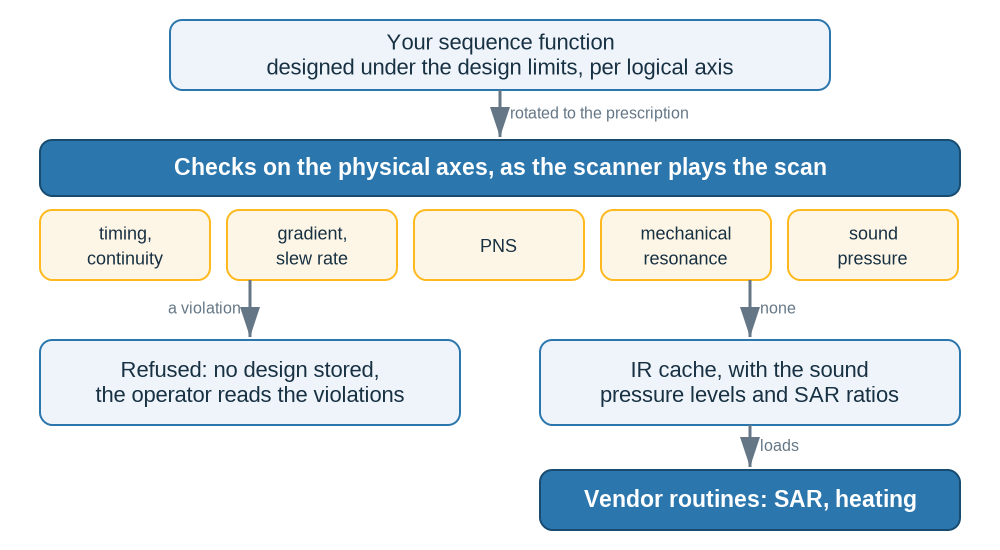
Rotated to the prescription, checked on the physical axes, then refused or converted into the IR cache with its sound pressure levels and SAR ratios.#
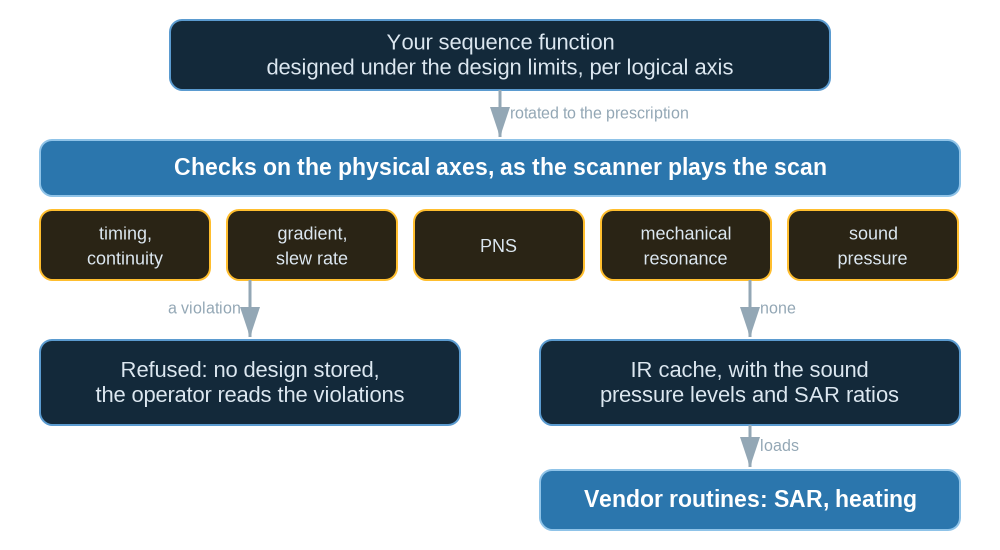
Rotated to the prescription, checked on the physical axes, then refused or converted into the IR cache with its sound pressure levels and SAR ratios.#
Physical frame#
Two logical axes at 0.8 of the amplitude limit put \(0.8\sqrt{2}\) of it on one
physical axis at 45°. So the sequence is designed under design_max_grad and
design_max_slew, the share of each coil’s limits the prescription’s rotation
leaves a logical axis with all three active, less the design margin of
pypulseqpp.apply_system_derates. Every scan is then checked as it plays:
rotated, on each physical axis, against max_grad and max_slew, the coil’s
own per-axis limits. Each physical gradient has its own amplifier, so these
are the limits of the scan’s own rotation; the gradient summed over the axes is
not limited by them. The rotation arrives in the protocol’s fov_rotation_ij
entries; your sequence function never sees it.
A scan that follows motion-correction poses is turned again during the scan,
by rotations no check sees: where the site follows poses (pmc_enable) and
the sequence sets EnablePmc, it is designed under the _any_rotation
limits, and its gradient amplitude and slew rate summed over the three axes, a
root sum of squares, are held to the per-axis limits, the most any rotation
can put on one axis.
Slew rate and nerve stimulation#
A gradient ramp stimulates peripheral nerves by its field’s rate of change,
which sums over the axes. The nerve model responds to a ramp of amplitude step
\(\Delta G\) at slew rate \(S\) with \(\Delta G / (b\,(c + \Delta G/S))\), for
rheobase \(b\) and chronaxie \(c\): a short ramp at a high slew rate stimulates
less than its slew rate alone suggests, so the slew rate a scan may play
depends on the amplitudes it ramps. The design limits are the coil’s; a design
whose response then exceeds pns_limit is designed again at a lower slew
rate, chosen from the response it measured, as a vendor sequence lowers its
ramps for its own waveforms. The response follows \(A\,S/(S+x)\), with
\(x = \Delta G/c\) and \(A = x/b\) for one ramp, so one reading fixes it under
the nerve model, and two readings fix it for any waveform whose response follows that law. The console’s protocol
is evaluated the same way, on the plugin’s representative sequence, which
plays the largest phase encodes of the scan, and the design starts at the
slew rate that evaluation ended at. A plugin that wants a design
refused rather than adjusted is strict, and says so in its files with the
StrictLimits definition (Sequence definitions).
Limit sources#
The interpreter sends a [Limits] block with every call
(Services): gradient limits and dead times, the nerve
model, the forbidden bands, the VOPs for pTx, and the acoustic transfer
function where the scanner has one. Called directly, as in the Course,
check() leaves out a check whose model it is not given.
Sound pressure and SAR#
Sound pressure is that of the repetition with the most gradient energy, filtered through the coil’s acoustic transfer function and played back to back. SAR ratios relate each subsequence’s pulses to a 1 ms, 180° hard pulse in the coil’s default channel weights, the pulse the vendor’s SAR routine is calibrated for; SAR ratios against a reference pulse derives them.
Examples#
3. What the scanner plays: a design refused on PNS, and the same design accepted when made at a lower slew rate.
Services: the
[Limits]keys an interpreter sends.Architecture: what is stored once a design passes.
Sequence definitions: the definitions a design writes and the checks read.