

Architecture#
TL;DR
An acquisition through pulserver has four tasks: design for the prescribed protocol, conversion into the scanner representation, playout and reconstruction. pulserver performs the first, second and fourth; the scanner’s interpreter plays the sequence.
The Pulseq representation, the engines (pypulseqpp and the reconstruction a plugin imports), pulserver’s orchestration and scanner execution are kept distinct.
The design calls run on the scanner host and the reconstruction proxy on the reconstruction computer; they share the design store, and exchange a protocol block, Pulseq files, the IR cache and an MRD stream.
A Pulseq sequence is a vendor-independent description of an acquisition. To acquire data with one on a clinical scanner, four tasks have to be performed: the sequence is designed for the protocol the operator prescribes, converted into a form the scanner hardware can play, played, and its raw data reconstructed into images returned to the console. Pulserver performs the first, second and fourth of these on computers beside the scanner, and a vendor-specific interpreter performs the third on the scanner itself.
Layers#
Four layers are kept distinct throughout the documentation.
- Pulseq representation
The content of a
.seqfile: blocks, event libraries, shapes, definitions and extensions. It is the design of record for every acquisition.- Engines
pypulseqpp designs and writes the sequence. The reconstruction is whatever a reconstruction plugin imports, normally bartorch. Pulserver implements neither sequence design nor reconstruction algorithms.
- Orchestration
Pulserver: the resolution of a protocol against a sequence function, the storage of the resulting designs, the conversion of a design into the scanner IR, and the routing and enrichment of raw data.
- Scanner execution
The interpreter: the vendor-specific program that presents the protocol in the scanner UI, loads the IR, plays the sequence and streams the raw data. It contains no sequence or reconstruction logic.
Services and data flow#
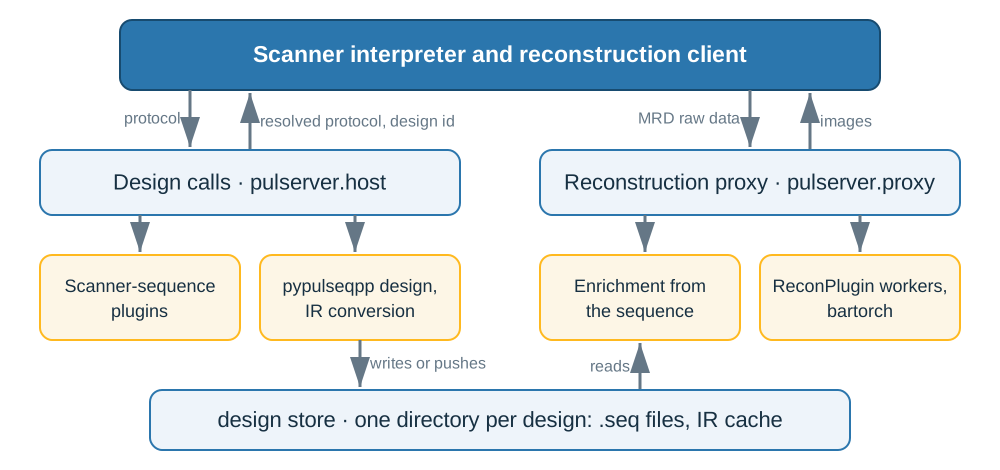
The two pulserver services between the scanner and the engines, and the design store: one directory both reach, or the proxy’s own, to which the design calls push each design.#
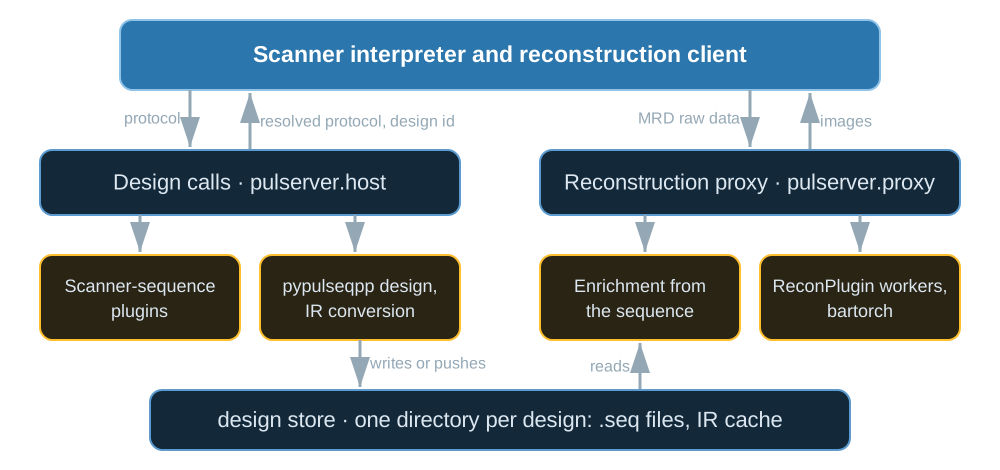
The two pulserver services between the scanner and the engines, and the design store: one directory both reach, or the proxy’s own, to which the design calls push each design.#
The design calls, pulserver.host, run on the scanner host and answer
the interpreter host process of each running sequence, one command per call or
through a warm server. The reconstruction proxy, pulserver.proxy, runs on
the reconstruction computer and answers the scanner’s reconstruction client.
One acquisition proceeds as follows.
On each protocol edit, the interpreter host process requests validation, naming the scanner-sequence plugin, the scanner limits and the requested protocol. The call evaluates the protocol with the plugin, which for a shipped sequence designs it with pypulseqpp, and replies with the protocol the design achieves and the scan time, or with the error the design raised (Protocol resolution).
When the scan is prepared, the process requests the design. The call designs the sequence, checks it, and stores the Pulseq files and the IR cache as a design of the design store, pushes the design to the proxy when the proxy keeps a store of its own, and replies its identifier (Designs and the design store, Scanner representation (PulSeg)). The interpreter loads the IR cache and plays the sequence.
The reconstruction client streams the raw data of the series as MRD. The header names the design the series was played from, and the client’s config names the reconstruction plugin.
The proxy reads the design’s sequence files, completes the MRD header and every acquisition from them, and runs the reconstruction plugin the config names in a worker process, or forwards the completed series to a reconstruction server on another computer (Raw-data enrichment and routing). The images return to the console through the client’s connection.
Representations at each boundary#
Representation |
Written by |
Read by |
|---|---|---|
Protocol block ( |
Design calls and interpreter |
Both; the grammar is in |
Pulseq files, binary form |
pypulseqpp, in a design call |
The IR conversion and the reconstruction proxy |
IR cache ( |
The interpreter, through the C library in |
|
MRD stream |
Reconstruction client; the proxy, forwarding |
Reconstruction proxy and its workers; a reconstruction server |
The reconstruction side reads the Pulseq files of a design, not its IR cache: the cache is a derived representation for playout, and the Pulseq files remain the design of record.
Implementation languages#
The orchestration is Python. The passes that compute the IR run only on the
host and are C++, in src/cpp/ir/. The code that reads the IR cache and walks
it during playout is linked into the interpreter, whose vendor toolchains
accept ANSI C; it is therefore C89, in src/c/, and depends on nothing that
runs only on the host.
See also#
Running the services — starting the two services.
API reference — the Python interface of each service.