

Note
Go to the end to download the full example code.
Protocol resolution for a 2D gradient echo#
This Tour resolves prescriptions of a two-dimensional gradient echo the way a design call does for the scanner UI, and shows what the resolved protocol depends on: the receiver bandwidth a readout realizes on the sampling rasters, and the shortest echo time the readout admits.
Prerequisites: lessons 1 and 2 of the course.
A request is resolved by evaluating the protocol under the scanner limits and
reading back the values the design achieved
(Protocol resolution). The sequence is pypulseqpp’s gre2d, bound
to five protocol entries. Its evaluation designs the whole scan, which keeps
the binding short; the shipped plugins, and lesson 2, design one repetition
instead, so that the time an edit takes does not grow with the matrix.
Scanner sequence#
The binding maps interpreter parameter names to keyword arguments of the
sequence function. Times are exchanged in integer microseconds, the field of view in
mm, and the Minimum preset of TE and TR requests the shortest time the
design admits. The evaluation designs the sequence and reads back the echo
time and the repetition time, which the sequence records as its TE and
TR definitions, and the receiver bandwidth, the inverse of the dwell time
of its ADC event. The reply carries those values and the scan time.
import numpy as np
import pypulseqpp as pp
from figure_style import MUTED, PAGE_WIDTH
from pypulseqpp import sequences
from pypulseqpp.sequences.sequence.gre2D_sequence import gre2d

from pulserver.design import (
    Evaluation,
    FloatParam,
    IntParam,
    SequencePlugin,
    TimeParam,
)
from pulserver.protocol import TEPreset, TRPreset, UIParam, format_listing


class Gre2D(SequencePlugin):
    app = gre2d
    protocol = {
        UIParam.TE: TimeParam(
            "te", range_min=1000, range_max=80000, presets={TEPreset.MINIMUM: None}
        ),
        UIParam.TR: TimeParam(
            "tr", range_min=1000, range_max=5_000_000, presets={TRPreset.MINIMUM: None}
        ),
        UIParam.BANDWIDTH: FloatParam(
            "readout_bandwidth_hz", unit="Hz", range_min=1e3, range_max=1e6
        ),
        UIParam.FOV: FloatParam(
            "fov_x", unit="mm", scale=1e-3, range_min=50.0, range_max=500.0
        ),
        UIParam.NX: IntParam("n_x", range_min=32, range_max=512, range_incr=2),
    }

    def evaluate(self, system, protocol):
        seq = self.app(system, **protocol.arguments)
        dwell = seq.libraries().adc[0, 1]
        achieved = {
            UIParam.TE: seq.definitions["TE"][0],
            UIParam.TR: seq.definitions["TR"][0],
            UIParam.BANDWIDTH: 1.0 / dwell,
        }
        return Evaluation(protocol.replace(achieved), sequences.duration(seq))


gre = Gre2D()
print(format_listing(gre.listing()), end="")
[Protocol]
TE: int|dropdown|8000|1000|80000|1|us|-2
TR: int|dropdown|250000|1000|5000000|1|us|-1
bandwidth: float|typein|250000.0|1000.0|1000000.0|1.0|Hz
fov: float|typein|220.0|50.0|500.0|1.0|mm
nx: int|typein|128|32|512|2|
fov_offset_x: float|off|0.0|-1000.0|1000.0|0.1|mm
fov_offset_y: float|off|0.0|-1000.0|1000.0|0.1|mm
fov_offset_z: float|off|0.0|-1000.0|1000.0|0.1|mm
fov_rotation_11: float|off|1.0|-1.0|1.0|1e-06|
fov_rotation_12: float|off|0.0|-1.0|1.0|1e-06|
fov_rotation_13: float|off|0.0|-1.0|1.0|1e-06|
fov_rotation_21: float|off|0.0|-1.0|1.0|1e-06|
fov_rotation_22: float|off|1.0|-1.0|1.0|1e-06|
fov_rotation_23: float|off|0.0|-1.0|1.0|1e-06|
fov_rotation_31: float|off|0.0|-1.0|1.0|1e-06|
fov_rotation_32: float|off|0.0|-1.0|1.0|1e-06|
fov_rotation_33: float|off|1.0|-1.0|1.0|1e-06|
[Protocol End]
The scanner limits are those an interpreter host process sends with each call. The rasters are stated explicitly because the achieved bandwidth depends on them.
Receiver bandwidth#
The readout samples at a dwell time that is a multiple of the ADC raster, and its duration, the number of samples times the dwell time, must be a whole number of gradient raster periods. The dwell time is the first that satisfies both, searched upward from the requested one, and the achieved bandwidth is its reciprocal: a request between two achievable bandwidths resolves to the lower of them. With twofold readout oversampling, a 64-column matrix is read with 128 samples and a 100-column matrix with 200.
For 128 samples, a duration that is a multiple of 10 µs requires a dwell time that is a multiple of 2.5 µs, so only 400, 200, 133, 100, 80 kHz and so on are achievable. For 200 samples, every multiple of the 100 ns ADC raster is achievable.
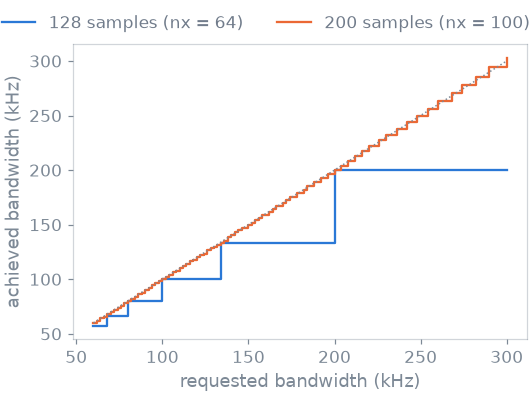
The reply always carries the achieved value, so the scanner UI shows the bandwidth that will be played rather than the one typed in.
for bw in (150e3, 190e3):
    reply = gre.validate(system, {"nx": 64, "bandwidth": bw})
    print(
        f"requested {bw / 1e3:6.1f} kHz -> achieved {reply.values['bandwidth'] / 1e3:6.1f} kHz"
    )
requested  150.0 kHz -> achieved  133.3 kHz
requested  190.0 kHz -> achieved  133.3 kHz
Shortest echo time#
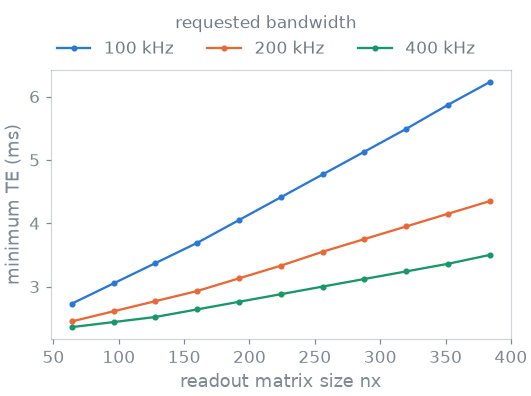
The Minimum preset of TE is resolved to the echo time of the design, in integer microseconds. The echo is placed after the excitation, the slice-selection rephaser and the readout prewinder, and before it the readout acquires half of its samples. The shortest echo time therefore grows with the number of samples and with the dwell time, that is, with matrix size and inversely with bandwidth.
matrices = np.arange(64, 385, 32)
bandwidths = (100e3, 200e3, 400e3)
minimum_te = {
    bw: [
        gre.validate(
            system, {"TE": TEPreset.MINIMUM, "nx": int(nx), "bandwidth": bw}
        ).values["TE"]
        for nx in matrices
    ]
    for bw in bandwidths
}
Infeasible requests and repeated resolution#
A prescription the design cannot realize is invalid. The reply carries the request unchanged and the message of the error the design raised, which the interpreter shows to the operator.
reply = gre.validate(system, {"TE": 1500, "nx": 256})
print(reply.valid)
print(reply.info)
False
the requested TE of 1.500 ms is shorter than the 3.550 ms this readout can achieve
A valid reply carries the resolved protocol at the precision a scanner parameter stores. Sending it back resolves to the same protocol, which is what lets a design be identified by its resolved protocol (Designs and the design store).
first = gre.validate(system, {"TE": TEPreset.MINIMUM, "nx": 192, "bandwidth": 150e3})
again = gre.validate(system, first.values)
for key in gre.protocol:
    print(f"{key}: {first.values[key]}")
print(again.values == first.values, f"scan time {first.duration:.1f} s")
TE: 3580
TR: 250000
bandwidth: 133333.0
fov: 220.0
nx: 192
True scan time 36.0 s
Total running time of the script: (0 minutes 4.521 seconds)