

Model-based reconstruction#
TL;DR
blochsim supplies the signal model of the forward operator; the encoding and the Gauss-Newton loop that inverts it come from bartorch or another library.
The linear route reconstructs coefficients in a temporal subspace; the nonlinear route solves for the parameter maps themselves.
Jacobian products cost one forward-mode or one reverse-mode pass, and the Jacobian is never formed.
You reconstruct parameter maps directly from k-space, with the signal model inside the forward operator rather than fitted to images afterwards.
Capabilities#
Wraps any simulator as an operator from parameter maps to contrast images, with a complex amplitude for proton density and receive phase.
Show code and tests
Code:
ModelOperator. Tests: the operator is the model; the amplitude costs no pass (test_operator.py).Applies the Jacobian and its adjoint without forming it.
Keeps box bounds at every point it is evaluated at, by solving for a transformed variable, and imposes an equality constraint by writing the model on what is free.
Show code and tests
Code:
ModelOperator(bounds=...). Tests: a bound holds however far the variable goes (test_operator.py); an equality constraint is the model written on what is free (test_constraints.py).Hands the temporal basis to a subspace encoding operator, and reads maps from the coefficients it returns.
Show code and tests
Code:
modes,from_coefficients(). Tests: the basis goes out in the layout the encoding reads; one mapping supplies the basis and reads what comes back (test_subspace_route.py).Converts to a deepinv physics, so deepinv’s optimizers and priors apply to the composed chain.
Show code and tests
Code:
physics(). Tests: it composes with a linear encoding operator; a deepinv optimizer drives the composed operator (test_deepinv.py).
Division of responsibility#
The encoding: sampling, non-uniform FFT, coil sensitivities, density compensation. bartorch’s operators, mri-nufft’s and deepinv’s
LinearPhysicsall compose with the model operator.The solver. bartorch’s
nlop.ModelOperatorturns the model operator into a BART nonlinear operator;nlop.IRGNMinverts it under an encoding,apps.mobafrom k-space andapps.mobafitvoxel by voxel from images.Regularizers, which enter through the linear solver of each Gauss-Newton step (
IRGNM(inner=...)).
Method#
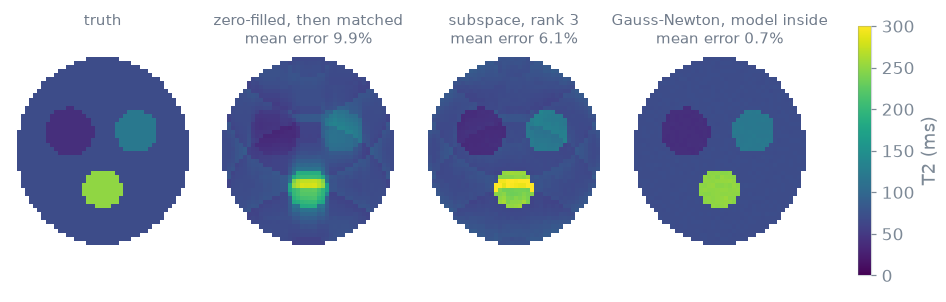
An 8-echo spin echo (TE 10 to 150 ms) on a 48 × 48 phantom, sampled at one
phase-encode line in three per echo, shifted from echo to echo, plus six
central lines. blochsim supplies the dictionary, the basis and the model
operator; the masked FFT is bartorch’s, the conjugate-gradient solve of the
subspace route is written in the figure’s code, and the nonlinear route is
bartorch’s nlop.IRGNM. Errors are the mean relative T2 error inside the phantom.#
Forward operator#
The forward operator is the chain \(F = P\,\mathcal{F}\,C\,M\) of sampling,
Fourier encoding, coil sensitivities and the signal model. Only \(M\) depends on
the sequence. ModelOperator is \(M\): maps in (..., channels),
images out in (..., contrasts). The encoding receives the contrast axis at
axis 1, as deepinv and mri-nufft lay it out.
Linear route#
An estimator fitted with rank carries a Subspace.
modes gives the basis as (rank, contrasts), the
layout mri-nufft’s MRISubspace and BART’s pics -B read. The reconstruction
is linear in the coefficients, has one minimum and needs no starting point.
from_coefficients() then maps the coefficients
without projecting them again. A signal that needs many components, such as a
phase-modulated train or a model with several parameters, gives no small
basis.
Nonlinear route#
Each Gauss-Newton step linearizes \(F\) at the current maps and solves the
damped least-squares problem for the step. With an encoding, the step is
solved by an iterative solver from products alone: one encoding application
and one A_jvp forward, one adjoint encoding and one A_vjp back. These are
the three products bartorch’s nlop.ModelOperator hands to BART, so the loop
is BART’s iteratively regularized Gauss-Newton method. Composing through
physics() instead lets deepinv differentiate the whole chain by autograd,
which gives up these analytic products.
Examples#
Subspace reconstruction: radial multi-echo T2 by gridding, per-echo CG, and a rank-3 subspace with mri-nufft.
Nonlinear inversion from k-space: the same data reconstructed by bartorch’s Gauss-Newton method with the model inside the operator.