Sequence design#
TL;DR
A design is a simulator with the tissue fixed on it, a cost you write as a function of the protocol parameters, and those parameters with their limits.
SequenceDesignminimizes the cost by gradient descent; the gradient is reverse-mode autograd through the simulator.A precision design minimizes a Cramér-Rao bound; an image-quality design minimizes a property of the signal itself.
You choose protocol parameters, such as flip angles, repetition times or echo train lengths, by minimizing a cost computed from what the sequence records.
Capabilities#
Minimizes a cost over named protocol parameters, each passed to the cost by keyword.
Show code and tests
Code:
SequenceDesign. Tests: a design lowers the cost it was given; several parameters are designed together (test_design.py).Keeps each parameter strictly between its limits at every step.
Show code and tests
Code:
Bounded. Test: the limits hold at every step (test_design.py).Computes the Cramér-Rao bound from a signal Jacobian, and refuses parameters the sequence cannot separate.
Show code and tests
Code:
crlb(). Tests: the bound is the variance a fit actually reaches; parameters no sequence can tell apart are refused (test_design.py).Designs one train per shot in a single batched simulation.
Show code and tests
Code:
SequenceDesign,Bounded. Test: a batch of trains is designed in one simulation (test_design.py).Reuses the event structure across the calls of a design loop, rebuilding only the values that change.
Show code and tests
Code:
simulate(). Tests: a resolved simulator answers what the plain one does (test_binding.py); an image quality design fits in its budget (test_design.py).Returns the cost at every step, and stops early when a callback returns
True.Show code and tests
Code:
minimize(). Test: a callback can stop early (test_design.py).
Division of responsibility#
Hardware and safety limits other than box limits on a parameter: gradient, PNS and SAR constraints enter as penalty terms you write, or are checked by sequence design tools such as pypulseqpp.
Global optimization. The optimizer descends from the starting values, and the result depends on them.
Predefined costs other than
crlb(). A blur, contrast or power term is a function you write.Writing the designed protocol to a Pulseq file.
Method#
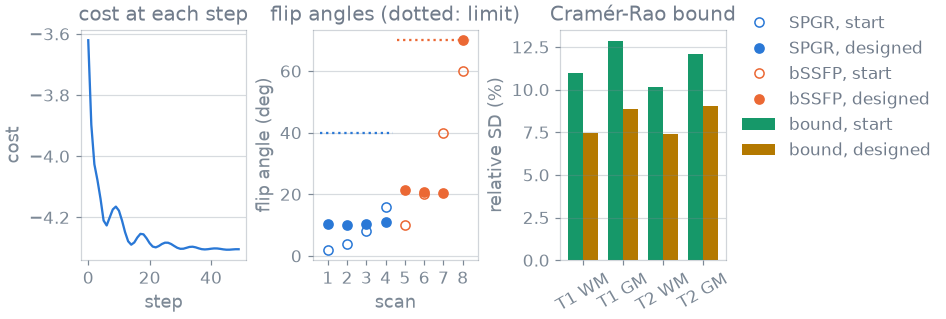
Four SPGR and four bSSFP flip angles designed for a joint fit of T1, T2, M0 and B0 in white and grey matter at 0.5 % noise. The cost is the log of the summed relative Cramér-Rao bounds of T1 and T2. The angles collapse onto a few values; one bSSFP angle ends at its 70° limit.#
Cost function#
The cost takes the designed parameters by keyword and returns one number. A
precision design asks its simulators for jacobian()
with respect to the estimated tissue properties and passes the result to
crlb(), which returns the diagonal of the inverse Fisher matrix,
counting real and imaginary channels as separate measurements. Dividing each
bound by its parameter squared makes the terms dimensionless; taking the
logarithm makes the gradient independent of the noise level. A block that is
blind to a parameter contributes a zero row, and the Fisher matrix sums the
information of all blocks. An image-quality design reads the signal alone, for
example the width of the point spread function an echo train produces. How the
gradient of either cost is computed is in Derivatives.
Limits and parameterization#
Bounded optimizes an unconstrained variable whose scaled
sigmoid is the parameter, so no iterate leaves the limits; a bare tensor is
left unconstrained. A limit the scanner cannot exceed belongs in Bounded; a
preference such as RF power or scan time belongs in the cost as a penalty. The
number of free variables is a choice of parameterization: a 120-echo train can
be written as a function of three control angles and designed over those.
Design result#
minimize() runs Adam (200 steps, learning rate
0.05 by default; optimizer_factory replaces it) and returns a
SequenceOptimization: parameters, a dictionary of detached values inside
their limits, and loss, the cost at every step, from which convergence is
read.
Examples#
Echo train design for sharpness: refocusing angles of a fast spin echo designed for sharpness, contrast and RF power, then a segmented 3D protocol.
Joint relaxometry protocol design: a DESPOT protocol designed against the Cramér-Rao bound and checked by fitting a BrainWeb slice.
RF pulse design by optimal control: the samples of a slice-selective pulse designed through a Bloch simulation over a range of B1.