

Note
Go to the end to download the full example code.
Spoiling#

The gradient echo of the previous lesson, Gradient echo, leaves transverse magnetisation at the end of each repetition, and the following pulses refocus part of it. This lesson first adds a spoiler gradient after the acquisition. The spoiler dephases the remaining transverse magnetisation through several cycles across a voxel, so that it integrates to nearly zero there; because every repetition applies the same dephasing, a coherent pathway remains and contributes to the steady state. The lesson then suppresses that pathway by advancing the phase of the RF pulse and of the receiver by a quadratically increasing amount from one repetition to the next, and measures which phase increments bring the steady-state signal close to that of ideal spoiling.
The steady-state signal is computed by summing isochromats across a voxel over several hundred repetitions of the sequence built here, and compared with the signal of an ideally spoiled repetition. The next lesson, Echo planar imaging, acquires many k-space lines after one excitation.
Learning objectives#
After this lesson, you should be able to:
prescribe a spoiler gradient by its dephasing across a voxel and place it in the repetition;
compute a steady-state signal by an isochromat summation that uses the echo time, repetition time and spoiler area of the built sequence;
explain why no spoiler area reproduces the ideally spoiled signal;
write the quadratic phase cycle of RF spoiling, set the phase offset of the RF and ADC events per repetition, and read it back from the blocks;
identify phase increments that leave the residual pathway coherent;
compare the gradient-spoiled and RF-spoiled steady states with the ideally spoiled signal over flip angle.
The spoiler#
The prescription is the same gradient echo, with one gradient added after the acquisition. A spoiler is stated as the phase it winds across a voxel, and the voxel here is the in-plane sample spacing of the prescription.
import numpy as np

import pypulseqpp as pp

system = pp.Opts(
    max_grad=32.0,
    grad_unit="mT/m",
    max_slew=130.0,
    slew_unit="T/m/s",
    rf_dead_time=100e-6,
    rf_ringdown_time=20e-6,
    adc_dead_time=10e-6,
)

FOV = 220e-3
MATRIX = 128
THICKNESS = 5e-3
FLIP_ANGLE_DEG = 12.0
REPETITION_TIME = 20e-3
SPOILER_CYCLES = 4.0
PHASE_INCREMENT_DEG = 117.0

VOXEL = FOV / MATRIX

dwell, readout_time = pp.calc_adc_timing(
    MATRIX,
    26e-6,
    grad_raster_time=system.grad_raster_time,
    adc_raster_time=system.adc_raster_time,
)
gx = pp.make_trapezoid(
    channel="x", flat_area=MATRIX / FOV, flat_time=readout_time, system=system
)
adc = pp.make_adc(num_samples=MATRIX, dwell=dwell, delay=gx.rise_time, system=system)
gx_pre = pp.make_trapezoid(channel="x", area=-gx.area / 2, duration=1e-3, system=system)
gy_pre = pp.make_trapezoid(
    channel="y", area=MATRIX / (2 * FOV), duration=1e-3, system=system
)
One repetition#
The spoiler is played on the slice axis after the acquisition, where it dephases the transverse magnetisation the repetition leaves behind without adding to the k-space the readout traverses. It lengthens the repetition, so the delay that brings the repetition up to the repetition time absorbs less.
phase_offset is the phase of an RF event or an ADC event, in radians. The
function below sets both to the phase of the cycle introduced later in this
lesson; with an increment of zero every phase is zero, and the sequence is
gradient spoiled only.
def transmit_phase(repetition, increment_deg):
    """The phase of one repetition's pulse and receiver, in radians."""
    return np.deg2rad(increment_deg) * repetition * (repetition + 1) / 2


def spoiled(cycles, increment_deg=0.0, flip_angle_deg=FLIP_ANGLE_DEG):
    """The sequence, with a spoiler and an RF phase cycle of the given increment."""
    pulse, selection, rephaser = pp.make_sinc_pulse(
        flip_angle=np.deg2rad(flip_angle_deg),
        duration=2e-3,
        slice_thickness=THICKNESS,
        apodization=0.5,
        time_bw_product=4.0,
        delay=system.rf_dead_time,
        system=system,
        use="excitation",
        return_gz=True,
    )
    spoiler = pp.make_crusher(cycles, VOXEL, channel="z", system=system)[0]
    played = (
        pp.calc_duration(pulse, selection)
        + pp.calc_duration(gx_pre, gy_pre, rephaser)
        + pp.calc_duration(gx, adc)
        + pp.calc_duration(spoiler)
    )
    recovery = pp.make_delay(
        pp.round_to_raster(REPETITION_TIME - played, system.block_duration_raster)
    )
    seq = pp.Sequence(system=system)
    steps = np.linspace(-1.0, 1.0, MATRIX, endpoint=False)
    for repetition, step in enumerate(steps):
        phase = transmit_phase(repetition, increment_deg) % (2 * np.pi)
        pulse.phase_offset = phase
        adc.phase_offset = phase
        seq.add_block(pulse, selection)
        seq.add_block(gx_pre, pp.scale_grad(gy_pre, step), rephaser)
        seq.add_block(gx, adc)
        seq.add_block(spoiler)
        seq.add_block(recovery)
    return seq


seq = spoiled(SPOILER_CYCLES)

ok, errors = seq.check_timing()
spoiler_duration = pp.calc_duration(
    pp.make_crusher(SPOILER_CYCLES, VOXEL, channel="z", system=system)[0]
)
print(
    f"timing {ok}, {seq.num_blocks} blocks, "
    f"spoiler {1e3 * spoiler_duration:.2f} ms for {SPOILER_CYCLES:.0f} cycles "
    f"across a {1e3 * VOXEL:.2f} mm voxel"
)

seq.paper_plot(tr=1)
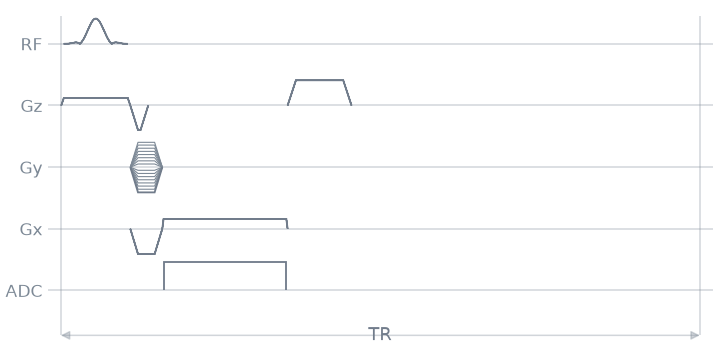
timing True, 640 blocks, spoiler 2.00 ms for 4 cycles across a 1.72 mm voxel
Isochromats across a voxel#
The steady state is reached by playing the repetition several hundred times on a set of isochromats spread across one voxel. Each one has a complex transverse component and a longitudinal one, and each repetition applies the pulse at its transmit phase, the interval to the echo, the interval from the echo to the end of the repetition, and the phase the spoiler winds at that isochromat’s position. The receiver is advanced with the transmitter, so the transmit phase of the current repetition is removed from the recorded signal.
The echo time and the repetition time come from the sequence that was built, and the spoiler phase from the dephasing it was prescribed with, so the summation follows the design rather than a restatement of it.
ISOCHROMATS = 201

_, _, t_excitation, _, t_adc = seq.calculate_kspace(block_range=[1, 5])
ECHO_TIME = float(t_adc[MATRIX // 2] - t_excitation[0])

print(
    f"echo time {1e3 * ECHO_TIME:.2f} ms, repetition time {1e3 * REPETITION_TIME:.2f} ms"
)


def steady_state(
    cycles, increment_deg, flip_angle_deg, t1=1000e-3, t2=80e-3, repetitions=600
):
    """The signal of each repetition, summed across a voxel."""
    flip = np.deg2rad(flip_angle_deg)
    position = (np.arange(ISOCHROMATS) + 0.5) / ISOCHROMATS
    spoiler_phase = np.exp(2j * np.pi * cycles * position)
    rest = REPETITION_TIME - ECHO_TIME

    transverse = np.zeros(ISOCHROMATS, dtype=complex)
    longitudinal = np.ones(ISOCHROMATS)
    signal = np.zeros(repetitions, dtype=complex)

    for repetition in range(repetitions):
        # The pulse, about an axis in the transverse plane at the transmit phase.
        turn = np.exp(1j * transmit_phase(repetition, increment_deg))
        rotated = (
            np.cos(flip / 2) ** 2 * transverse
            + np.sin(flip / 2) ** 2 * turn**2 * np.conj(transverse)
            - 1j * np.sin(flip) * turn * longitudinal
        )
        longitudinal = np.cos(flip) * longitudinal + np.sin(flip) * np.imag(
            np.conj(turn) * transverse
        )
        transverse = rotated

        # Excitation to echo, where the signal is read at the receiver phase.
        transverse *= np.exp(-ECHO_TIME / t2)
        longitudinal = 1.0 + (longitudinal - 1.0) * np.exp(-ECHO_TIME / t1)
        signal[repetition] = (transverse * np.conj(turn)).mean()

        # Echo to the end of the repetition, and the spoiler.
        transverse *= np.exp(-rest / t2) * spoiler_phase
        longitudinal = 1.0 + (longitudinal - 1.0) * np.exp(-rest / t1)

    return signal


def ideally_spoiled(flip_angle_deg, t1=1000e-3):
    """The signal of a repetition that begins with no transverse component."""
    flip = np.deg2rad(flip_angle_deg)
    recovery = np.exp(-REPETITION_TIME / t1)
    return np.sin(flip) * (1 - recovery) / (1 - recovery * np.cos(flip))
echo time 4.05 ms, repetition time 20.00 ms
Steady state against spoiler area#
The sweep is run without a phase cycle, at the prescribed flip angle and at one large enough for the residual pathway to be substantial.
CYCLES = np.linspace(0.0, 8.0, 41)
SWEPT_FLIPS = (FLIP_ANGLE_DEG, 30.0)

against_area = {
    flip: np.array([abs(steady_state(cycles, 0.0, flip)[-1]) for cycles in CYCLES])
    for flip in SWEPT_FLIPS
}
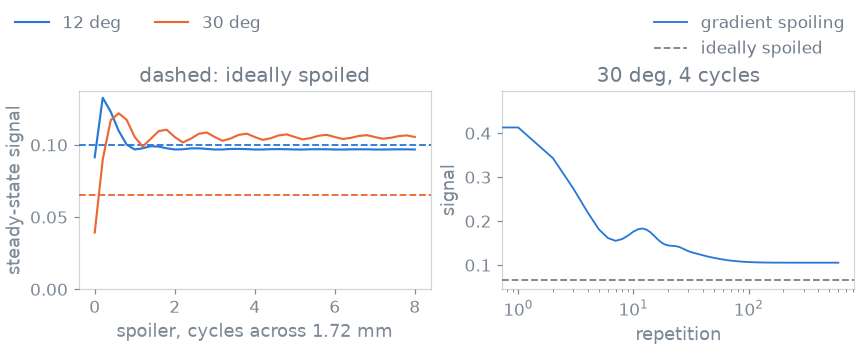
at 30 degrees: ideally spoiled 0.0655, gradient spoiled 0.1054, rippling by 4.7 percent above three cycles
Below one cycle across a voxel the isochromats are not spread over the whole circle, and the steady state depends on how far the spoiler winds them. Above it the dependence is a ripple that decays as the reciprocal of the cycle count, because a uniform voxel wound through a non-integral number of cycles does not quite average to zero, and past about three cycles the curve is flat to the last digit.
The plateau consists of a pathway that the pulse refocuses from one repetition to the next: the spoiler winds every repetition through the same phase, so it leaves that pathway unchanged. At 30 degrees that residual is more than one and a half times the ideally spoiled signal it is being compared with, and no spoiler area removes it.
The right-hand panel shows the approach to the steady state at the prescribed spoiler, which takes a few hundred repetitions — long enough that the first lines of a scan are acquired before it.
The RF phase cycle#
The transmit phase of repetition \(n\) is advanced by \(n\) times a fixed increment, so that the phase itself grows quadratically:
The pathway a pulse refocuses from an earlier repetition arrives with a phase that depends on how many repetitions ago it was produced, so a phase that is not linear in \(n\) puts successive repetitions’ residuals at different phases and their sum towards zero. The signal of the current repetition is unaffected, because the receiver is advanced by the same amount.
The phase the events were written with is read back from the blocks, which is where an interpreter and a reconstruction find it.
rf_spoiled = spoiled(SPOILER_CYCLES, PHASE_INCREMENT_DEG)

ok, errors = rf_spoiled.check_timing()
print(f"timing {ok}, {rf_spoiled.num_blocks} blocks, {rf_spoiled.duration()[0]:.3f} s")

written = np.array(
    [np.rad2deg(rf_spoiled.get_block(1 + 5 * n).rf.phase_offset) for n in range(6)]
)
print("transmit phase of the first repetitions (degrees): ", np.round(written, 1))
timing True, 640 blocks, 2.560 s
transmit phase of the first repetitions (degrees):  [  0. 117. 351. 342.  90. 315.]
Steady state against phase increment#
The summation above, with the transmit phase of each repetition applied to the pulse and removed from the signal, swept over the increment.
INCREMENTS = np.arange(0.0, 181.0, 1.0)
INCREMENT_FLIPS = (FLIP_ANGLE_DEG, 30.0, 60.0)

against_increment = {
    flip: np.array(
        [
            abs(steady_state(SPOILER_CYCLES, step, flip, repetitions=500)[-1])
            for step in INCREMENTS
        ]
    )
    for flip in INCREMENT_FLIPS
}
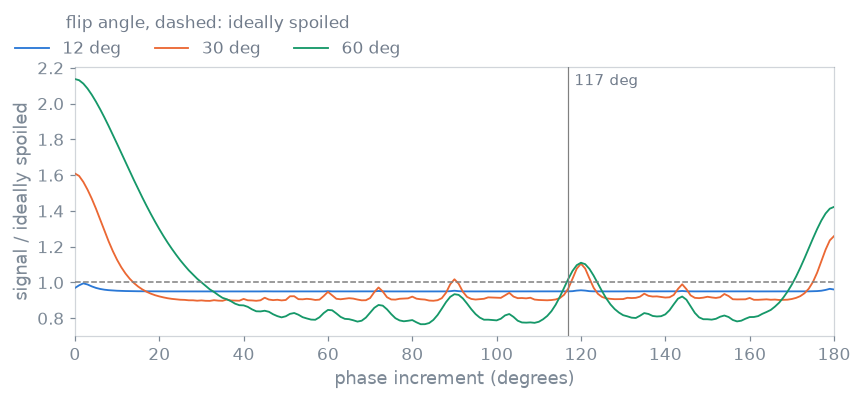
flip   at 117 deg              lowest             highest
  12        0.950      0.950 at  86      0.995 at   2
  30        0.967      0.897 at  32      1.609 at   0
  60        1.020      0.767 at  82      2.137 at   0
The curve is spiky rather than smooth. An increment that returns to a small set of phases leaves the residual as coherent as no phase cycle at all: zero and 180 degrees are the clearest, and each of the flip angles swept here has others of its own. An increment of 117 degrees is within a few percent of the ideally spoiled value at every one of them, which is the reason for its common use, and its neighbourhood is narrow — at 60 degrees of flip, an increment of 82 degrees gives a quarter less signal than the ideal and 117 gives it to two percent.
Steady state against flip angle#
The residual pathway contains magnetisation that the pulse returns from the longitudinal axis, so it grows with the flip angle, and it adds to or subtracts from the ideally spoiled signal depending on where the flip angle sits. Both spoiling schemes are compared with the ideally spoiled signal.
FLIP_ANGLES = np.arange(2.0, 61.0, 2.0)

gradient_only = np.array(
    [abs(steady_state(SPOILER_CYCLES, 0.0, flip)[-1]) for flip in FLIP_ANGLES]
)
phase_cycled = np.array(
    [
        abs(
            steady_state(SPOILER_CYCLES, PHASE_INCREMENT_DEG, flip, repetitions=500)[-1]
        )
        for flip in FLIP_ANGLES
    ]
)
ideal = ideally_spoiled(FLIP_ANGLES)
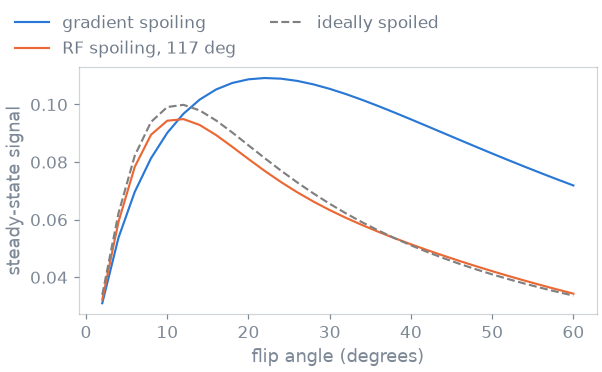
 flip   gradient spoiled   RF spoiled   ideally spoiled
   10             0.0901       0.0944            0.0991
   20             0.1087       0.0811            0.0858
   30             0.1054       0.0633            0.0655
   40             0.0948       0.0515            0.0511
   50             0.0830       0.0421            0.0410
   60             0.0719       0.0343            0.0336
peak: ideally spoiled at 12 degrees, gradient spoiled at 22 degrees, RF spoiled at 12 degrees
largest departure of RF spoiling from the ideally spoiled signal: 5.5 percent, at 20 degrees
The ideally spoiled curve peaks at the Ernst angle for this repetition time and T1, and its shape is what a signal model inverted for T1 assumes. The gradient-spoiled curve peaks well beyond it, falls below it at small flip angles and rises to twice it at large ones, and the whole departure depends on T2, which that model does not include.
The RF-spoiled curve lies with the ideally spoiled one over the whole range, and its peak is back at the Ernst angle. A departure of a few percent remains, which depends on T2 and on the flip angle: the phase cycle cancels the residual pathway approximately rather than removing it, and a T1 estimated from this signal under an ideally spoiled model is biased by the remainder.
Total running time of the script: (0 minutes 11.891 seconds)