

Note
Go to the end to download the full example code.
Multi-echo readouts#

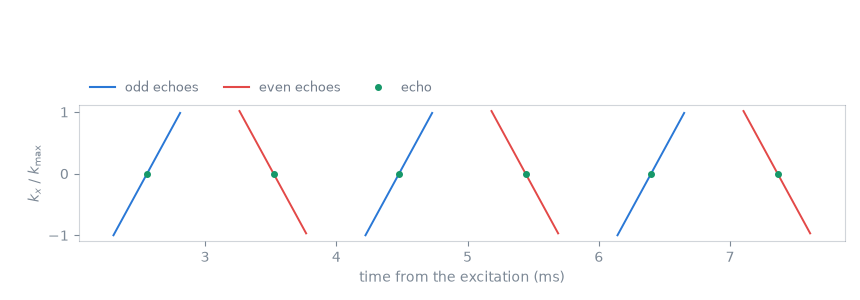
A multi-echo gradient echo follows the readout gradient with further readout gradients of alternating polarity, each with its own ADC event. The rest of the repetition is unchanged, and the echoes sample the same k-space line at increasing echo times. The measured quantities are the echo spacing, which depends on the receiver bandwidth, and the number of echoes that fit in the repetition time at each bandwidth. Where the echoes of such a train land, and why the even echoes are acquired in reverse order, is measured in Course lesson 5.
Prerequisites: Course lessons 3, Gradient echo, and 5, Echo planar imaging.
Objectives#
After this example, you should be able to:
build a multi-echo repetition from a train of readout gradients of alternating polarity, each with its own ADC event;
relate the echo spacing and the train length to the receiver bandwidth, the gradient amplitude limit and the ramp times.
A train of readouts#
A readout gradient traverses one k-space line from one end to the other. A second gradient of the opposite polarity traverses it back, so a train of them needs no rewinder between the echoes and forms one echo per gradient.
import numpy as np

import pypulseqpp as pp

system = pp.Opts(
    max_grad=32.0,
    grad_unit="mT/m",
    max_slew=130.0,
    slew_unit="T/m/s",
    rf_dead_time=100e-6,
    rf_ringdown_time=20e-6,
    adc_dead_time=10e-6,
)

FOV = 220e-3
MATRIX = 128
THICKNESS = 5e-3
FLIP_ANGLE_DEG = 20.0
REPETITION_TIME = 40e-3
BANDWIDTH_HZ = 250e3
ECHOES = 6

rf, gz, gz_reph = pp.make_sinc_pulse(
    flip_angle=np.deg2rad(FLIP_ANGLE_DEG),
    duration=2e-3,
    slice_thickness=THICKNESS,
    apodization=0.5,
    time_bw_product=4.0,
    delay=system.rf_dead_time,
    system=system,
    use="excitation",
    return_gz=True,
)


def readout(bandwidth_hz):
    """The readout gradient, its acquisition window and its prewinder.

    The dwell time is put on the ADC raster and the flat top on the gradient
    raster, which are different rasters, so the flat top is the acquisition
    window rounded up rather than equal to it. The amplitude is set so that a
    sample advances k-space by ``1 / FOV`` however long the window is.
    """
    dwell = pp.round_to_raster(1.0 / bandwidth_hz, system.adc_raster_time)
    acquisition = MATRIX * dwell
    raster = system.grad_raster_time
    gx = pp.make_trapezoid(
        channel="x",
        amplitude=MATRIX / FOV / acquisition,
        flat_time=raster * np.ceil(acquisition / raster),
        system=system,
    )
    adc = pp.make_adc(
        num_samples=MATRIX, dwell=dwell, delay=gx.rise_time, system=system
    )
    # The prewinder cancels the ramp, one step per sample before the echo and
    # the half step to the centre of the first sample.
    gx_pre = pp.make_trapezoid(
        channel="x",
        area=-(gx.amplitude * gx.rise_time / 2 + (MATRIX / 2 + 0.5) / FOV),
        duration=1e-3,
        system=system,
    )
    return gx, adc, gx_pre


gx, adc, gx_pre = readout(BANDWIDTH_HZ)
gy_pre = pp.make_trapezoid(
    channel="y", area=MATRIX / (2 * FOV), duration=1e-3, system=system
)

print(
    f"dwell {1e6 * adc.dwell:.1f} us, "
    f"readout {1e3 * pp.calc_duration(gx):.3f} ms, "
    f"amplitude {1e3 * gx.amplitude / 42.576e6:.2f} mT/m, "
    f"slew {gx.amplitude / gx.rise_time / 42.576e6:.0f} T/m/s"
)
dwell 4.0 us, readout 0.960 ms, amplitude 26.69 mT/m, slew 121 T/m/s
One repetition#
The train replaces the single readout block. The gradients of the train are played back to back, so the echo spacing is the duration of one readout gradient, ramps included.
def multi_echo(echoes, bandwidth_hz=BANDWIDTH_HZ, lines=MATRIX):
    """A multi-echo gradient echo with the given train length."""
    gx, adc, gx_pre = readout(bandwidth_hz)
    spoiler = pp.make_crusher(4.0, FOV / MATRIX, channel="z", system=system)[0]
    played = (
        pp.calc_duration(rf, gz)
        + pp.calc_duration(gx_pre, gy_pre, gz_reph)
        + echoes * pp.calc_duration(gx)
        + pp.calc_duration(spoiler)
    )
    seq = pp.Sequence(system=system)
    for step in np.linspace(-1.0, 1.0, lines, endpoint=False):
        seq.add_block(rf, gz)
        seq.add_block(gx_pre, pp.scale_grad(gy_pre, step), gz_reph)
        for echo in range(echoes):
            seq.add_block(pp.scale_grad(gx, (-1.0) ** echo), adc)
        seq.add_block(spoiler)
        seq.add_block(
            pp.make_delay(
                pp.round_to_raster(
                    REPETITION_TIME - played, system.block_duration_raster
                )
            )
        )
    return seq


seq = multi_echo(ECHOES)

ok, errors = seq.check_timing()
print(
    f"timing {ok}, {seq.num_blocks} blocks, "
    f"{seq.duration()[0]:.3f} s for {ECHOES} echoes on each of {MATRIX} lines"
)

seq.paper_plot(tr=1)
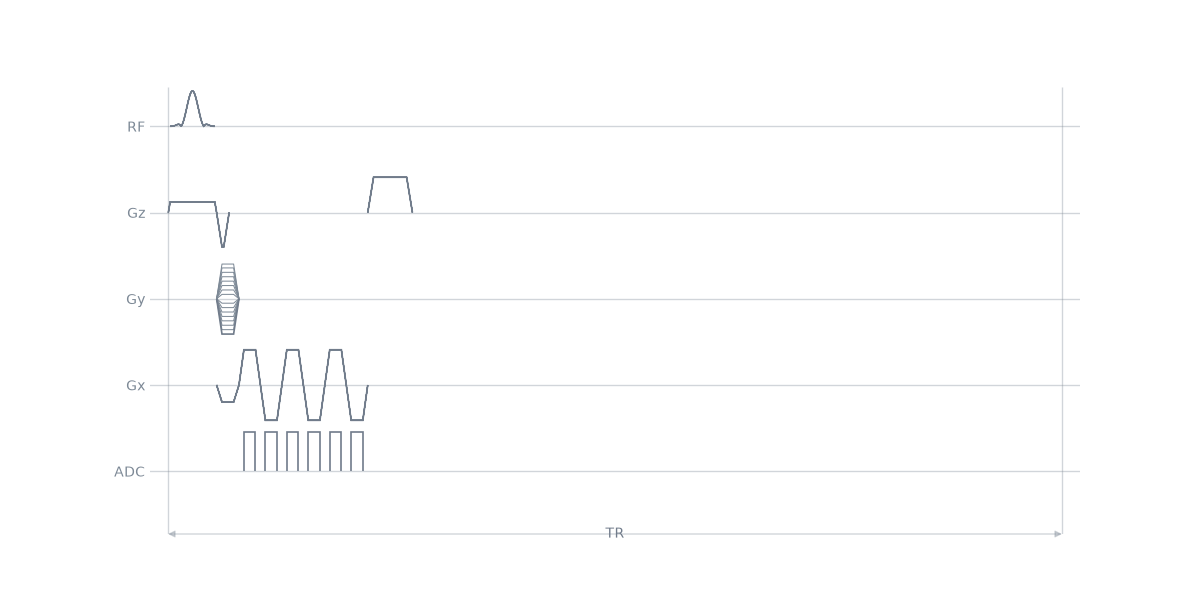
timing True, 1280 blocks, 5.120 s for 6 echoes on each of 128 lines
Echo spacing against receiver bandwidth#
The readout gradient has to cover the same area whatever the bandwidth, so a shorter flat top is a proportionally stronger gradient, until the amplitude limit is reached and the flat top can shorten no further. The echo spacing follows the flat top, and the train that fits in a repetition follows the echo spacing.
# The dwell time is the quantity the ADC raster quantizes, so the sweep is over
# dwell times and the bandwidth is read from them.
DWELLS = np.array([16e-6, 12e-6, 10e-6, 8e-6, 6e-6, 4e-6, 2e-6])
BANDWIDTHS = 1.0 / DWELLS

overhead = (
    pp.calc_duration(rf, gz)
    + pp.calc_duration(gx_pre, gy_pre, gz_reph)
    + pp.calc_duration(
        pp.make_crusher(4.0, FOV / MATRIX, channel="z", system=system)[0]
    )
)

spacing = []
for bandwidth in BANDWIDTHS:
    try:
        gradient = readout(bandwidth)[0]
    except ValueError:
        spacing.append({"bandwidth": bandwidth, "realizable": False})
        continue
    spacing.append(
        {
            "bandwidth": bandwidth,
            "realizable": True,
            "spacing": pp.calc_duration(gradient),
            "ramps": gradient.rise_time + gradient.fall_time,
            "amplitude": gradient.amplitude / 42.576e6,
            "echoes": int((REPETITION_TIME - overhead) // pp.calc_duration(gradient)),
        }
    )

realizable = [row for row in spacing if row["realizable"]]
bandwidth     amplitude     spacing    ramps   echoes
    62 kHz       6.67 mT/m    2.180 ms       6%       15
    83 kHz       8.90 mT/m    1.700 ms       9%       20
   100 kHz      10.68 mT/m    1.480 ms      14%       23
   125 kHz      13.35 mT/m    1.280 ms      19%       27
   167 kHz      17.79 mT/m    1.060 ms      26%       32
   250 kHz      26.69 mT/m    0.960 ms      46%       36
   500 kHz                beyond the amplitude limit
The acquisition window falls as the reciprocal of the bandwidth; the echo spacing does not. A shorter window at the same k-space extent is a stronger gradient, and a stronger gradient takes longer to ramp, at both ends of every echo. Over the sweep the window shortens fourfold and the spacing by a factor of little more than two, with the ramps growing from a sixteenth of the echo spacing to nearly half of it. Beyond the last point the amplitude the readout would need is above the limit, and the factory raises an error rather than lengthening the flat top.
The shorter spacing reduces the signal-to-noise ratio. The noise in a sample grows as the square root of the bandwidth, so the fourfold bandwidth of the sweep halves the signal-to-noise ratio of each echo, in exchange for the number of echoes and a shorter shortest echo time.
Total running time of the script: (0 minutes 0.286 seconds)