
Timing and rasterization#
TL;DR
Every event time in a
.seqfile is quantized to one of four rasters declared in[DEFINITIONS]: RF, gradient, ADC and block duration. TheOptsdefaults are 2 µs for the RF and ADC rasters and 20 µs for the gradient and block-duration rasters.A block’s duration is independent of the extent of its events, subject to being at least as long. A block longer than its events is a delay and is not reported; a gradient that ends at a nonzero amplitude before its block ends is reported by
check_timingasGRADIENT_END_NONZERO.When the ADC window must coincide with the readout flat top, the smallest admissible dwell for \(N\) samples is \(d_{\min} = a\,r/\gcd(N, r)\), with \(a\) the ADC raster, \(g\) the gradient raster and \(r = g/a\). At the default rasters, 128 samples therefore admit at most 100 kHz of receiver bandwidth and 100 samples admit 500 kHz.
calc_adc_timing()returns the achieved dwell, so the achieved bandwidth1 / dwellmay be lower than the one requested; the readout modules report it asbandwidth_hz.Raster addressability and the dead and ringdown times of the transmit and receive chains are separate constraints, and
check_timingreports both.check_timingand the constraint checks establish different properties and are separate calls.
A sequencer starts and stops events on a discrete time grid. A time that is not
an integer multiple of the grid period cannot be addressed, so every event time
in a .seq file is quantized before it is written.
The four rasters#
[DEFINITIONS] declares four raster periods, and each class of time is
quantized to one of them:
Raster |
Quantizes |
|---|---|
RF raster |
RF waveform sample spacing, RF event delays and centre times |
Gradient raster |
arbitrary-gradient sample spacing, gradient delays, trapezoid rise, flat and fall times |
ADC raster |
ADC dwell time and the ADC event delay |
Block-duration raster |
the duration of every block |
Opts holds all four. The defaults are 2 µs for the RF and
ADC rasters and 20 µs for the gradient and block-duration rasters, but they are
properties of the system the sequence is designed against, and a file records
the values it was written with.
round_to_raster() and ceil_to_raster()
quantize a single interval. Rounding up rather than to nearest is the usual
choice for a delay that must not fall below a computed minimum.
Block duration against event extent#
The duration recorded for a block is independent of the extent of its events, subject to being at least as long. The difference is dead time on every channel, which is how an echo time or a repetition time is realized.
Two consequences follow. A block longer than its events is legal and silent: no
check reports it, because it is a delay. A gradient that ends at a nonzero
amplitude before its block ends is not silent, because the amplitude over the
remaining interval is undefined; check_timing reports it as
GRADIENT_END_NONZERO.
Coupling between the ADC and gradient rasters#
An acquisition window is num_samples * dwell long. The dwell is quantized to
the ADC raster, and the readout gradient’s flat top is quantized to the
gradient raster. Whenever the samples must be taken at constant gradient
amplitude the window has to coincide with the flat top, and both
conditions apply at once, and they constrain the achievable receiver bandwidth.
Write \(a\) for the ADC raster, \(g\) for the gradient raster and \(r = g / a\), an integer for any realistic pair. Admissible dwell times are the multiples \(d = k a\) for which \(N d\) is a multiple of \(g\), and the smallest is
The sample count therefore participates in setting the maximum receiver bandwidth, alongside the rasters themselves. At the default rasters (\(a = 2\ \mu\mathrm{s}\), \(g = 20\ \mu\mathrm{s}\), \(r = 10\)), a readout of 128 samples has \(\gcd(128, 10) = 2\) and admits no dwell shorter than 10 µs, a receiver bandwidth of 100 kHz; a readout of 100 samples has \(\gcd(100, 10) = 10\) and admits 2 µs, a bandwidth of 500 kHz. A request for 250 kHz is met in the second case and not in the first, and nothing about the first prescription is otherwise unusual.
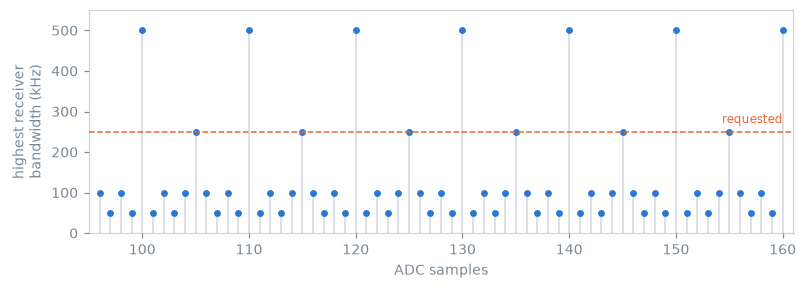
The highest receiver bandwidth each sample count admits at the default rasters, over one range of readout lengths. The four levels are the four values \(\gcd(N, r)\) takes for \(r = 10\), and a request is met only where the ceiling reaches it.#
calc_adc_timing() performs this search and returns the dwell
together with the acquisition duration, so the achieved bandwidth is
1 / dwell and may be lower than the one requested. The readout modules report
what they achieved as bandwidth_hz rather than echoing the request.
Dead times and ringdown#
Raster addressability and the settling times of the transmit and receive chains
are separate constraints. Three intervals in Opts state the
second: rf_dead_time before a pulse, rf_ringdown_time after it, and
adc_dead_time after an acquisition window. None of the three is a
quantization constraint, so a sequence can satisfy every raster and still
violate them.
check_timing reports both classes. Raster violations appear as RASTER;
chain violations appear as RF_DEAD_TIME, RF_RINGDOWN_TIME, ADC_DEAD_TIME
and POST_ADC_DEAD_TIME. The same pass also reports BLOCK_DURATION_MISMATCH,
NEGATIVE_DELAY, GRADIENT_START_DELAY, GRADIENT_END_NONZERO, the
soft-delay consistency conditions, and ADC_SAMPLES_DIVISOR where a vendor
requires the sample count to be divisible by a fixed factor.
A sequence whose gradient waveforms are within every amplitude and slew limit
can still be unplayable because one delay is off the raster. The constraint
checks of Gradient, PNS and SAR constraints and check_timing establish different
properties and are separate calls.
See also#
Events and blocks — what a block contains.
Timing and rasterization — the quantization and ADC timing helpers.
Constraint checks — running the checks over a finished sequence.