
Gradient amplitude#
TL;DR
check_max_grad()compares the largest per-axis amplitude, after each block’s rotation, withmax_gradfrom the system limits. A nonpositivemax_graddisables the comparison.The report also states each axis peak with its 1-based block and the largest simultaneous vector magnitude. Only the per-axis quantity is compared with a limit, because
max_gradin a Pulseq system description is a per-axis limit.The axis peaks are in general attained at different times, so their root-sum-square is an upper bound on the vector magnitude, and usually a loose one.
A rotation preserves the vector magnitude and changes its per-axis components, so a sequence within
max_gradunrotated can exceed it at an oblique prescription. A prescription is evaluated by applying it withTransformFOVand checking the result.A readout traversing \(\Delta k = N/\mathrm{FOV}\) at constant amplitude in a window of duration \(T\) requires \(G = \Delta k/T\) in Hz/m. At fixed field of view and matrix size, halving \(T\) doubles both the receiver bandwidth and the required amplitude.
A gradient amplifier has a maximum output current, and therefore a maximum
gradient amplitude on the axis it drives.
check_max_grad() compares the largest per-axis
amplitude of the sequence with max_grad from the system limits.
Quantity compared with the limit#
The check reconstructs the gradient waveforms after each block’s rotation and evaluates
The report also states the peak of each axis, with its 1-based block, and the largest simultaneous vector magnitude
Only the per-axis quantity is compared with a limit, because max_grad in a
Pulseq system description is a per-axis limit. Whether a system also constrains
the vector magnitude is a property of its gradient chain; the reported vector
peak permits that comparison outside the check. A nonpositive max_grad
disables the comparison, and the report is returned regardless.
Simultaneous vector magnitude and per-axis peaks#
The three axis peaks are in general attained at different times, so their root-sum-square is an upper bound on the vector magnitude, and usually a loose one. The reported vector peak is evaluated at each instant.
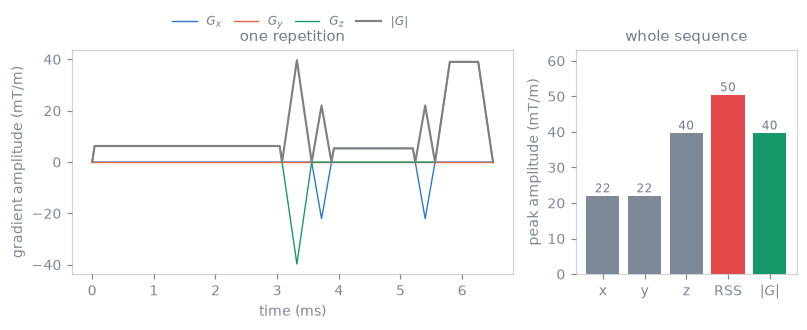
A radial gradient echo. The slice-selection lobe reaches 40 mT/m on z while x and y are idle, and the rotated readout reaches 22 mT/m on each of x and y at angles the slice lobe is not played at. The root-sum-square of the three axis peaks is 50 mT/m; the largest simultaneous vector magnitude is 40 mT/m.#
Dependence on rotation#
A rotation preserves the vector magnitude at every instant and changes its
per-axis components. In a plane, a vector of magnitude \(|G| \le\) max_grad is
within the per-axis limit at every orientation; a longer one exceeds it at some
orientations. A sequence within max_grad unrotated can therefore exceed it at
an oblique prescription.
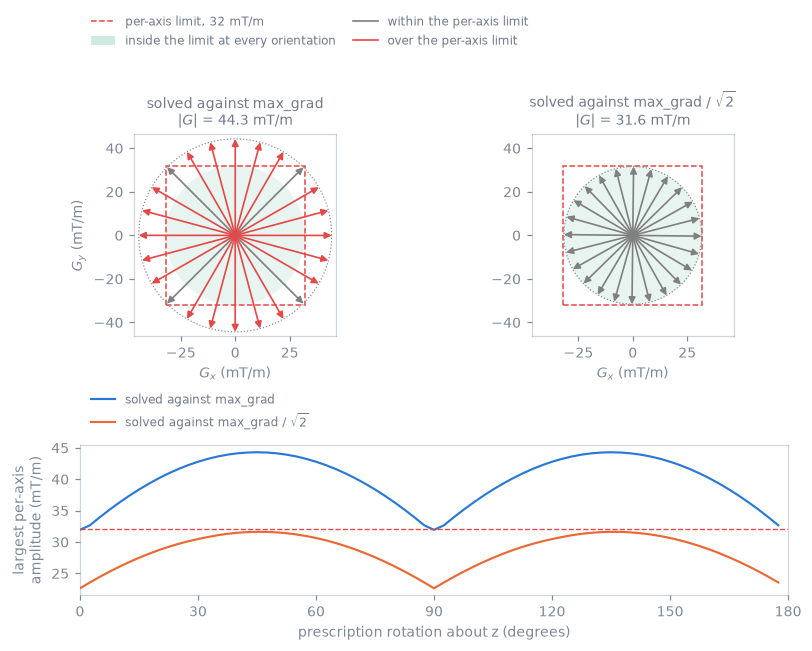
The in-plane gradient vector of a Cartesian gradient echo at the instant its
magnitude is largest, drawn at prescription rotations 15 degrees apart. Left,
a design solved against max_grad: its prewinder and its
rewinder-and-spoiler block play the readout and phase-encode axes together, and
each reaches the limit, so the vector is \(\sqrt2\) times that amplitude. Only
the orientations that leave it on a diagonal of the box keep both components
inside. Right, the same prescription solved against
max_grad divided by \(\sqrt2\), which fits the vector inside the circle. Below,
the largest per-axis amplitude over the whole scan against the prescription
angle.#
The check reads the rotations the sequence holds. A prescription is evaluated
by applying it with TransformFOV and checking the result;
apply_system_derates() returns reduced limits to design
against.
Readout amplitude and resolution#
A readout traversing \(\Delta k = N/\mathrm{FOV}\) in an acquisition window of duration \(T\) at constant amplitude requires
in Hz/m, or \(\Delta k/(\gamma T)\) in T/m. At fixed field of view and matrix size, halving \(T\) doubles both the receiver bandwidth and the required amplitude.
See also#
check_max_grad()— the call and its report.apply_system_derates()andcap_system()— limits other than the ones the sequence was designed under.Slew rate — the limit on the rate of change of amplitude.