
Note
Go to the end to download the full example code.
RF spoiling#

The previous lesson showed that a spoiler gradient leaves a coherent pathway in the steady state. This lesson suppresses the coherent residual transverse pathways by advancing the phase of the RF pulse and of the receiver by a quadratically increasing amount from one repetition to the next, and measures which phase increments bring the steady-state signal close to that of ideal spoiling.
The steady-state signal is computed against the phase increment, summed across a voxel as in Gradient spoiling. The increment in common use is read from that curve rather than assumed.
Learning objectives#
After this lesson, you should be able to:
write the quadratic phase cycle of RF spoiling;
set the phase offset of the RF and ADC events per repetition, and read it back from the blocks;
identify phase increments that leave the residual pathway coherent;
compare the RF-spoiled steady state with the ideally spoiled signal over flip angle.
The phase cycle#
The transmit phase of repetition \(n\) is advanced by \(n\) times a fixed increment, so that the phase itself grows quadratically:
The pathway a pulse refocuses from an earlier repetition arrives with a phase that depends on how many repetitions ago it was produced, so a phase that is not linear in \(n\) puts successive repetitions’ residuals at different phases and their sum towards zero. The signal of the current repetition is unaffected, because the receiver is advanced by the same amount.
import numpy as np

import pypulseqpp as pp

system = pp.Opts(
    max_grad=32.0,
    grad_unit="mT/m",
    max_slew=130.0,
    slew_unit="T/m/s",
    rf_dead_time=100e-6,
    rf_ringdown_time=20e-6,
    adc_dead_time=10e-6,
)

FOV = 220e-3
MATRIX = 128
THICKNESS = 5e-3
FLIP_ANGLE_DEG = 12.0
REPETITION_TIME = 20e-3
SPOILER_CYCLES = 4.0
PHASE_INCREMENT_DEG = 117.0

VOXEL = FOV / MATRIX


def transmit_phase(repetition, increment_deg):
    """The phase of one repetition's pulse and receiver, in radians."""
    return np.deg2rad(increment_deg) * repetition * (repetition + 1) / 2
One repetition#
phase_offset is the phase of an RF event or an ADC event, in radians.
Setting the two to the same value in each repetition advances the receiver
phase with the transmit phase; the events are otherwise those of the
gradient echo.
rf, gz, gz_reph = pp.make_sinc_pulse(
    flip_angle=np.deg2rad(FLIP_ANGLE_DEG),
    duration=2e-3,
    slice_thickness=THICKNESS,
    apodization=0.5,
    time_bw_product=4.0,
    delay=system.rf_dead_time,
    system=system,
    use="excitation",
    return_gz=True,
)

dwell, readout_time = pp.calc_adc_timing(
    MATRIX,
    26e-6,
    grad_raster_time=system.grad_raster_time,
    adc_raster_time=system.adc_raster_time,
)
gx = pp.make_trapezoid(
    channel="x", flat_area=MATRIX / FOV, flat_time=readout_time, system=system
)
adc = pp.make_adc(num_samples=MATRIX, dwell=dwell, delay=gx.rise_time, system=system)
gx_pre = pp.make_trapezoid(channel="x", area=-gx.area / 2, duration=1e-3, system=system)
gy_pre = pp.make_trapezoid(
    channel="y", area=MATRIX / (2 * FOV), duration=1e-3, system=system
)
spoiler = pp.make_crusher(SPOILER_CYCLES, VOXEL, channel="z", system=system)[0]

played = (
    pp.calc_duration(rf, gz)
    + pp.calc_duration(gx_pre, gy_pre, gz_reph)
    + pp.calc_duration(gx, adc)
    + pp.calc_duration(spoiler)
)
recovery = pp.make_delay(
    pp.round_to_raster(REPETITION_TIME - played, system.block_duration_raster)
)

seq = pp.Sequence(system=system)
for repetition, step in enumerate(np.linspace(-1.0, 1.0, MATRIX, endpoint=False)):
    phase = transmit_phase(repetition, PHASE_INCREMENT_DEG) % (2 * np.pi)
    rf.phase_offset = phase
    adc.phase_offset = phase
    seq.add_block(rf, gz)
    seq.add_block(gx_pre, pp.scale_grad(gy_pre, step), gz_reph)
    seq.add_block(gx, adc)
    seq.add_block(spoiler)
    seq.add_block(recovery)

ok, errors = seq.check_timing()
print(f"timing {ok}, {seq.num_blocks} blocks, {seq.duration()[0]:.3f} s")
timing True, 640 blocks, 2.560 s
The phase the events were written with is read back from the blocks, which is where an interpreter and a reconstruction find it.
written = np.array(
    [np.rad2deg(seq.get_block(1 + 5 * n).rf.phase_offset) for n in range(6)]
)
print("transmit phase of the first repetitions (degrees): ", np.round(written, 1))
transmit phase of the first repetitions (degrees): [ 0. 117. 351. 342. 90. 315.]
Steady state against phase increment#
The summation is the one of the previous lesson with the transmit phase of each repetition applied to the pulse and removed from the signal.
ISOCHROMATS = 201
REPETITIONS = 500

_, _, t_excitation, _, t_adc = seq.calculate_kspacePP(block_range=[1, 5])
ECHO_TIME = float(t_adc[MATRIX // 2] - t_excitation[0])


def steady_state(increment_deg, flip_angle_deg, t1=1000e-3, t2=80e-3):
    """The signal the repetition settles at, under the given phase cycle."""
    flip = np.deg2rad(flip_angle_deg)
    position = (np.arange(ISOCHROMATS) + 0.5) / ISOCHROMATS
    spoiler_phase = np.exp(2j * np.pi * SPOILER_CYCLES * position)
    rest = REPETITION_TIME - ECHO_TIME

    transverse = np.zeros(ISOCHROMATS, dtype=complex)
    longitudinal = np.ones(ISOCHROMATS)
    signal = np.zeros(REPETITIONS, dtype=complex)

    for repetition in range(REPETITIONS):
        phase = transmit_phase(repetition, increment_deg)
        turn = np.exp(1j * phase)
        rotated = (
            np.cos(flip / 2) ** 2 * transverse
            + np.sin(flip / 2) ** 2 * turn**2 * np.conj(transverse)
            - 1j * np.sin(flip) * turn * longitudinal
        )
        longitudinal = np.cos(flip) * longitudinal + np.sin(flip) * np.imag(
            np.conj(turn) * transverse
        )
        transverse = rotated

        transverse *= np.exp(-ECHO_TIME / t2)
        longitudinal = 1.0 + (longitudinal - 1.0) * np.exp(-ECHO_TIME / t1)
        # The receiver is advanced with the transmitter, so the phase of the
        # current repetition's signal is removed from what is recorded.
        signal[repetition] = (transverse * np.conj(turn)).mean()

        transverse *= np.exp(-rest / t2) * spoiler_phase
        longitudinal = 1.0 + (longitudinal - 1.0) * np.exp(-rest / t1)

    return signal


def ideally_spoiled(flip_angle_deg, t1=1000e-3):
    """The signal of a repetition that begins with no transverse component."""
    flip = np.deg2rad(flip_angle_deg)
    recovered = np.exp(-REPETITION_TIME / t1)
    return np.sin(flip) * (1 - recovered) / (1 - recovered * np.cos(flip))


INCREMENTS = np.arange(0.0, 181.0, 1.0)
SWEPT_FLIPS = (FLIP_ANGLE_DEG, 30.0, 60.0)

against_increment = {
    flip: np.array([abs(steady_state(step, flip)[-1]) for step in INCREMENTS])
    for flip in SWEPT_FLIPS
}
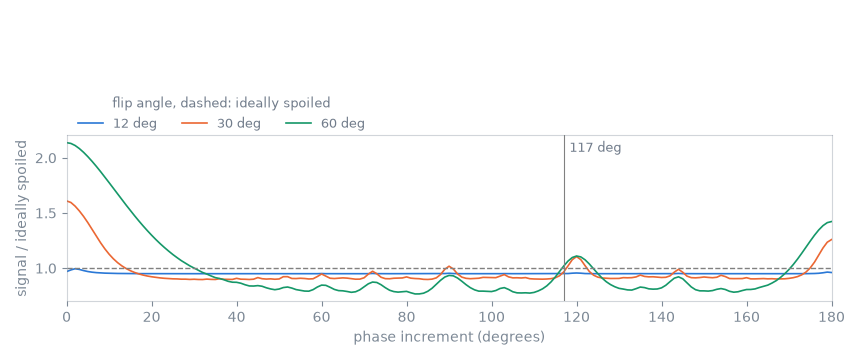
flip   at 117 deg              lowest             highest
  12        0.950      0.950 at  86      0.995 at   2
  30        0.967      0.897 at  32      1.609 at   0
  60        1.020      0.767 at  82      2.137 at   0
The curve is spiky rather than smooth. An increment that returns to a small set of phases leaves the residual as coherent as no phase cycle at all: zero and 180 degrees are the clearest, and each of the flip angles swept here has others of its own. An increment of 117 degrees is within a few percent of the ideally spoiled value at every one of them, which is the reason for its common use, and its neighbourhood is narrow — at 60 degrees of flip, an increment of 82 degrees gives a quarter less signal than the ideal and 117 gives it to two percent.
The chosen increment against flip angle#
The comparison of the previous lesson, repeated with the phase cycle in place.
FLIP_ANGLES = np.arange(2.0, 61.0, 2.0)

spoiled = np.array(
    [abs(steady_state(PHASE_INCREMENT_DEG, flip)[-1]) for flip in FLIP_ANGLES]
)
ideal = ideally_spoiled(FLIP_ANGLES)
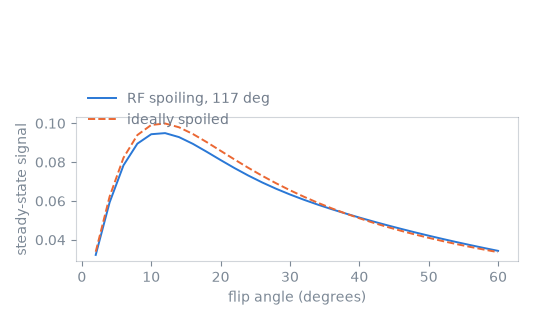
largest departure from the ideally spoiled signal: 5.5 percent, at 20 degrees
The two curves lie together over the whole range, and the peak is back at the Ernst angle. A departure of a few percent remains, which depends on T2 and on the flip angle: the phase cycle cancels the residual pathway approximately rather than removing it, and a T1 estimated from this signal under an ideally spoiled model is biased by the remainder.
Total running time of the script: (0 minutes 6.737 seconds)