
Gradient continuity#
TL;DR
Adjacent Pulseq blocks have no implicit gap, so the change on each axis between the endpoint of one block and the initial amplitude of the next, after the blocks’ rotations, must satisfy the one-raster slew criterion \(|\Delta G| \leq \mathtt{max\_slew}\cdot\mathtt{grad\_raster\_time}\).
check_grad_continuity()evaluates every boundary and reports the 1-based block index, axis, endpoint amplitudes and implied slew rate.The final gradient amplitude on every axis must be zero; otherwise
ends_at_zeroand the overall verdict are false.Each block’s rotation is applied before the comparison, so endpoints equal on the channel axes of two blocks with different rotations can differ after them. Returning every interleaf to zero avoids this dependence.
Adjacent Pulseq blocks have no implicit gap. A change on each axis between the endpoint of one block and the initial amplitude of the next, after the blocks’ rotations, must satisfy the one-raster slew criterion
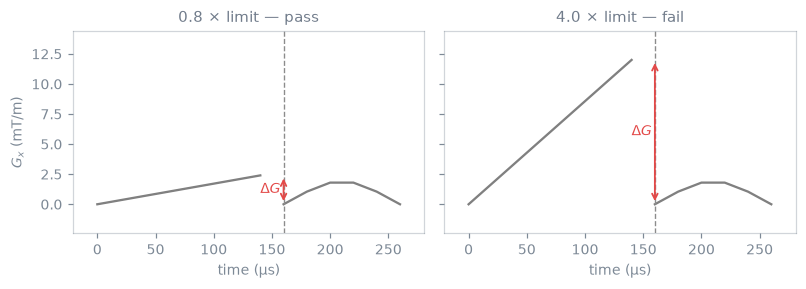
A boundary step below the one-raster limit passes; a larger step is reported. The dashed line marks the block boundary and the red arrow marks \(\Delta G\).#
check_grad_continuity() evaluates every boundary and
reports the 1-based block index, axis, endpoint amplitudes, and implied slew
rate. The final gradient amplitude on every axis must also be zero; otherwise
ends_at_zero and the overall verdict are false.
Each block’s rotation is applied before the comparison. Endpoints equal on the channel axes of two blocks with different rotations can therefore differ after them. Returning every interleaf to zero avoids this dependence.
See also#
check_grad_continuity()— check and report fields.Slew rate — within-block slew-rate evaluation.