Sequence optimization#
Choosing a sequence’s parameters rather than simulating the ones you were given.
A design problem is three pieces: a simulator with the tissue it is designed
for already fixed on it; a cost, which is a plain function of what that
simulator records; and a SequenceDesign, which holds the
parameters inside the limits the scanner will play and runs the loop.
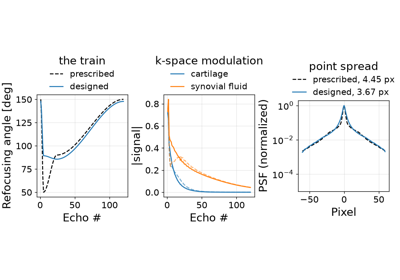
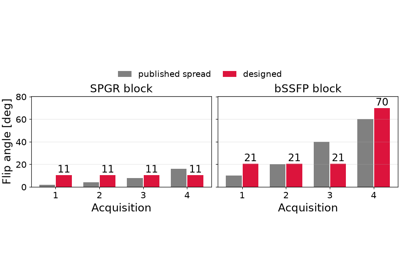
Only the cost changes between the first two examples here. One asks for a picture – sharp where sharpness is decided, with contrast where contrast is decided – and the other asks for precision, choosing flip angles so that T1 and T2 are estimated as tightly as the scan time allows.
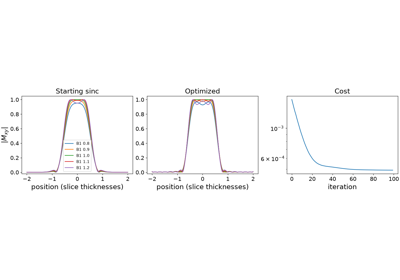
The third designs no protocol parameter at all but the samples of an RF pulse, through a Bloch simulation of the slice it excites, so that the excitation holds where the transmit field does not.