

Homepage#












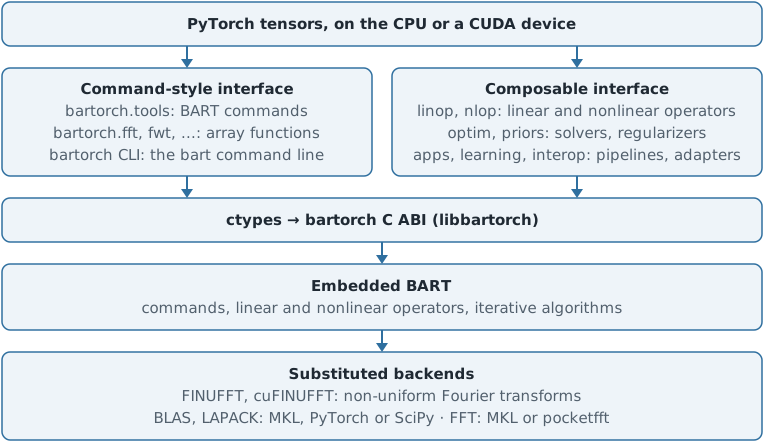
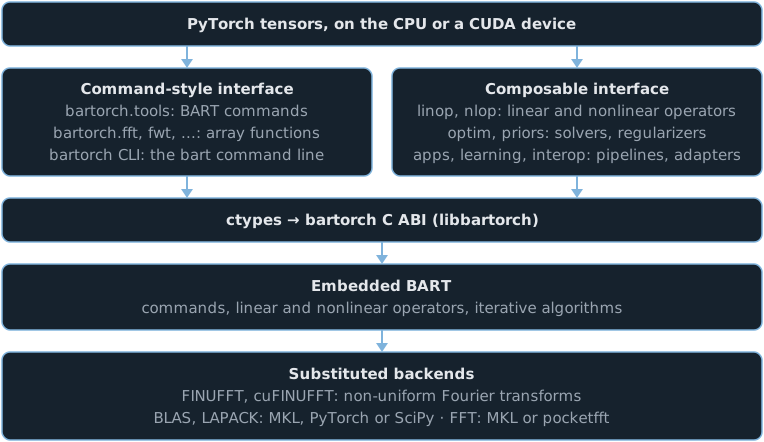
bartorch makes BART, the Berkeley Advanced Reconstruction Toolbox, available in Python on PyTorch tensors, in host memory or on a CUDA device. BART is compiled into the package and runs in the Python process, so a reconstruction written in Python uses BART’s parallel imaging, compressed sensing, non-Cartesian and model-based methods without writing files or calling an executable, and can be placed inside a larger PyTorch computation such as the training of an unrolled network.
BART’s encoding operators are composable Python objects, its iterative
algorithms are solver classes and differentiable iteration blocks, its
reconstructions (pics, moba, mobafit, POCSENSE) are pipelines assembled
from both, and its remaining commands are Python functions. The arithmetic is
BART’s except where bartorch substitutes a component: FINUFFT and cuFINUFFT
compute every non-uniform FFT, the FFT and BLAS/LAPACK routines come from MKL,
PyTorch’s linked library or SciPy, and the MRI encoding operators run on
bartorch’s own executor built from BART’s operators.
Features#
BART’s reconstructions (
pics,moba,mobafit, POCSENSE) as pipelines of operators and solvers, and its calibration, sampling and simulation commands (ecalib,nlinv,traj,phantom, …) as functions of tensors.Corrections outside the reconstruction (EPI ghosting, bias field, gradient nonlinearity, off-resonance and susceptibility distortion) and rigid motion estimation from navigators.
The
bartorchcommand line, which accepts the arguments ofbart.MRI encoding operators — Cartesian, non-Cartesian and wave-encoded SENSE, subspace models, B0 off-resonance correction — composed with
@and+into single BART operators.BART’s regularization terms and its CG, IST, FISTA, ADMM and primal-dual iterations, as solvers and as differentiable iteration blocks.
Nonlinear operators, iteratively regularized Gauss-Newton, and quantitative signal models from TorchSim.
Adapters for unrolled networks, plug-and-play denoisers and DeepInverse.
Quick start#
pip install bartorch
import bartorch.tools as bt
from bartorch import apps, priors

kspace = bt.phantom(128, coils=8, kspace=True)  # (coils, z, y, x)
maps = bt.ecalib(kspace, maps=1)
image = apps.pics(kspace, maps, regularizers=priors.Wavelet((-1, -2), 0.005), solver="fista")
The same reconstruction can be assembled from an encoding operator and a solver; Interfaces and execution describes which interface fits which task.
Documentation#
https://pulserver.github.io/bartorch/ has the user guide (supported platforms, installation, reporting issues), the developer guide, conceptual explanations, executed examples and the API reference, with a version switcher between the development version and the releases.
Citation#
bartorch has no publication or archival DOI. Work that uses it should cite BART and the methods it applied (ESPIRiT, compressed sensing, nonlinear inversion, …), and report the bartorch version or commit and the pinned BART revision; Contributors and citation gives the references and what else a reproducible report records.
License#
bartorch is MIT-licensed. The embedded BART (BSD-3-Clause) and FINUFFT (Apache-2.0), the libraries FINUFFT’s build compiles in with it, and the vendored pocketfft (BSD-3-Clause) and BlocksRuntime (MIT or NCSA) keep their own licenses; see License and third-party notices. bartorch is an independent project, not affiliated with or endorsed by the BART developers, the PyTorch Foundation or The Linux Foundation. The logo combines BART’s mark with the PyTorch logo’s flame; PyTorch, the PyTorch logo and any related marks are trademarks of The Linux Foundation.