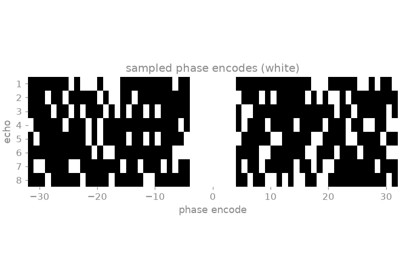

nlop.MultiEcho#
- bartorch.nlop.MultiEcho()#
T2 or T2* from a multi-echo readout.
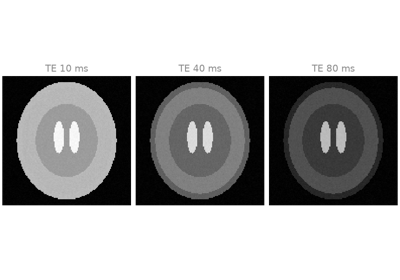
The transverse decay read at a series of echo times. Which relaxation is measured is a property of the sequence that produced the data, not of the model: a spin-echo train measures T2 and a gradient-echo train T2*, and the exponential is the same either way.
- Parameters:
TE (sequence of float) – Echo times, in milliseconds.
shape (tuple of int, default=()) – The voxel shape, C order.
bounds (dict, default=None) –
{name: (low, high)};T2defaults to(1, 1000)ms.unknown (sequence of str, default=('T2',)) – What to solve for.
offsetis the other thing the model exposes.amplitude (bool, default=True) – Carry a complex amplitude multiplying the decay.
subspace (torchsim.Subspace, default=None) – Solve in a temporal basis rather than in the contrasts.
**scale – The size of a step in a parameter left unbounded.