
tools.Gradunwarp#
- class bartorch.tools.Gradunwarp#
Bases:
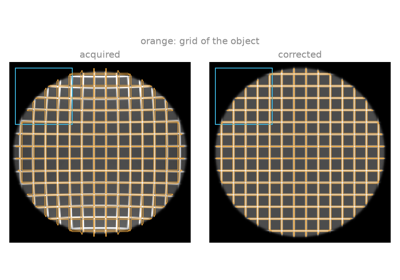
Gradient nonlinearity correction of images from a coil’s coefficient table.
The coil’s spherical-harmonic field is evaluated at the scanner position \(r\) of every voxel of the target grid, giving the position \(r + d(r)\) at which that voxel was acquired, and the image is resampled there by cubic B-spline interpolation (SimpleITK), optionally multiplied by the Jacobian determinant \(|\det(I + \nabla d)|\). Geometry is in scanner coordinates, in millimetres; voxel centres are at
center_mm + ((index - (n - 1) / 2) * fov_mm / n) @ orientation.T.- Parameters:
coefficients (str, bytes, pathlib.Path, CoefficientAccessor or GradientCoefficients) – The coil’s table, as
GradientCoefficients.from_file()reads it, or already parsed.shape (sequence of int) – Matrix of the acquired image,
(z, y, x)or(y, x).fov_mm (sequence of float) – Field of view per axis of
shape, in millimetres; independent of the matrix, so a zero-filled reconstruction gives its ownshapeand the acquired field of view.orientation (numpy.ndarray, default=None) –
(3, ndim)direction cosines: columniis the unit scanner vector along which array axisiincreases.Noneis the identity’s firstndimcolumns.center_mm (sequence of float, default=(0.0, 0.0, 0.0)) – Scanner position of the image centre.
target_shape (sequence of int, default=None) – Matrix of the grid corrected onto;
shapeifNone. The target grid sharesorientationandcenter_mm, and correction and reslicing are one interpolation.target_fov_mm (sequence of float, default=None) – Field of view of the target grid;
fov_mmifNone.jacobian (bool, default=True) – Multiply by the Jacobian determinant of the mapping, which conserves the signal of a voxel whose volume the nonlinearity changes.
coefficient_format ({"auto", "dat", "grad", "coef"}, default='auto') – As in
GradientCoefficients.from_file().reference_radius_mm (float, default=None) – As in
GradientCoefficients.from_file().
- coefficients#
The parsed table.
- Type:
Examples
>>> correct = Gradunwarp("coil.grad", shape=(8, 16, 16), fov_mm=(80.0, 240.0, 240.0))
>>> corrected = correct(volume)  # (..., 8, 16, 16)
- classmethod from_mrd()#
Correction for the image of one encoding of an MRD stream.
The header and the acquisition are read by attribute, as the ISMRMRD Python objects carry them; no MRD library is imported.
- Parameters:
header (object) – MRD XML header.
header.encoding[k].reconSpacegives the matrix and field of view; the table is read from the first entry ofheader.userParameters.userParameterStringnamed for gradient coefficients (GradientCoefficientsand similar).acquisition (object) – An acquisition or its head:
encoding_space_refselects the encoding,slice_dir,phase_dirandread_dirthe orientation of the(z, y, x)array axes,positionthe centre.coefficients (str, pathlib.Path, CoefficientAccessor or GradientCoefficients, default=None) – The table, which takes precedence over the header’s; text is also accepted as bytes.
**kwargs – Passed to
Gradunwarp.
- Return type:
- Raises:
ValueError – If the header has no such encoding, or no table is given or found.
- classmethod from_affine()#
Correction for an image whose voxel centres map to scanner millimetres by
affine.- Parameters:
coefficients (str, bytes, pathlib.Path, CoefficientAccessor or GradientCoefficients) – The coil’s table.
affine (numpy.ndarray) –
(4, 4)map from array indices(i, j[, k], 1)to scanner position in millimetres.shape (sequence of int) – Matrix of the image.
**kwargs – Passed to
Gradunwarp.
- Return type:
- property shape#
Matrix size of the corrected image.
- property source_grid#
Floating indices into the acquired image, one per corrected voxel.
- property target_grid#
Scanner coordinates in millimetres of the grid being corrected onto.
- property jacobian_grid#
The intensity multiplier, or ones when
jacobianis off.
- clear_cache()#
Drop the cached physical sampling grid and Jacobian.
- __call__()#
Correct
imageonto the target grid.- Parameters:
image (torch.Tensor) – Real or complex image
(..., *shape); the real and imaginary parts are resampled separately.- Returns:
(..., *target_shape), with the dtype and device ofimage(float32for an integer image).- Return type:
torch.Tensor