
tools.ecalib#
- bartorch.tools.ecalib()#
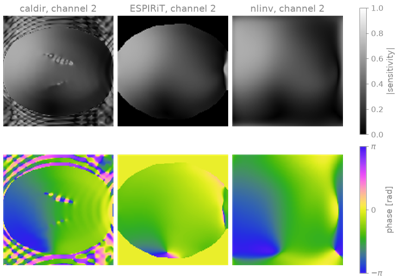
Coil sensitivities by ESPIRiT.
- Parameters:
kspace (torch.Tensor) – Fully sampled calibration data, or k-space with a sampled centre,
(coils, z, y, x), or(coils, y, x)for one slice.maps (int, default=None) – How many sets of sensitivities to produce (
-m).calib_size (int or tuple of int, default=None) – The calibration region’s size (
-r), the same on every axis or one per axis.threshold (float, default=None) – The singular-value threshold for the calibration matrix (
-t).crop (float, default=None) – The eigenvalue below which a sensitivity is set to zero (
-c).kernel_size (int, default=None) – The calibration kernel’s size (
-k).softsense (bool, default=False) – Return the maps without the eigenvalue crop, for soft-SENSE (
-S).intensity_correction (bool, default=False) – Correct for intensity rather than normalising (
-I).return_eigenvalues (bool, default=False) – Also return the eigenvalue map, which BART writes as a second array only when asked.
**extra – Further BART
ecaliboptions, by name.e, the axis the second step is split along, takes an axis ofkspace.
- Returns:
The sensitivities, and the eigenvalues when asked for, without a
zaxis whenkspacehas none.- Return type:
torch.Tensor or tuple of torch.Tensor
Examples
>>> maps = ecalib(kspace, maps=1, crop=0.8)