
apps.pics#
- bartorch.apps.pics()#
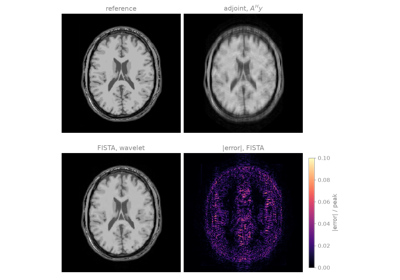
Parallel-imaging compressed-sensing reconstruction.
The pipeline BART’s
picscommand runs, assembled here: the sampling pattern applied to the k-space, the modulation into the convention BART iterates in, the scaling estimated from what is left, and then an encoding frombartorch.linopunder an iteration frombartorch.optim.- Parameters:
kspace (torch.Tensor) – Under-sampled k-space, C order:
(coils, z, y, x)on a grid, and(coils, *encoding, shots, samples)off it.sensitivities (torch.Tensor) – Coil sensitivities, as
ecalib()produces them.regularizers (Regularizer or iterable of Regularizer, default=None) –
bartorch.priorsterms. Their axes index the image’s shape.l2 (float, default=None) – Plain Tikhonov weight.
solver ({'cg', 'ist', 'fista', 'admm', 'pridu'}, default=None) –
Nonechooses from the terms, as the application does. IST and FISTA apply a term’s proximal operator to the image, so a first term over a transform –FourierL1,Laplace– for which the application chooses FISTA is refused here;'admm'and'pridu'take it.maxiter (int, default=None) – Iterations; BART’s default is thirty.
step (float, default=None) – Step size for the gradient iterations.
admm_rho (float, default=None) – ADMM penalty; setting it selects ADMM unless
solversays otherwise.cg_maxiter (int, default=None) – Inner conjugate-gradient steps for ADMM.
traj (torch.Tensor, default=None) – Non-Cartesian trajectory, in grid units.
pattern (torch.Tensor, default=None) – Sampling pattern or weights; on a grid it is read off
kspacewhen it is not given.basis (torch.Tensor, default=None) – Subspace basis over frames and coefficients.
initial (torch.Tensor, default=None) – An image to start the iteration from, in the units the solve works in – that is, already divided by
scaling.pics -Wreads it the same way: it rescales the warm start only under-S, where the answer is put back into the data’s units at the end.eigen_step (bool, default=False) – Take the step size from the largest eigenvalue of the normal operator rather than from
step, estimated by thirty power iterations aspics -eestimates it. The starting vector comes from BART’s process-global generator, so this is the one setting under which two runs in a process do not agree to the bit.toeplitz (bool, default=None) –
Falseapplies the encoding and its adjoint rather than the normal operator’s convolution.scaling (float, default=None) – The data scaling to divide by; estimated when it is not given, which is what makes a regularization weight transferable.
- Returns:
The reconstructed image.
- Return type:
torch.Tensor
Examples
>>> image = pics(kspace, maps, l2=0.01, maxiter=50)
>>> image = pics(kspace, maps, regularizers=priors.Wavelet((-1, -2), 0.005))