

Note
Go to the end to download the full example code.
Segmented echo planar imaging#

A single-shot echo planar readout acquires the whole matrix after one excitation, and its long echo train distorts the image along the phase-encode direction. A segmented readout divides the phase-encode lines of the matrix over several excitations (shots). Each shot acquires an interleaved subset of the lines, with a phase-encode blip between its echoes, so a shot has a shorter echo train.
In this Tour you build the blips and the shots, check from the k-space analysis that the shots together cover every line once, and compute how the bandwidth per pixel along the phase-encode direction and the displacement of an off-resonant voxel change with the number of shots, against the scan time.
Prerequisites: lessons 1 and 2 of the course, and the echo planar imaging Tour.
Phase-encoding blips#
Within a shot, consecutive echoes are separated by as many k-space lines as
there are shots, so that the shots interleave and together cover every line.
make_phase_blip() takes that number of lines and the field
of view rather than an area, and solves the shortest gradient that delivers
it.
import numpy as np

import pypulseqpp as pp

system = pp.Opts(
    max_grad=32.0,
    grad_unit="mT/m",
    max_slew=130.0,
    slew_unit="T/m/s",
    rf_dead_time=100e-6,
    rf_ringdown_time=20e-6,
    adc_dead_time=10e-6,
)

FOV = 220e-3
MATRIX = 64
THICKNESS = 5e-3
FLIP_ANGLE_DEG = 90.0
REPETITION_TIME = 100e-3
DWELL = 4e-6
SHOTS = 4

rf, gz, gz_reph = pp.make_sinc_pulse(
    flip_angle=np.deg2rad(FLIP_ANGLE_DEG),
    duration=2e-3,
    slice_thickness=THICKNESS,
    apodization=0.5,
    time_bw_product=4.0,
    delay=system.rf_dead_time,
    system=system,
    use="excitation",
    return_gz=True,
)

# A readout of alternating polarity at a fixed dwell time.
acquisition = MATRIX * DWELL
raster = system.grad_raster_time
gx = pp.make_trapezoid(
    channel="x",
    amplitude=MATRIX / FOV / acquisition,
    flat_time=raster * np.ceil(acquisition / raster),
    system=system,
)
adc = pp.make_adc(num_samples=MATRIX, dwell=DWELL, delay=gx.rise_time, system=system)
gx_pre = pp.make_trapezoid(
    channel="x",
    area=-(gx.amplitude * gx.rise_time / 2 + (MATRIX / 2 + 0.5) / FOV),
    duration=5e-4,
    system=system,
)

blip = pp.make_phase_blip(channel="y", fov=FOV, steps=SHOTS, system=system)

print(
    f"echo spacing {1e3 * pp.calc_duration(gx):.3f} ms, "
    f"blip {1e6 * pp.calc_duration(blip):.0f} us for {SHOTS} lines, "
    f"readout {1e3 * gx.amplitude / 42.576e6:.1f} mT/m "
    f"rising in {1e6 * gx.rise_time:.0f} us"
)
echo spacing 0.700 ms, blip 120 us for 4 lines, readout 26.7 mT/m rising in 220 us
Shot structure#
A shot is the excitation, the prewinders, and then one block per echo. The blip is played in the same block as the readout gradient it follows, on the other axis, so the echo spacing remains equal to the duration of one readout gradient. The phase-encode prewinder of each shot moves the k-space position to the first line of that shot.
def segmented(shots, lines=MATRIX):
    """A segmented echo planar acquisition covering ``lines`` k-space lines."""
    step = pp.make_phase_blip(channel="y", fov=FOV, steps=shots, system=system)
    train = lines // shots
    seq = pp.Sequence(system=system)
    for shot in range(shots):
        start = pp.make_trapezoid(
            channel="y", area=(-lines / 2 + shot) / FOV, duration=5e-4, system=system
        )
        played = (
            pp.calc_duration(rf, gz)
            + pp.calc_duration(gx_pre, start, gz_reph)
            + train * pp.calc_duration(gx)
        )
        seq.add_block(rf, gz)
        seq.add_block(gx_pre, start, gz_reph)
        for echo in range(train):
            readout = pp.scale_grad(gx, (-1.0) ** echo)
            # The blip advances k-space before every echo but the first, and
            # plays inside the rise of the readout gradient it shares a block
            # with, so it is complete before the acquisition window opens.
            if echo == 0:
                seq.add_block(readout, adc)
            else:
                seq.add_block(readout, step, adc)
        seq.add_block(
            pp.make_delay(
                pp.round_to_raster(
                    REPETITION_TIME - played, system.block_duration_raster
                )
            )
        )
    return seq


seq = segmented(SHOTS)

ok, errors = seq.check_timing()
print(
    f"timing {ok}, {seq.num_blocks} blocks, {MATRIX // SHOTS} echoes per shot, "
    f"{seq.duration()[0]:.3f} s"
)

seq.paper_plot(tr=1)
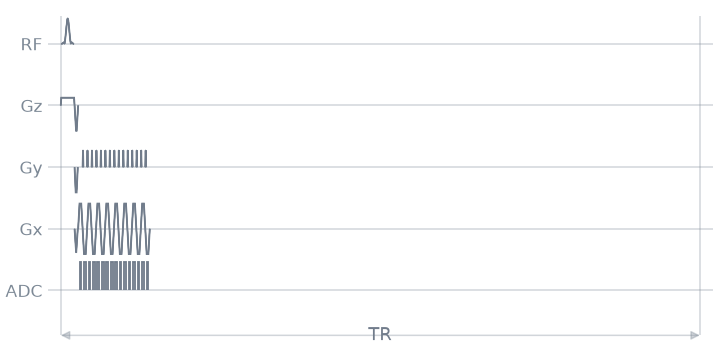
timing True, 76 blocks, 16 echoes per shot, 0.400 s
Interleaved k-space raster#
Each excitation contributes every fourth line, and the four together cover the matrix, each line once.
k_adc = seq.calculate_kspace()[0]
# Every sample of one echo shares that echo's phase-encode line.
lines = np.round(k_adc[1] * FOV).astype(int)
covered, samples = np.unique(lines, return_counts=True)
print(
    f"{covered.size} lines from {covered.min()} to {covered.max()}, "
    f"each acquired {(samples // MATRIX).min()} to {(samples // MATRIX).max()} times"
)

pp.plot.plot_kspace(seq, color_by="shot", plane="xy")
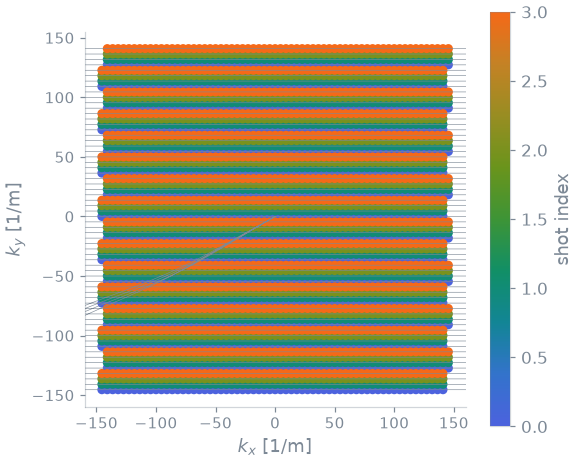
64 lines from -32 to 31, each acquired 1 to 1 times
Distortion against shot count#
Off-resonance displaces a voxel along the phase-encode direction by the ratio of its offset to the bandwidth per pixel in that direction. That bandwidth is not the receiver bandwidth: the phase-encode direction is traversed one line per echo, so one line takes an echo spacing divided by the number of shots, and the bandwidth per pixel is
with \(S\) shots, \(N\) lines and an echo spacing \(\mathrm{ESP}\). It is smaller than the receiver bandwidth per pixel by the number of echoes in a shot, which is why an echo planar image is distorted along the phase-encode direction and not along the readout.
OFF_RESONANCE_HZ = 100.0
COUNTS = (1, 2, 4, 8, 16)

echo_spacing = pp.calc_duration(gx)

trade_off = []
for shots in COUNTS:
    phase_bandwidth = shots / (MATRIX * echo_spacing)
    trade_off.append(
        {
            "shots": shots,
            "echoes": MATRIX // shots,
            "train": (MATRIX // shots) * echo_spacing,
            "phase_bandwidth": phase_bandwidth,
            "displacement": OFF_RESONANCE_HZ / phase_bandwidth,
            "scan": shots * REPETITION_TIME,
        }
    )
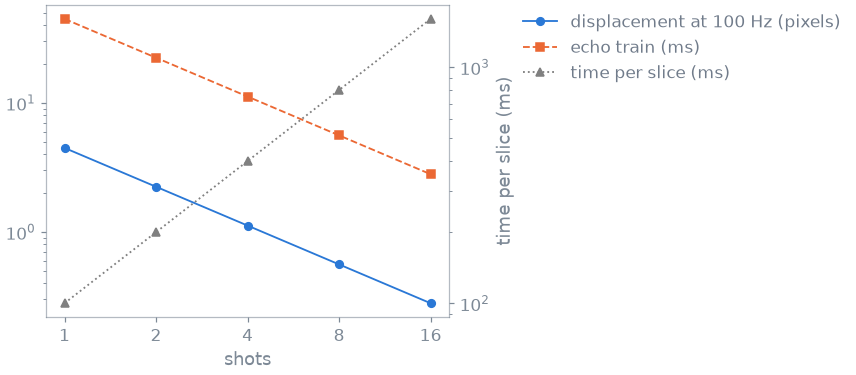
shots   echoes       train     BW per pixel   displacement   per slice
    1       64    44.80 ms          22.3 Hz        4.48 px      100 ms
    2       32    22.40 ms          44.6 Hz        2.24 px      200 ms
    4       16    11.20 ms          89.3 Hz        1.12 px      400 ms
    8        8     5.60 ms         178.6 Hz        0.56 px      800 ms
   16        4     2.80 ms         357.1 Hz        0.28 px     1600 ms
Displacement and echo train fall as the reciprocal of the shot count, and the scan time rises in proportion to it, so the segmentation is a straight exchange of time for geometric fidelity. The other terms of it are the echo spacing, which a higher receiver bandwidth shortens and which enters the displacement in the same way, and the number of lines, which the prescription fixes.
Segmentation does not address two effects. Each shot is excited separately, so any motion or phase change between them appears as an inconsistency between interleaved lines rather than as blurring within one; and the displacement it reduces is a property of the trajectory, not of the reconstruction, so an image acquired in one shot is distorted whatever is done to it afterwards.
Specification#
What this Tour built, stated the way you would ask an agent for it:
Write a segmented 2D echo planar gradient echo with pypulseqpp:
220 mm FOV, 64 matrix, 5 mm slice, 90 degree sinc excitation, TR
100 ms, 4 us dwell time, 4 shots. Each shot plays the excitation,
the readout prewinder and a phase-encode prewinder at line
(-32 + shot), then 16 readout gradients of alternating polarity.
Each echo after the first carries a make_phase_blip of 4 lines in
the block of its readout gradient. Check the timing and show from
calculate_kspace that every line is acquired once. Tabulate, for 1
to 16 shots, the echo train, the phase-encode bandwidth per pixel
S / (N * ESP), the displacement of a 100 Hz offset and the time per
slice.
Total running time of the script: (0 minutes 0.563 seconds)