

Note
Go to the end to download the full example code.
Twisting radial readout#

A radial spoke samples the centre of k-space far more densely than the periphery: at radius \(k\), adjacent spokes of an \(N\)-interleaf set are \(2\pi k / N\) apart, which exceeds the Nyquist spacing \(1/\mathrm{FOV}\) beyond a transition radius
A twisting radial line [JNM92] departs from the spoke beyond that radius and accumulates azimuth with radius, so that the perpendicular distance between neighbouring interleaves stays at the Nyquist spacing.
In this Tour you state one interleaf as a path in k-space, let the time-optimal solver turn it into a gradient waveform under the amplitude and slew limits, and wrap it in a readout module. You compare its readout duration with that of a constant-density spiral of the same coverage, and rotate the solved interleaf once per shot in a scan loop.
Prerequisites: lessons 5 and 10 of the course.
The module interface, and the events a module publishes, are described in Sequence modules and functions.
k-space path#
The interleaf is a polyline in k-space: its samples set the geometry and
nothing else. Arbitrary passes it to the
time-optimal solver, which assigns the timing under the amplitude and slew
limits and builds the gradient events, the acquisition window and the
rewinder back to k = 0. Along the radius, the azimuth advances by the amount
that keeps neighbouring interleaves one Nyquist spacing apart.
import numpy as np
from scipy.integrate import cumulative_trapezoid

import pypulseqpp as pp
from pypulseqpp import sequences


def twirl_path(fov: float, matrix: int, interleaves: int, samples: int = 2048):
    """Return the ``(samples, 2)`` k-space path of one interleaf, in 1/m."""
    radius = np.linspace(0.0, matrix / (2 * fov), samples)
    transition = interleaves / (2 * np.pi * fov)
    twisting = radius > transition
    slope = np.zeros_like(radius)
    slope[twisting] = (
        np.sqrt((2 * np.pi * fov * radius[twisting] / interleaves) ** 2 - 1.0)
        / radius[twisting]
    )
    angle = cumulative_trapezoid(slope, radius, initial=0.0)
    return np.column_stack([radius * np.cos(angle), radius * np.sin(angle)])
Interleaf#
Arbitrary stretches the readout to hold the samples it is given, so the
sample count has to match the interleaf rather than the matrix. The
time-optimal duration is not known until the path is solved, so it is solved
once with two samples to measure that duration, and once more with the number
of samples the duration holds at the requested rate.
def twirl_interleaf(
    system: pp.Opts,
    fov: float,
    matrix: int,
    interleaves: int,
    *,
    readout_bandwidth_hz: float = 250e3,
):
    """Solve one twisting radial interleaf and fill it with samples."""
    path = twirl_path(fov, matrix, interleaves)
    probe = sequences.Arbitrary(
        system, path, matrix=2, bandwidth_hz_px=readout_bandwidth_hz
    )
    samples = int(probe.read_duration * readout_bandwidth_hz)
    return sequences.Arbitrary(
        system, path, matrix=samples, bandwidth_hz_px=readout_bandwidth_hz
    )
Readout module#
NonCartesianReadout plays any two-channel
interleaf: it places the prewinder, the acquisition and the rewinder against
the pulse it is given, solves the echo time and the repetition time, and adds
the spoiler. A family that designs its own interleaf subclasses it, builds
the trajectory in init_module and forwards the rest, which is how the
shipped spiral and rosette readouts are written.
class TwirlReadout2D(sequences.NonCartesianReadout):
    """One twisting radial interleaf in a plane.

    Parameters
    ----------
    fov : float
        Isotropic in-plane field of view (m).
    matrix : int
        In-plane matrix size.
    interleaves : int
        Number of interleaves that sets the pitch and the transition
        radius. The loop may acquire any number of rotated copies.
    readout_bandwidth_hz : float, optional
        Requested ADC sampling rate (Hz).
    """

    def init_module(
        self,
        system: pp.Opts,
        rf,
        gz=None,
        gz_reph=None,
        *,
        fov: float,
        matrix: int,
        interleaves: int,
        readout_bandwidth_hz: float = 250e3,
        **kwargs,
    ) -> None:
        trajectory = twirl_interleaf(
            system,
            fov,
            matrix,
            interleaves,
            readout_bandwidth_hz=readout_bandwidth_hz,
        )
        super().init_module(system, rf, gz, gz_reph, trajectory=trajectory, **kwargs)
Readout duration against a spiral#
A constant-density spiral designed for the same interleaf count samples the same field of view at the same resolution with a longer readout: the twisting interleaf crosses the centre of k-space radially, where the spiral has to wind through it at the Nyquist pitch.
system = pp.Opts(
    max_grad=40.0,
    grad_unit="mT/m",
    max_slew=150.0,
    slew_unit="T/m/s",
    rf_dead_time=100e-6,
    rf_ringdown_time=30e-6,
    adc_dead_time=10e-6,
)

FOV = 220e-3
MATRIX = 128
INTERLEAVES = 16

interleaf = twirl_interleaf(system, FOV, MATRIX, INTERLEAVES)
spiral = sequences.Spiral(system, FOV, MATRIX, design_interleaves=INTERLEAVES)
for name, shape in (("twisting radial", interleaf), ("spiral", spiral)):
    print(
        f"{name:16} {shape.n_samples:5d} samples, readout "
        f"{shape.read_duration * 1e3:5.2f} ms, interleaf "
        f"{shape.duration * 1e3:5.2f} ms"
    )
print(
    f"transition radius {INTERLEAVES / (2 * np.pi * FOV):.1f} of "
    f"{MATRIX / (2 * FOV):.1f} 1/m"
)
twisting radial    968 samples, readout  3.88 ms, interleaf  4.60 ms
spiral            1100 samples, readout  4.42 ms, interleaf  5.04 ms
transition radius 11.6 of 290.9 1/m
Repetition#
excitation = sequences.SpatialSelectiveExcitation(
    system, flip_angle_deg=15.0, thickness_m=5e-3, duration_s=3e-3
)
readout = TwirlReadout2D(
    system,
    excitation.rf,
    excitation.gz,
    excitation.gz_reph,
    fov=FOV,
    matrix=MATRIX,
    interleaves=INTERLEAVES,
    te=None,
    tr=None,
    spoiling_cycles=4.0,
)
print("events:", ", ".join(sorted(vars(readout.events))))
print(
    f"TE {readout.echo_time * 1e3:.3f} ms over a {readout.duration * 1e3:.3f} ms "
    "repetition"
)

seq = pp.Sequence(system=system)
for block in readout.blocks:
    seq.add_block(*block)
seq.paper_plot(tr=1)
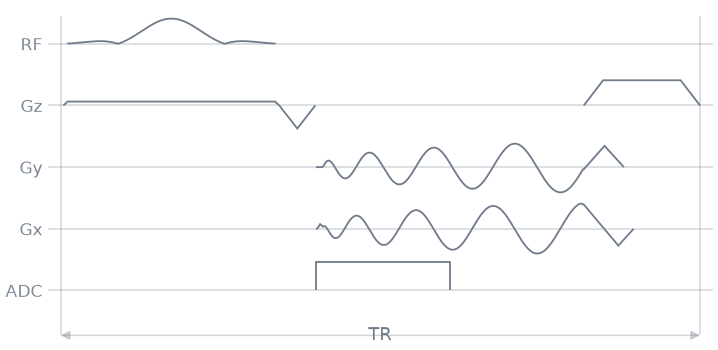
events: adc, gx, gx_rew, gy, gy_rew, gz, gz_reph, gz_spoil, rf, wait_pre, wait_rew
TE 2.080 ms over a 9.240 ms repetition
Scan loop#
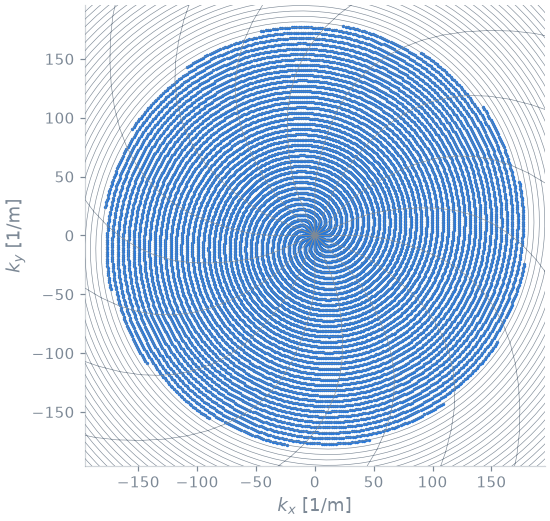
One solved interleaf is turned per shot by a rotation extension, which the loop adds to every block that drives an in-plane gradient. The interleaf is designed once and stored once; only the rotation changes from shot to shot.
angles = 2 * np.pi * np.arange(INTERLEAVES) / INTERLEAVES
rotations = [pp.make_rotation(float(angle)) for angle in angles]

scan = pp.Sequence(system=system)
for shot, rotation in enumerate(rotations):
    scan.add_block(excitation.rf, excitation.gz, pp.make_label("LIN", "SET", shot))
    for block in readout.blocks[1:]:
        events = list(block)
        if any(getattr(event, "channel", None) in ("x", "y") for event in events):
            events.append(rotation)
        scan.add_block(*events)

print(
    f"{scan.num_blocks} blocks, {scan.duration()[0] * 1e3:.1f} ms, "
    f"timing {scan.check_timing()[0]}"
)
64 blocks, 147.8 ms, timing True
The interleaves the loop acquired.
pp.plot.plot_kspace(scan, plane="xy")
References#
Jackson JI, Nishimura DG, Macovski A. Twisting radial lines with application to robust magnetic resonance imaging of irregular flow. Magnetic Resonance in Medicine. 1992;28(2):251-263. https://doi.org/10.1002/mrm.1910280209
Specification#
What this Tour built, stated the way you would ask an agent for it:
Write a pypulseqpp readout module TwirlReadout2D, a subclass of
sequences.NonCartesianReadout, for a 220 mm FOV, a 128 matrix and
16 interleaves. The interleaf is a twisting radial line: radial up
to the transition radius N/(2 pi FOV), then azimuth advancing so
that neighbouring interleaves stay 1/FOV apart. Solve the path
with sequences.Arbitrary at 250 kHz, once to measure the duration
and once with the sample count it holds. Compare its readout
duration with sequences.Spiral for the same interleaf count on
40 mT/m and 150 T/m/s. Play 16 shots after a 15 degree, 5 mm
slice excitation, turning the interleaf with make_rotation on
every block that drives x or y, label LIN, check the timing and
plot the k-space trajectory.
Total running time of the script: (0 minutes 0.287 seconds)