

Note
Go to the end to download the full example code.
10. Custom sequence module#

The shipped modules cover the common parts of a sequence, but sooner or later you need one that is not there. A module is a small class, and writing one is the same work as designing its events by hand, done once and given a name.
In this lesson you write a T2 preparation: a train of pulses that tips the
magnetisation into the transverse plane, lets it decay with T2 for a set
echo time, and stores what is left back along z. Played in place of the
inversion, it turns your MPRAGE from T1- into T2-weighted. Then you compare
your module with the shipped
T2Preparation, and see why that one is built
from adiabatic pulses.
Learning objectives
Subclass
RfModuleand implementinit_module: buildself.seqand setself.center.Time a train of pulses by their centres, on the block raster.
Swap a preparation in your sequence function without touching its loop.
Simulate how a preparation responds to errors in the transmit field and the resonance frequency.
Previous: 9. Sequence modules. This is the last lesson of the course; the Tours and the Sequence catalogue catalogue go further from here.
T2 preparation#
The simplest robust T2 preparation is four hard pulses:
a 90° pulse about x tips the magnetisation into the transverse plane;
two 180° pulses about y, a quarter and three quarters of the way through the echo time, refocus it twice, so off-resonance during the train cancels and the errors of the two pulses largely cancel too;
a 90° pulse about -x, at the echo time, stores it back along +z;
a crusher dephases whatever the pulses left in the transverse plane.
The echo time is measured from the centre of the first pulse to the centre of the last. The magnetisation comes back along z scaled by \(e^{-\mathrm{TE}/T_2}\), and the next excitation reads that.
Module class#
A module subclasses SequenceModule, or
RfModule when it plays RF, and implements
one method, init_module. Its parameters are the module’s parameters,
after system. It assigns self.seq, adds its blocks to it, and sets
self.center, the instant the rest of the sequence is timed against:
here the centre of the storing pulse, when the preparation is complete. The
local variables that hold events, the pulses, the waits and the crusher,
are published on the module under their own names.
import numpy as np

import pypulseqpp as pp
from pypulseqpp import sequences


class HardT2Preparation(sequences.RfModule):
    """T2 preparation of hard pulses: 90 x, 180 y, 180 y, 90 -x, crusher.

    Parameters
    ----------
    system : pypulseqpp.Opts
        System limits.
    echo_time_s : float
        Preparation echo time (s), from the first pulse centre to the last.
    pulse_duration_s : float, default=0.5e-3
        Duration of a 90 degree pulse (s); a 180 is twice as long.
    voxel_size_m : float, default=1e-3
        Length the crusher dephases four cycles over (m).
    """

    def init_module(
        self, system, echo_time_s, *, pulse_duration_s=0.5e-3, voxel_size_m=1e-3
    ):
        tip_down = pp.make_block_pulse(
            np.pi / 2,
            duration=pulse_duration_s,
            delay=system.rf_dead_time,
            use="preparation",
            system=system,
        )
        refocus = pp.make_block_pulse(
            np.pi,
            duration=2 * pulse_duration_s,
            phase_offset=np.pi / 2,
            delay=system.rf_dead_time,
            use="refocusing",
            system=system,
        )
        tip_up = pp.make_block_pulse(
            np.pi / 2,
            duration=pulse_duration_s,
            phase_offset=np.pi,
            delay=system.rf_dead_time,
            use="preparation",
            system=system,
        )
        gz_spoil = pp.make_crusher(4.0, voxel_size_m, channel="z", system=system)[0]

        # Each pulse's centre from the start of its block, and the time from
        # its centre to the end of the block.
        def centre(rf):
            return rf.delay + pp.calc_rf_center(rf)[0]

        def tail(rf):
            return pp.calc_duration(rf) - centre(rf)

        raster = system.block_duration_raster
        quarter = echo_time_s / 4
        wait_first = pp.make_delay(
            pp.round_to_raster(quarter - tail(tip_down) - centre(refocus), raster)
        )
        wait_inner = pp.make_delay(
            pp.round_to_raster(2 * quarter - tail(refocus) - centre(refocus), raster)
        )
        wait_last = pp.make_delay(
            pp.round_to_raster(quarter - tail(refocus) - centre(tip_up), raster)
        )

        self.seq = pp.Sequence(system)
        self.seq.add_block(tip_down)
        self.seq.add_block(wait_first)
        self.seq.add_block(refocus)
        self.seq.add_block(wait_inner)
        self.seq.add_block(refocus)
        self.seq.add_block(wait_last)
        self.seq.add_block(tip_up)
        self.seq.add_block(gz_spoil)

        storing = self.seq.duration()[0] - pp.calc_duration(gz_spoil) - tail(tip_up)
        self.center = storing
        self.echo_time = storing - centre(tip_down)
Your module is constructed like a shipped one, and reports the same things:
preparation = HardT2Preparation(
    pp.Opts(rf_dead_time=100e-6, rf_ringdown_time=20e-6), 50e-3, voxel_size_m=5e-3
)
print(
    f"echo time {1e3 * preparation.echo_time:.2f} ms, "
    f"duration {1e3 * preparation.duration:.2f} ms, "
    f"events: {', '.join(sorted(vars(preparation.events)))}"
)
preparation.paper_plot()
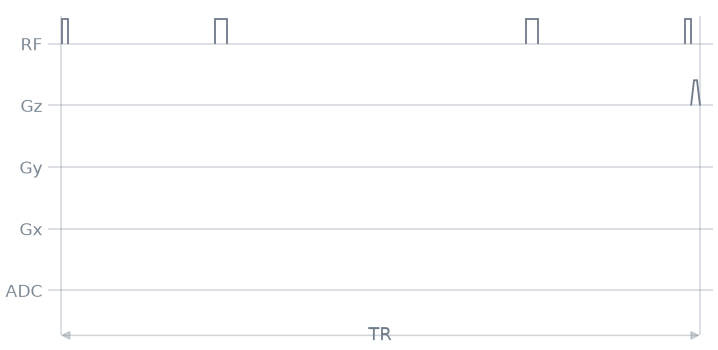
echo time 50.02 ms, duration 51.36 ms, events: gz_spoil, refocus, tip_down, tip_up, wait_first, wait_inner, wait_last
Interchangeable preparations#
Your sequence function of lesson 9 played the inversion as
for block in inversion.blocks, and placed the first excitation from
the inversion’s center. Neither cares what the preparation is. Add a
preparation parameter that chooses the module, and the loop stays as
it was. ti becomes the delay from the preparation’s centre to the first
excitation: the inversion time for the inversion, and a short gap for the
T2 preparation.
GOLDEN_ANGLE = np.pi * (3 - np.sqrt(5)) / 2


def prepared_radial(
    system: pp.Opts,
    *,
    preparation: str = "inversion",
    t2_prep_te: float = 50e-3,
    fov: float = 220e-3,
    matrix: int = 128,
    partitions: int = 16,
    partition_thickness: float = 5e-3,
    spokes_per_train: int = 64,
    flip_angle_deg: float = 8.0,
    ti: float = 900e-3,
    tr: float = 2.5,
) -> pp.Sequence:
    """3D radial gradient echo on a stack of stars, one partition per preparation.

    Parameters
    ----------
    preparation : {'inversion', 't2'}, default='inversion'
        An adiabatic inversion, or a hard-pulse T2 preparation.
    t2_prep_te : float, default=0.05
        Echo time of the T2 preparation (s).
    fov : float, default=0.22
        In-plane field of view (m).
    matrix : int, default=128
        In-plane matrix size.
    partitions : int, default=16
        Number of partitions.
    partition_thickness : float, default=0.005
        Thickness of one partition (m).
    spokes_per_train : int, default=64
        Golden-angle spokes played after each preparation.
    flip_angle_deg : float, default=8.0
        Readout flip angle (degrees).
    ti : float, default=0.9
        Time from the preparation's centre to the first excitation (s).
    tr : float, default=2.5
        Time between two preparations (s).

    Raises
    ------
    ValueError
        If ``preparation`` is unknown, or the train does not fit between
        ``ti`` and the next preparation.
    """
    slab = partitions * partition_thickness
    if preparation == "inversion":
        prep = sequences.InversionPreparation(system, voxel_size_m=partition_thickness)
    elif preparation == "t2":
        prep = HardT2Preparation(system, t2_prep_te, voxel_size_m=partition_thickness)
    else:
        raise ValueError(
            f"preparation must be 'inversion' or 't2', got {preparation!r}"
        )
    excitation = sequences.SpatialSelectiveExcitation(
        system, flip_angle_deg, slab, duration_s=1e-3, is_slab=True
    )
    readout = sequences.RadialStackReadout(
        system,
        excitation.rf,
        excitation.gz,
        fov=fov,
        matrix=matrix,
        fov_z=slab,
        matrix_z=partitions,
        readout_bandwidth_hz=100e3,
        spoiling_cycles=4.0,
    )
    pulse, _, read, _ = readout.blocks

    steps = (np.arange(partitions) - partitions // 2) / (partitions / 2)
    gz_encode = [pp.scale_grad(readout.gz_pre, step) for step in steps]
    gz_rewind = [pp.scale_grad(readout.gz_rew, step) for step in steps]

    raster = system.block_duration_raster
    ti_wait = pp.round_to_raster(
        ti - (prep.duration - prep.center) - excitation.center, raster
    )
    if ti_wait < raster:
        raise ValueError(f"TI of {1e3 * ti:.1f} ms is shorter than the preparation")
    played = prep.duration + ti_wait + spokes_per_train * readout.duration
    recovery = pp.round_to_raster(tr - played, raster)
    if recovery < raster:
        raise ValueError(
            f"TR of {1e3 * tr:.0f} ms is shorter than the "
            f"{1e3 * (played + raster):.0f} ms one preparation takes"
        )
    wait_ti, wait_recovery = pp.make_delay(ti_wait), pp.make_delay(recovery)

    angles = (np.arange(partitions * spokes_per_train) * GOLDEN_ANGLE) % np.pi
    rotations = [pp.make_rotation(angle) for angle in angles]
    phases = pp.make_rf_spoiling_schedule(
        partitions * spokes_per_train, increment=np.deg2rad(117.0)
    )

    seq = pp.Sequence(system)
    labels = sequences.Labels()
    n = 0
    for partition in range(partitions):
        for block in prep.blocks:
            seq.add_block(*block)
        seq.add_block(wait_ti)
        for spoke in range(spokes_per_train):
            readout.rf.phase_offset = readout.adc.phase_offset = phases[n]
            seq.add_block(*pulse, *labels(LIN=spoke, PAR=partition))
            seq.add_block(gz_encode[partition])
            seq.add_block(*read, rotations[n])
            seq.add_block(gz_rewind[partition], readout.gz_spoil)
            n += 1
        seq.add_block(wait_recovery)

    seq.set_definition("Name", f"radial_{preparation}")
    seq.set_definition("FOV", [fov, fov, slab])
    seq.set_definition("Matrix", [matrix, matrix, partitions])
    seq.set_definition("TR", tr)
    return seq
The same function now plays either scan:
system = pp.Opts(
    max_grad=32.0,
    grad_unit="mT/m",
    max_slew=130.0,
    slew_unit="T/m/s",
    rf_dead_time=100e-6,
    rf_ringdown_time=20e-6,
    adc_dead_time=10e-6,
)
mprage = prepared_radial(system)
t2_prepared = prepared_radial(system, preparation="t2", ti=20e-3)
for name, seq in [("inversion", mprage), ("T2 preparation", t2_prepared)]:
    ok, errors = seq.check_timing()
    print(f"{name:15} timing ok: {ok}, scan time {seq.duration()[0]:.1f} s")

t2_prepared.paper_plot(time_range=(0, 0.12))
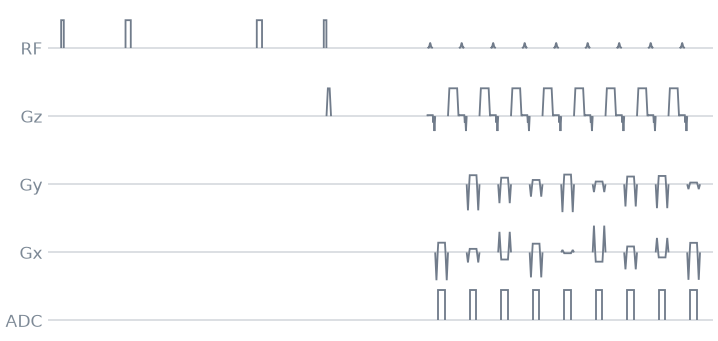
inversion       timing ok: True, scan time 40.0 s
T2 preparation  timing ok: True, scan time 40.0 s
After the preparation, each tissue starts the train with what survived the echo time, \(e^{-\mathrm{TE}/T_2}\), and the contrast is the reverse of the MPRAGE’s: CSF, with its long T2, is the brightest.
white matter  T2     70 ms, Mz after preparation 0.49
grey matter   T2    100 ms, Mz after preparation 0.61
CSF           T2   2000 ms, Mz after preparation 0.98
Sensitivity to B1 and off-resonance#
A preparation is played before every train, across the whole head, where
the transmit field \(B_1\) varies by tens of per cent and the resonance
frequency by tens to hundreds of hertz. Without relaxation, an ideal
preparation returns the magnetisation to \(M_z = 1\) whatever the field.
The figure below simulates the RF of your module, and of the shipped
T2Preparation, over a range of both errors
with sim_bloch():
shipped = sequences.T2Preparation(system, 50e-3, voxel_size_m=5e-3)
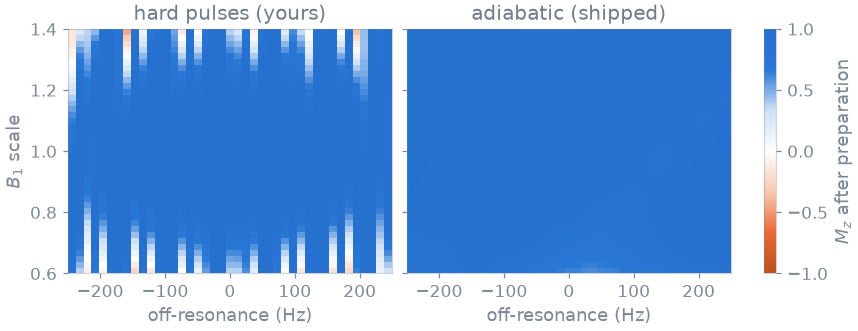
On resonance your hard-pulse train is robust to \(B_1\): the second 180° pulse undoes most of the error of the first. Off resonance, the refocusing is imperfect, the magnetisation it leaves behind precesses during the long waits, and the stored \(M_z\) oscillates with the frequency, with a period of \(2/\mathrm{TE} = 40\) Hz. The shipped preparation replaces the 90° pulses by adiabatic half passages and the 180° pulses by adiabatic full passages, whose rotation depends little on the field above a threshold, and it stays close to one over most of the range. The two modules share their structure and differ only in the pulses.
Further reading#
The Sequence catalogue catalogue is a set of sequence functions written as in lessons 8 and 9, and the Tours treat individual topics in more depth.
Specification#
What this lesson built, stated the way you would ask an agent for it:
Write a pypulseqpp RfModule HardT2Preparation(system, echo_time_s,
pulse_duration_s=0.5e-3, voxel_size_m=1e-3): block pulses 90 x,
180 y, 180 y, 90 -x with the 180s at TE/4 and 3TE/4 (centre to
centre, waits on the block raster), then a 4-cycle z crusher; center
is the storing pulse's centre. Add a preparation parameter
{'inversion', 't2'} to the lesson-9 radial MPRAGE function that picks
InversionPreparation or this module, and compare the stored Mz of
this module and the shipped T2Preparation over B1 0.6-1.4 and
+-250 Hz with sim_bloch.
Total running time of the script: (0 minutes 1.441 seconds)