

InversionPreparation#
- class pypulseqpp.sequences.InversionPreparation[source]#
Bases:
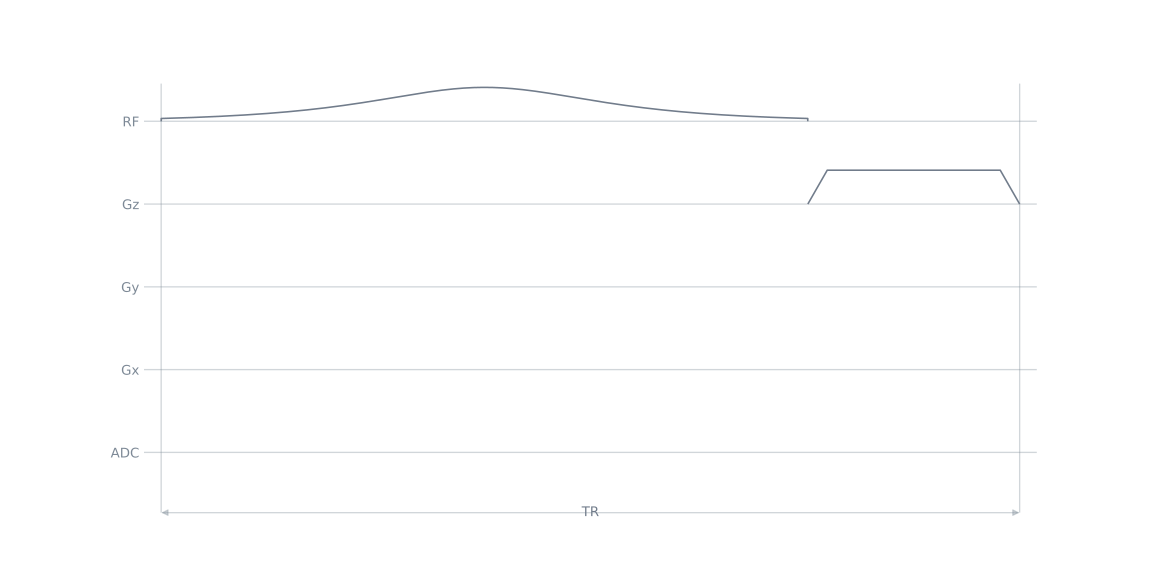
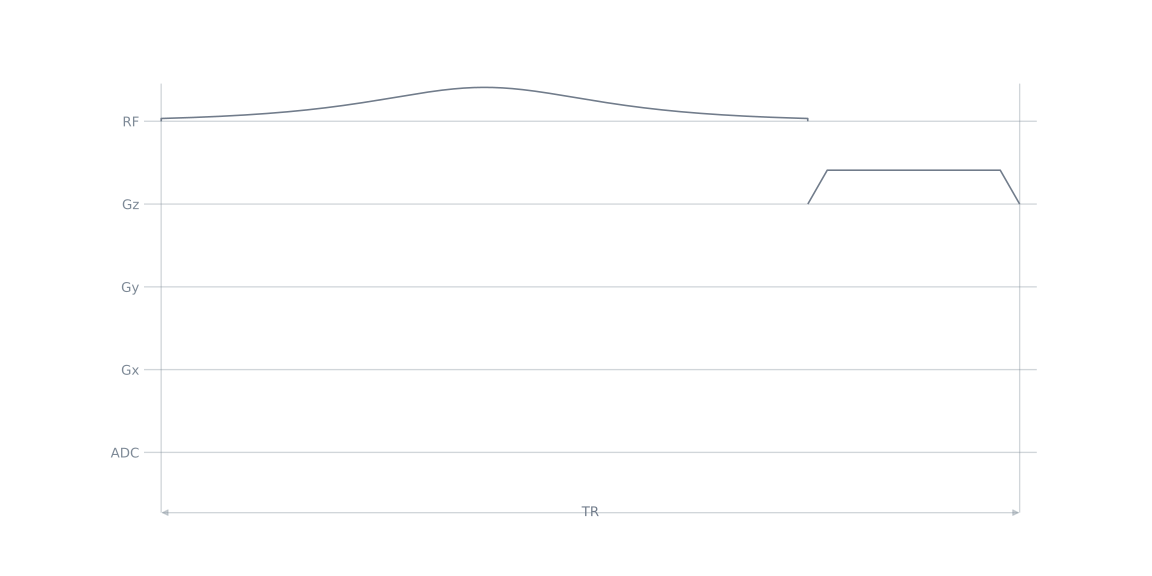
RfModuleNon-selective adiabatic inversion, followed by an optional crusher.
The module contains no inversion-time delay; the caller adds it. A pulse whose peak exceeds
MAX_B1_DERATEofsystem.max_b1is lengthened at the same adiabaticity and swept bandwidth, up toADIABATIC_MAX_STRETCH(2) timesduration_s, and past it held there with its adiabaticity lowered, to no less thanADIABATICITY_FLOOR(0.75) ofadiabaticity.- Parameters:
system (pypulseqpp.Opts) – System limits.
duration_s (float, default=0.01) – Inversion pulse duration (s) while the pulse fits the system’s peak B1; a shorter pulse needs a faster sweep, which may violate the adiabatic condition.
spoiling_cycles (float, default=4.0) – Cycles of dephasing of the crusher across
voxel_size_m. Zero omits the crusher.voxel_size_m (float, default=0.001) – Length the dephasing is counted over (m); the smallest voxel dimension.
axis ({'z', 'x', 'y'}, default='z') – Gradient channel of the crusher.
pulse_type (str, default='hypsec') – Adiabatic sweep family.
bandwidth_hz (float, default=40000.0) – Frequency width of the sweep (Hz); unused by
'hypsec', which sweepsmu * beta(make_adiabatic_pulse()).adiabaticity (float, default=4) – Sweep-rate margin over the adiabatic condition while the pulse fits the system’s peak B1.
labels (sequence of str, default=None) – Labels the inversion block sets to 0, to be changed per shot by the caller.
- Attributes:
rf_prep (RfEvent) – The inversion pulse.
pulse_duration (float) – Duration the pulse was designed at (s):
duration_s, or longer under the system’s peak B1.adiabaticity (float) – Adiabaticity the pulse was designed at: the requested one, or lower under the system’s peak B1.
gz_spoil (GradEvent) – The crusher, when
spoiling_cyclesis nonzero.prep_labels (LabelSetEvent or list of LabelSetEvent) – One per name in
labels, in order. Absent whenlabelsis empty, and a bare event rather than a list when there is one.
- Raises:
ValueError – If
voxel_size_mis not positive,spoiling_cyclesis negative,axisis not a gradient channel, or the pulse cannot fit the system’s peak B1.
Examples
>>> import pypulseqpp.sequences as design
>>> import pypulseqpp as pp
>>> prep = design.InversionPreparation(pp.Opts(), duration_s=8e-3)
>>> len(prep.blocks)
2
>>> len(design.InversionPreparation(pp.Opts(), spoiling_cycles=0).blocks)
1
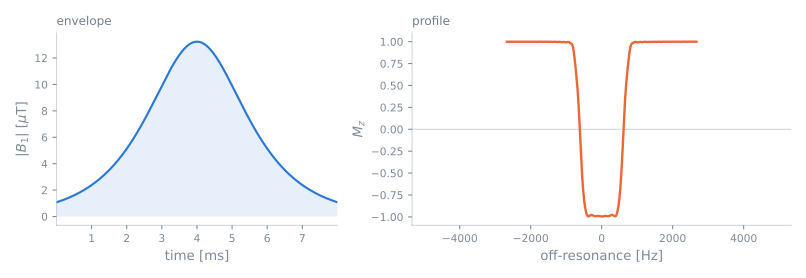
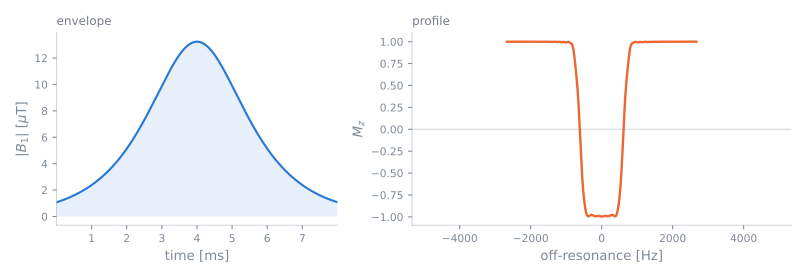
Under an 11.2 uT limit the 13.2 uT pulse is lengthened, at the same adiabaticity, to peak below 0.9 of it:
>>> prep = design.InversionPreparation(pp.Opts(max_b1=11.2))
>>> round(prep.pulse_duration * 1e3, 2), prep.adiabaticity
(17.26, 4)
Methods
Build the module's block layout; implemented by the subclass. |
|
Publish events from the caller's locals and register keyword aliases. |
|
Publish named events, whether or not they were added to a block. |
|
Simulate this module's pulse across off-resonance. |
Attributes