
Note
Go to the end to download the full example code.
2D radial gradient echo#

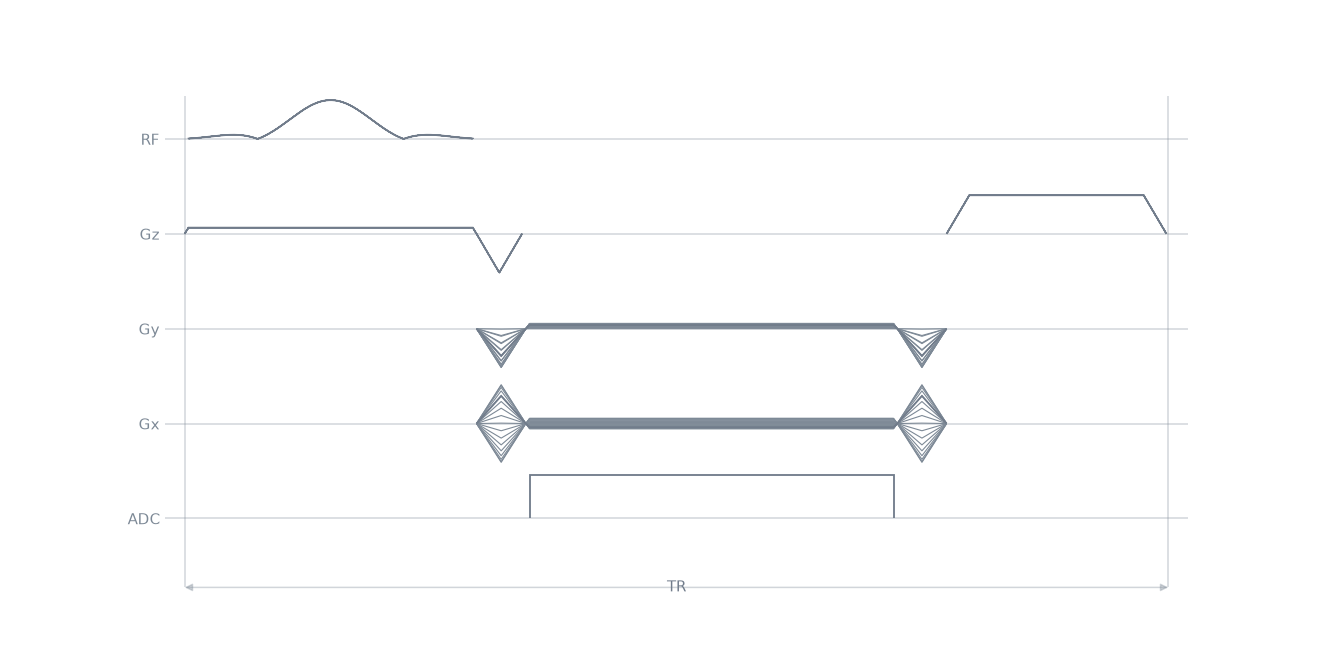
A spoiled low-flip-angle excitation is followed by one radial spoke through k-space centre. Gradient and RF spoiling suppress residual transverse coherence before the next TR. TR and flip angle primarily determine T1 weighting, with T2* decay during TE. Radial SPGR is used for motion-robust dynamic and structural imaging.
Nyquist angular sampling#
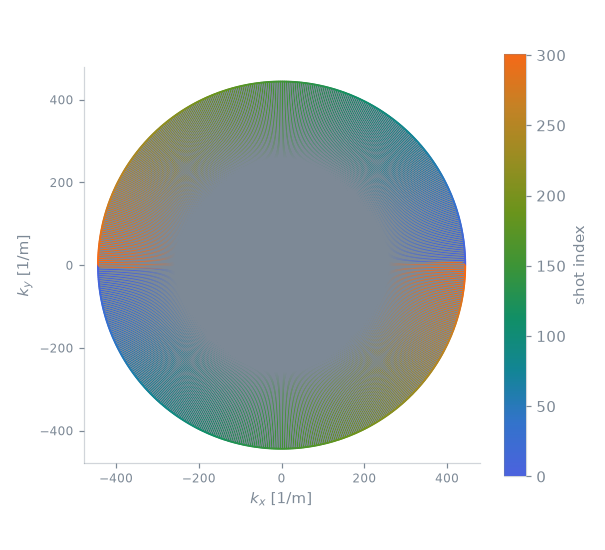
ceil(pi / 2 * n) spokes over half a turn, which sample the outer
radius at the Nyquist spacing.
import pypulseqpp as pp
from pypulseqpp.sequences import gre_radial2D_sequence

baseline = gre_radial2D_sequence(n=192, n_slices=1, te=None, tr=None, n_dummy=0)
print(f"{baseline.num_blocks} blocks, {baseline.duration()[0]:.2f} s")
1208 blocks, 3.13 s
Sequence diagram#
Sampling order#
Colour encodes spoke acquisition order. Consecutive spokes use a distributed angular ordering rather than adjacent angles.
pp.plot.plot_kspace(baseline, color_by="shot", plane="xy")
Angular undersampling#
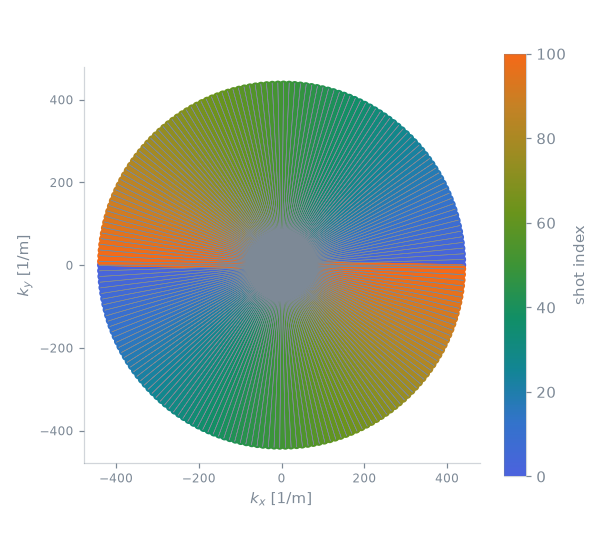
ry=3 retains one third of the spoke angles. Every spoke crosses the
origin, whereas angular sampling density decreases with k-space radius.
alternative = gre_radial2D_sequence(
    n=192, n_slices=1, ry=3, te=None, tr=None, n_dummy=0
)
                   blocks  duration (s)  acquisitions
Nyquist              1208          3.13           302
ry = 3                404          1.05           101
pp.plot.plot_kspace(alternative, color_by="shot", plane="xy")
Total running time of the script: (0 minutes 2.690 seconds)