
Note
Go to the end to download the full example code.
2D echo-planar imaging#

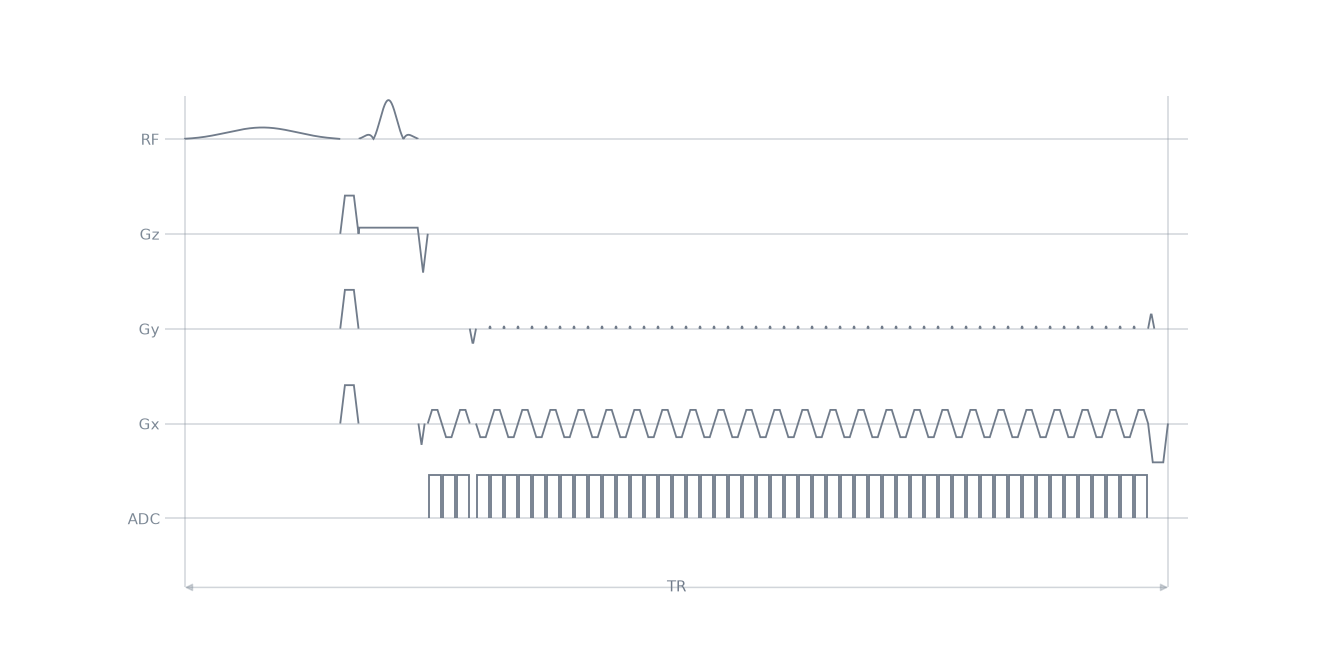
A slice-selective excitation is followed by alternating readout gradients and phase-encode blips that acquire multiple Cartesian lines in one echo train. Spoilers suppress residual transverse coherence between repetitions. Off-resonance phase accumulates during the train and produces geometric distortion along the phase-encode axis. EPI supports rapid structural imaging and functional MRI.
Single-shot acquisition#
Every phase-encode line is acquired after one excitation. Echo-train length equals the number of acquired lines and determines the accumulated off-resonance phase across k-space.
from pypulseqpp.sequences import epi2D_sequence

diagram = epi2D_sequence(
    n_x=64,
    n_y=48,
    n_slices=1,
    n_shots=1,
    n_dummy=0,
    fat_saturation=True,
    tr=None,
)
single = epi2D_sequence(n_x=96, n_y=96, n_slices=1, n_shots=1, n_dummy=0)
print(
    f"{diagram.num_blocks} blocks, {diagram.duration()[0] * 1e3:.1f} ms, "
    f"TE {diagram.get_definition('TE')[0] * 1e3:.2f} ms"
)
58 blocks, 50.6 ms, TE 22.14 ms
Sequence diagram#
Segmentation and in-plane acceleration#
Segmentation and in-plane acceleration both reduce echo-train length.
n_shots interleaves the lines over several excitations, so every line is
still acquired. ry skips lines within one excitation and requires a
parallel-imaging reconstruction for the omitted lines. Off-resonance
\(\Delta f\) adds a phase of \(2\pi \Delta f\, \mathrm{esp}\)
per echo spacing \(\mathrm{esp}\). This phase is linear in \(k_y\)
and displaces the image along the phase-encode axis by
\(\Delta f \cdot \mathrm{esp} \cdot N_\mathrm{etl}\) pixels, where
\(N_\mathrm{etl}\) is the echo-train length. Both segmentation and
acceleration reduce \(N_\mathrm{etl}\) and therefore the displacement.
segmented = epi2D_sequence(n_x=96, n_y=96, n_slices=1, n_shots=3, n_dummy=0)
accelerated = epi2D_sequence(n_x=96, n_y=96, n_slices=1, ry=3, n_dummy=0, n_acs_y=0)

designs = {"1 shot": single, "3 shots": segmented, "ry = 3": accelerated}
            echoes  trains  per train   TE (ms)  scan (ms)  px per Hz
1 shot          96       1       96.0     55.94      108.3      0.100
3 shots         96       3       32.0     23.46      131.6      0.035
ry = 3          32       1       32.0     23.44       43.1      0.035
Echo traversal#
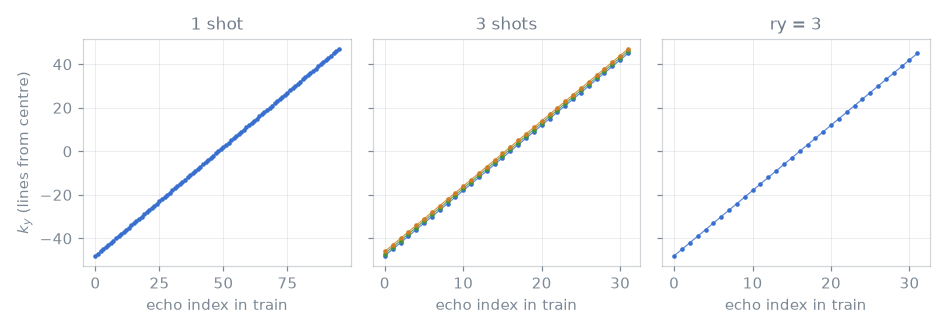
The ordinate gives the phase-encode line acquired at each echo index. A
single shot traverses the axis one line at a time. A segmented acquisition
traverses it in steps of n_shots, each shot starting one line further
on. An accelerated acquisition traverses it once in steps of ry.
Which lines are acquired#
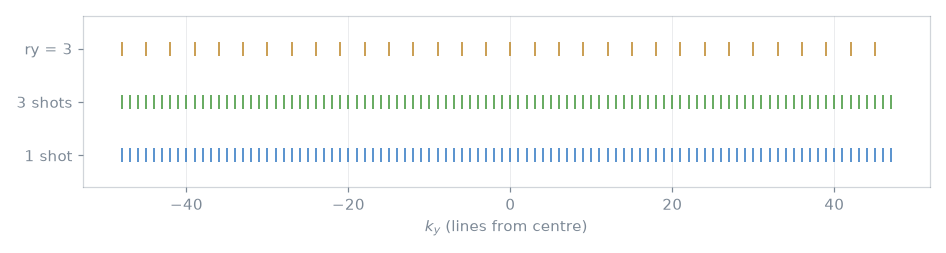
Segmentation and acceleration produce the same train length from different sets of lines: the segmented acquisition acquires every line, the accelerated acquisition one line in three.
Functional MRI time series#
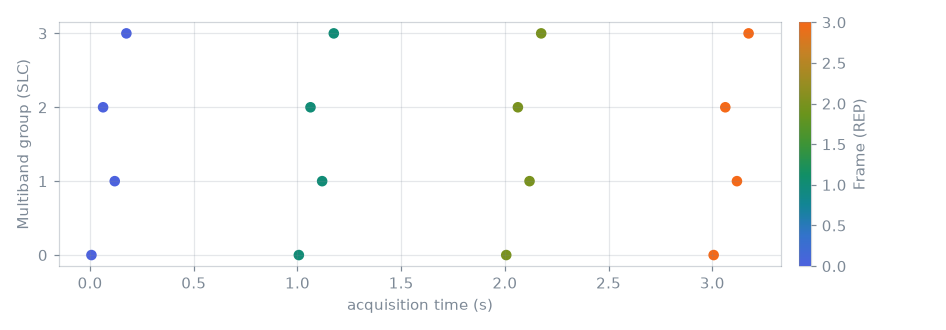
Repeated frames form an fMRI time series. The acquisition below uses eight
slices in four multiband groups. REP identifies the volume and SLC
identifies the group; acquisition times are the start times of the ADC
blocks in the sequence.
fmri = epi2D_sequence(
    n_x=64,
    n_y=64,
    n_slices=8,
    multiband=2,
    n_frames=4,
    n_shots=1,
    n_dummy=0,
    fat_saturation=False,
    tr=1.0,
)
labels = fmri.evaluate_labels(evolution="adc")
Total running time of the script: (0 minutes 0.832 seconds)