

BlochSiegertPreparation#
- class pypulseqpp.sequences.BlochSiegertPreparation[source]#
Bases:
OffResonanceSaturationOff-resonance Fermi pulse for Bloch-Siegert B1 mapping.
No spoiler is played by default, which preserves the transverse phase between excitation and readout. The pulse shifts the phase by an amount proportional to the squared B1, reported by
kbsandkbs_per_gauss2.- Parameters:
system (pypulseqpp.Opts) – System limits.
freq_offset_hz (float, default=4000.0) – Offset from water (Hz); flip its sign for the second acquisition.
duration_s (float, default=0.008) – Pulse duration (s).
peak_b1_hz (float, default=500.0) – Plateau amplitude (Hz).
flat_fraction (float, default=0.8) – Fraction of the duration held at
peak_b1_hz, in(0, 1).transition_fraction (float, default=0.02) – Width parameter of each shoulder, as a fraction of the duration.
dwell_s (float, default=1e-05) – RF raster (s).
spoiling_cycles (float, default=0.0) – Cycles of dephasing of the closing spoiler across
voxel_size_m. Zero omits the spoiler.n_pulses (int, default=1) – Pulses in the train.
voxel_size_m (float, default=0.001) – Length the dephasing is counted over (m).
labels (sequence of str, default=None) – Labels set to 0 on the first pulse’s block, to be changed per shot by the caller.
- Attributes:
rf_prep (RfEvent) – The Fermi pulse.
gx_spoil, gy_spoil, gz_spoil (GradEvent) – Spoiler gradient of each axis; absent when
spoiling_cyclesis zero.prep_labels (LabelSetEvent or list of LabelSetEvent) – One per name in
labels.kbs (float) – Bloch-Siegert phase shift (rad) of the pulse at
peak_b1_hz.kbs_per_gauss2 (float) – Bloch-Siegert phase shift per squared peak B1 (rad/G^2); independent of
peak_b1_hz.
- Raises:
ValueError – If
freq_offset_hzis zero,duration_s,peak_b1_hzordwell_sis not positive, or an envelope fraction is out of range. Ifn_pulsesis below one, or a spoiling argument is out of range.
References
Sacolick et al., B1 mapping by Bloch-Siegert shift, Magn Reson Med 2010;63:1315-1322,
10.1002/mrm.22357.Examples
>>> import pypulseqpp.sequences as design
>>> import pypulseqpp as pp
>>> pulse = design.BlochSiegertPreparation(pp.Opts())
>>> len(pulse.blocks), round(pulse.kbs_per_gauss2, 1)
(1, 86.6)
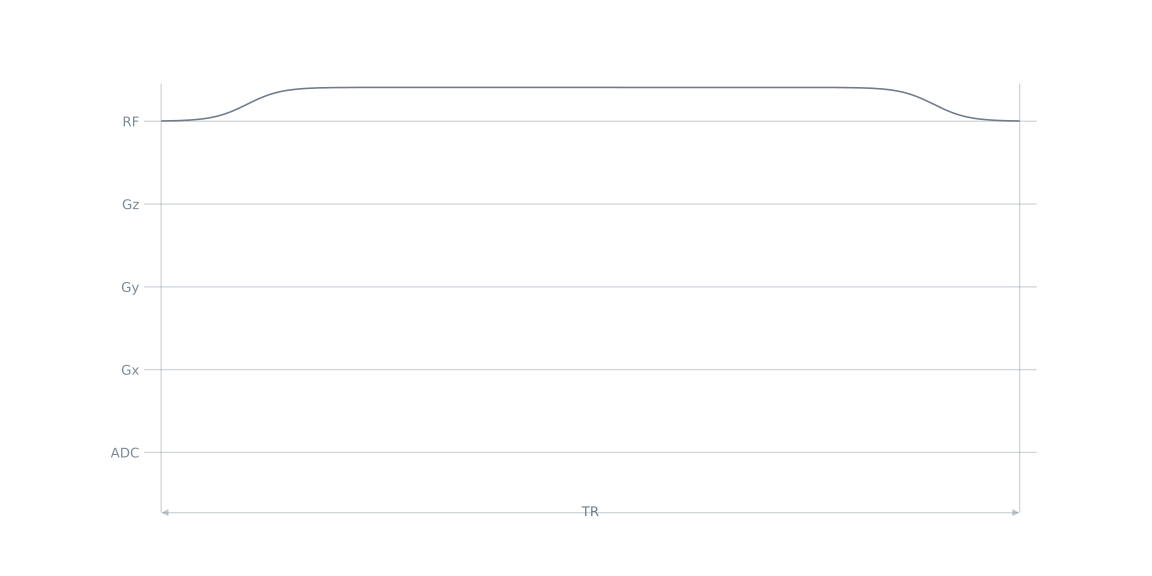
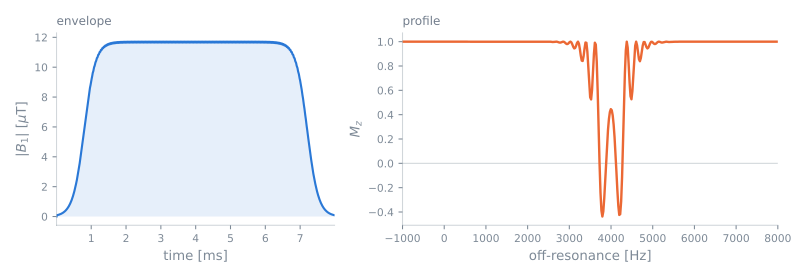
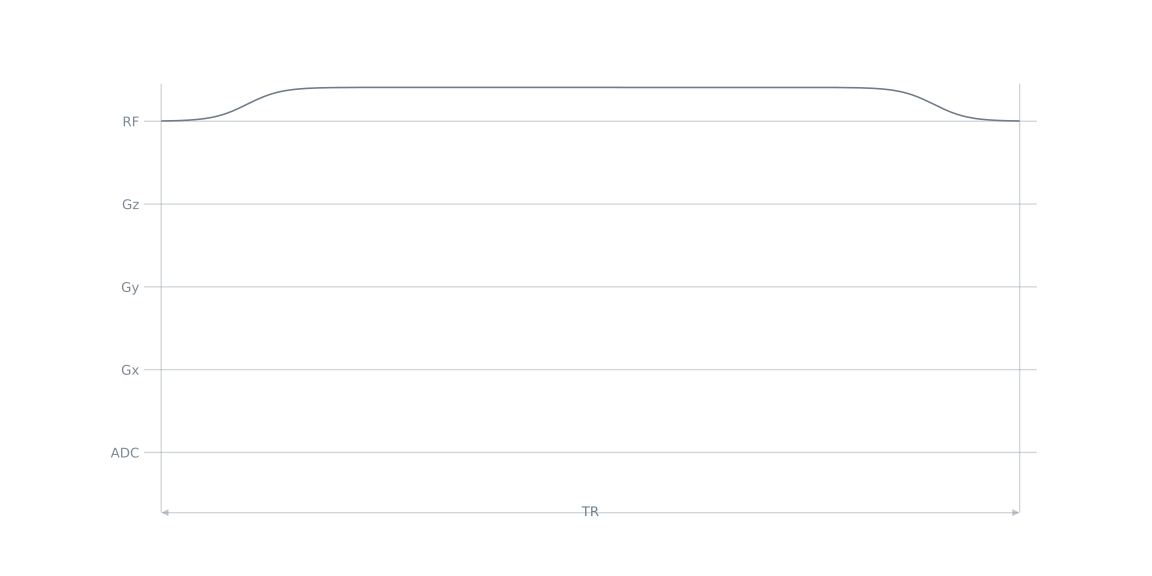
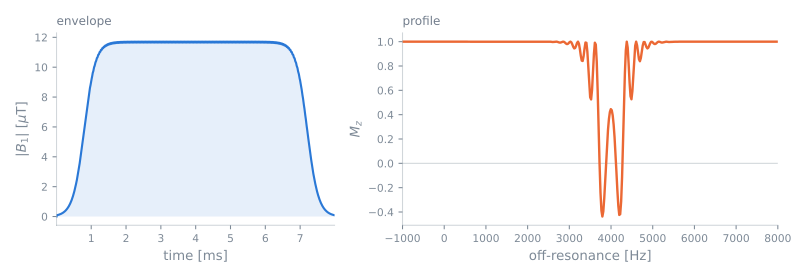
The pulse is placed far enough off resonance to produce a phase shift with a small flip angle; the residual dip at its offset is the saturation that remains at that frequency offset:
Methods
Build the module's block layout; implemented by the subclass. |
|
Publish events from the caller's locals and register keyword aliases. |
|
Publish named events, whether or not they were added to a block. |
|
Simulate this module's pulse across off-resonance. |
Attributes