
LineReadout2D#
- class pypulseqpp.sequences.LineReadout2D[source]#
Bases:
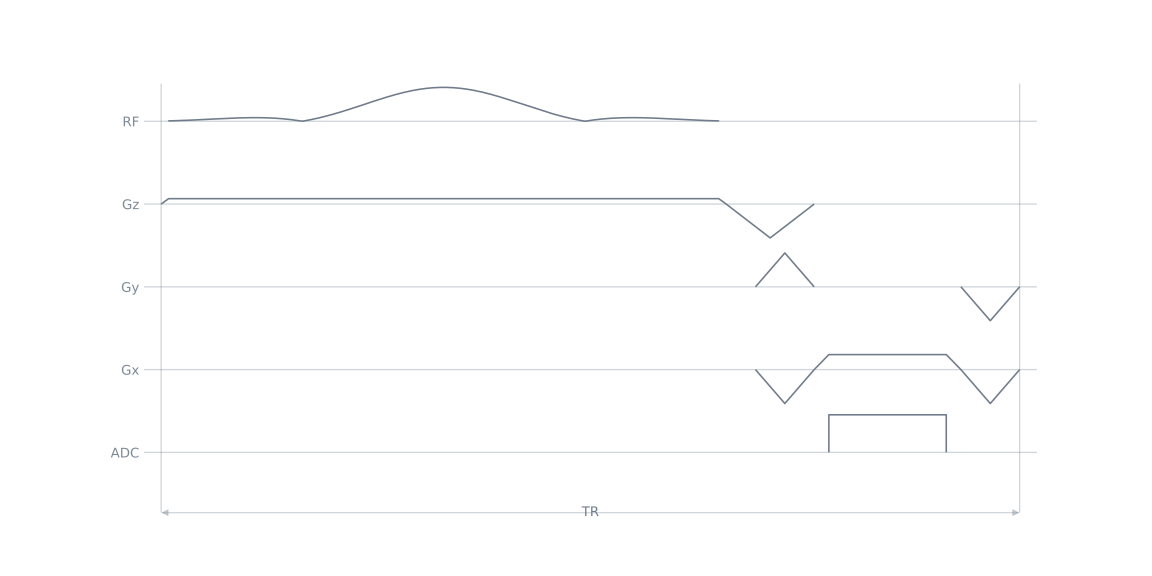
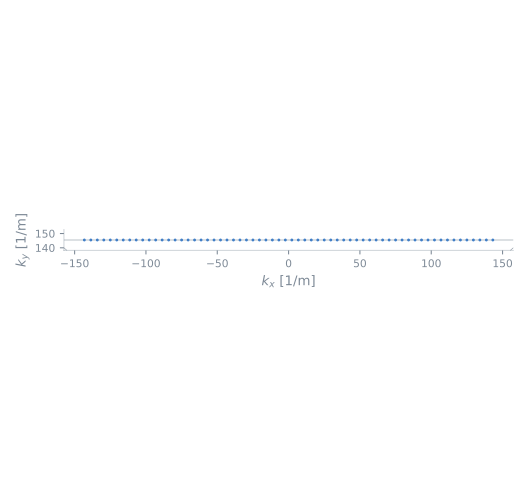
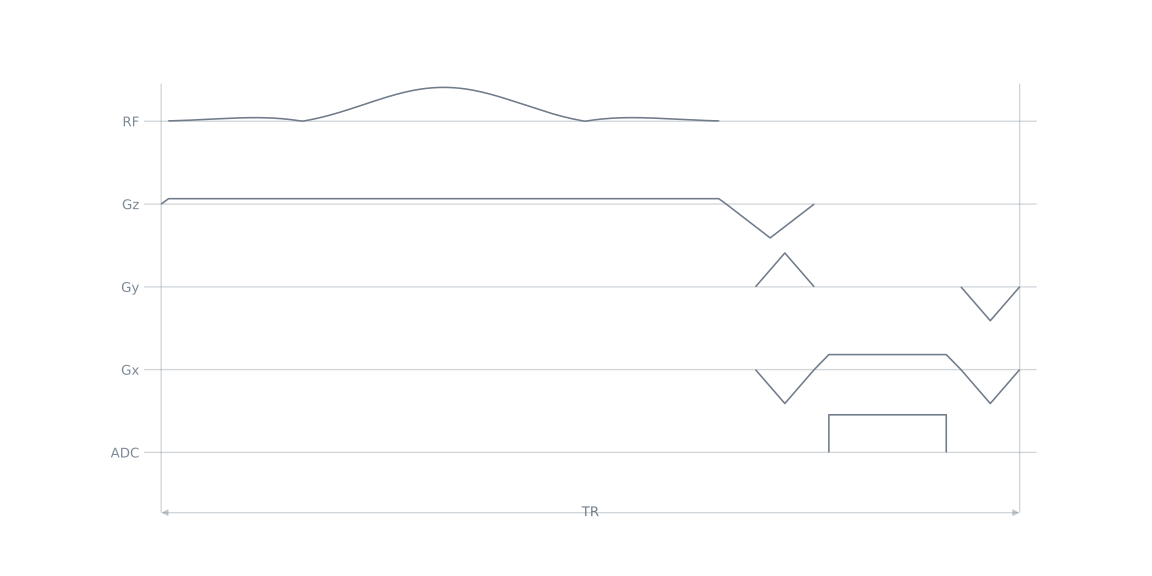
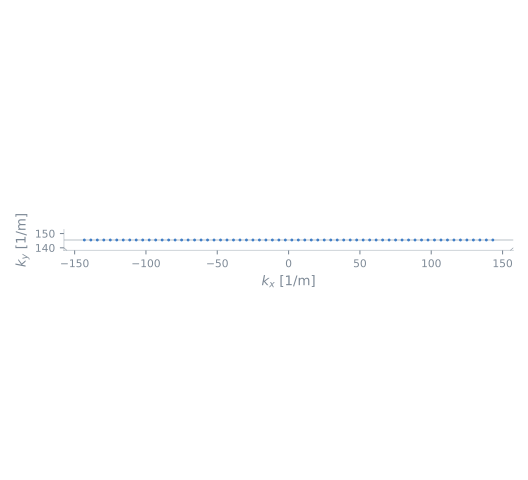
SequenceModuleOne Cartesian line, frequency-encoded along x and phase-encoded along y.
fovandmatrixtake two values, readout first.An excitation gives a gradient echo; a refocusing pulse gives the readout half of a spin echo. The phase encodes are templates at their largest step, which the caller scales per shot.
Zero spoiling balances every axis. Positive spoiling after the acquisition gives SSFP-FID, before it SSFP-Echo; in the latter case the FID trajectory of
calculate_kspaceneed not cross k = 0, andecho_timeis still the timing interval.- Parameters:
system (pypulseqpp.Opts) – System limits.
rf (RfEvent) – Pulse that opens the repetition.
gz (GradEvent, default=None) – Selection gradient played with
rf;Nonefor a hard pulse.gz_reph (GradEvent, default=None) – Rephaser of
gz, left-aligned in the first block after the pulse (the TE wait if there is one, else the prewinder block).Nonefor a slab excitation (is_slab=True), which carries it ingz.fov (float or sequence of float) – Field of view per encoded axis, readout first (m).
matrix (int or sequence of int) – Matrix size per encoded axis, readout first. The caller sets the number and order of acquired lines.
te (float, default=None) – Echo time (s), from the RF centre to the first echo.
Noneis as short as possible.tr (float, default=None) – Repetition time (s) of the whole module.
Noneis as short as possible.partial_echo (float, default=1.0) – Fraction of the full echo acquired, in (0.5, 1]. The samples before the echo are omitted, which shortens TE.
oversampling (float, default=1.0) – Readout oversampling: the sample spacing in k-space is
1 / (oversampling * fov).readout_bandwidth_hz (float, default=250000.0) – Requested ADC sampling rate (Hz);
bandwidth_hzis the rate achieved on the ADC and gradient rasters.spoiling_cycles (float, default=0.0) – Cycles of dephasing across
voxel_size_mleft at the end of the TR. Zero balances the TR.voxel_size_m (float, default=None) – Length the spoiling is counted over (m);
Noneis the readout resolutionfov[0] / matrix[0].spoiling_position ({'post', 'pre'}, default='post') – Side of the acquisition on which the spoiler is played.
n_echoes (int, default=1) – Echoes per repetition.
flyback (bool, default=True) – With several echoes, rewind between them so that all are read in the same direction (monopolar), or alternate the readout sign (bipolar). A bipolar train reads even echoes backwards, so a gradient delay error becomes a phase difference between echoes, and it needs as many samples before the echo as after it:
partial_echo < 1and an odd sample count are rejected.echo_spacing (float, default=None) – Echo spacing (s);
Noneis as short as possible. Ignored with one echo.wave ({'phase', 'partition', 'both'}, default=None) – Wave-CAIPI encoding under the readout flat top: a sine on y, a cosine on z, or both. 3D only, unless
wave_cyclesorwave_amplitudeis zero, which builds no wave gradients.wave_cycles (int, default=8) – Wave periods across the sampling window.
wave_amplitude (float, default=0.008) – Upper bound of the wave gradient amplitude (T/m, not Hz/m); the slew rate may lower it. The module’s
wave_amplitudeattribute is the amplitude built.labels (sequence of str, default=None) – Labels set to 0 on the acquisition block, to be changed per shot by the caller.
trigger (TriggerEvent or DigitalOutputEvent, default=None) – Event armed on the prewinder block.
- Attributes:
rf (RfEvent) – The pulse the module was given.
gz (GradEvent) – Its selection gradient, if one was given.
gz_reph (GradEvent) – Its rephaser, if one was given.
gx_pre (GradEvent) – Readout prephaser, right-aligned in the prewinder block; includes the spoiler area under
spoiling_position='pre'.gx (GradEvent) – Readout lobe. With a single echo and a spoiler, the spoiler is joined to the lobe, which then lacks the ramp on that side. A spoiler joined at the end leaves from a plateau held to the end of the acquisition block, past the last sample by the ADC dead time, and
gx_spoilhas correspondingly less area.gx_spoil (GradEvent) – Last read-axis gradient of the TR, left-aligned with
gy_rew: rewinds the part of the line after the echo and, underspoiling_position='post', adds the spoiler.gy_pre, gz_pre (TrapEvent) – Phase encodes at their largest step, to be scaled per shot.
gz_preis 3D only.gy_rew, gz_rew (TrapEvent) – The negated encodes that unwind them.
gx_flyback (TrapEvent) – Rewinder played after every echo but the last of a monopolar train.
gx_rev (GradEvent) – Negated lobe that reads the even echoes of a bipolar train.
gy_wave, gz_wave (GradEvent) – Wave gradients under the readout flat top, each self-balanced so that scaling one to zero changes nothing else. Only the channels driven by
wave.adc (AdcEvent) – The acquisition window, shared by every echo.
adc_labels (LabelSetEvent or list of LabelSetEvent) – One per name in
labels; absent whenlabelsis empty.wait_te (DelayEvent) – Present only when
teexceeds the minimum and the wait can holdgz_reph; otherwise the prewinder block starts later.wait_esp (DelayEvent) – Present only when
echo_spacingexceeds the minimum; played after every echo but the last (after the readout lobe of a bipolar train, after the rewinder of a monopolar one).wait_tr (DelayEvent) – Present only when
trexceeds the minimum.echo_time (float) – Time from the RF centre to the first echo (s), on the block raster.
echo_spacing (float) – Time between successive echoes (s), on the block raster; zero with one echo.
bandwidth_hz (float) – Achieved ADC sampling rate
1 / dwell(Hz).n_samples (int) – ADC samples per echo.
center_sample (int) – Index of the sample at the echo;
partial_echomoves it toward the start.delta_kx (float) – K-space sample spacing along the readout (1/m).
readout_duration (float) – Duration of the sampled flat top (s).
wave_amplitude (float) – Peak wave gradient amplitude built (T/m), below the requested one where the slew rate binds; zero without
wave.
- Raises:
ValueError – If a count or a fraction is out of range,
waveis not a wave mode or would build wave gradients on a 2D readout,gz_rephshares a channel with an encoded axis, orte,trorecho_spacingis shorter than the module can achieve.
Examples
>>> import pypulseqpp.sequences as design
>>> import pypulseqpp as pp
>>> system = pp.Opts()
>>> excitation = design.SpatialSelectiveExcitation(system, 15.0, 5e-3)
>>> readout = design.LineReadout2D(
...     system, excitation.rf, excitation.gz, excitation.gz_reph,
...     fov=0.22, matrix=128,
... )
>>> int(readout.adc.num_samples)
128
>>> readout.blocks[1] == (readout.gx_pre, readout.gy_pre, readout.gz_reph)
True
Methods
Build the module's block layout; implemented by the subclass. |
|
Publish events from the caller's locals and register keyword aliases. |
|
Publish named events, whether or not they were added to a block. |
Attributes
Block tuples in play order, holding the original event objects. |
|
Duration of the module (s). |
|
Sequence holding the module's construction-time block layout. |