
Note
Go to the end to download the full example code.
2D spiral gradient echo#

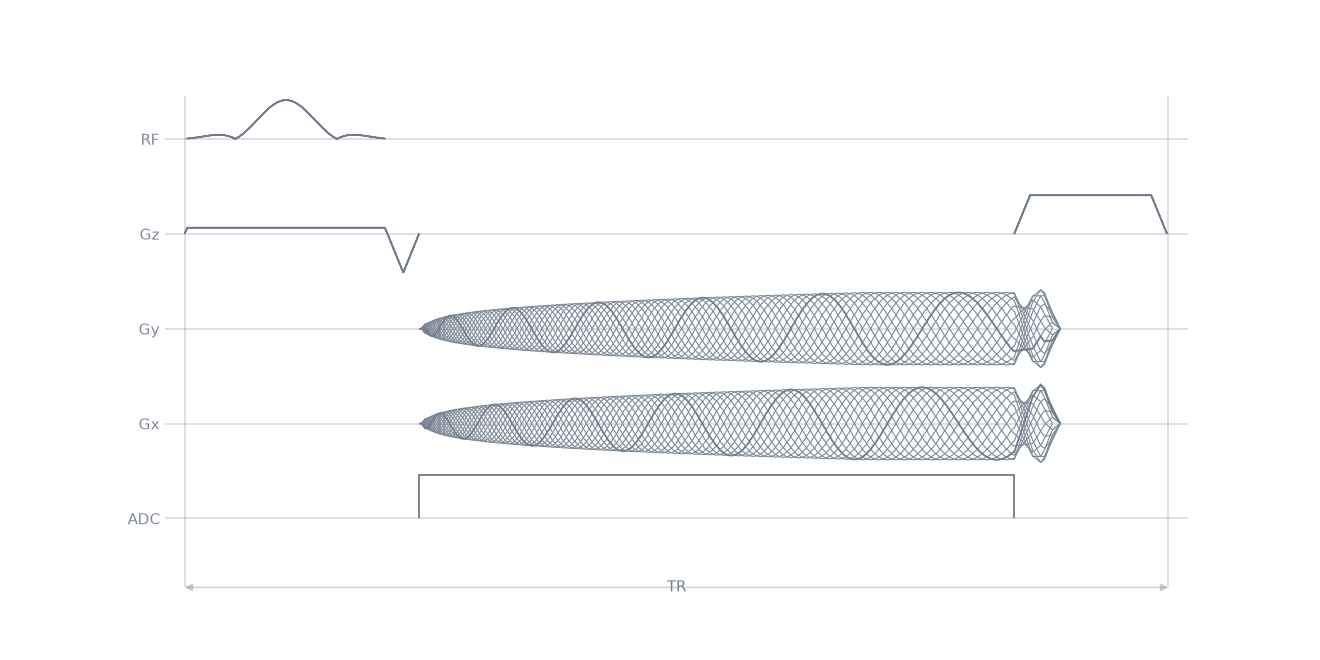
A spoiled low-flip-angle excitation is followed by one spiral interleaf. Gradient and RF spoiling suppress residual transverse coherence between repetitions. TR and flip angle primarily determine T1 weighting; off-resonance and T2* decay affect the spiral readout. Spiral SPGR supports rapid dynamic and structural imaging.
Constant-density spiral#
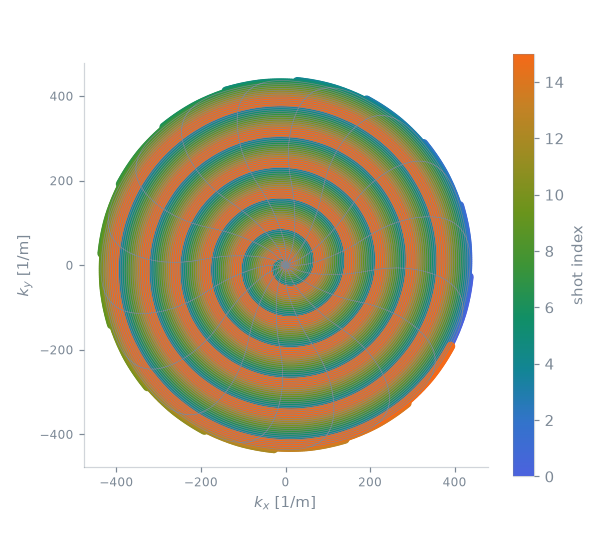
Sixteen interleaves at a constant pitch, which sample the disc at the Nyquist spacing.
import pypulseqpp as pp
from pypulseqpp.sequences import gre_spiral2D_sequence

baseline = gre_spiral2D_sequence(
    n=192, n_shots=16, n_slices=1, te=None, tr=None, n_dummy=0
)
print(f"{baseline.num_blocks} blocks, {baseline.duration()[0]:.2f} s")
80 blocks, 0.24 s
Sequence diagram#
Sampling order#
Each interleaf is the same spiral gradient waveform, rotated to its own angle by a rotation extension.
pp.plot.plot_kspace(baseline, color_by="shot", plane="xy")
Variable density#
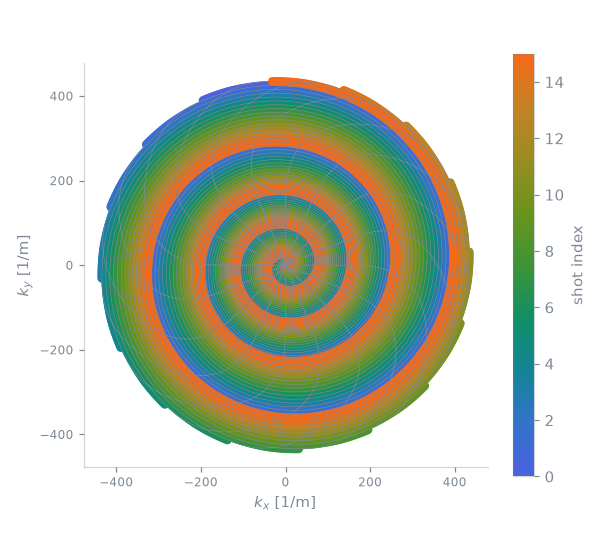
density='dual' preserves the Nyquist spacing near the origin and
increases the pitch at larger radii. The shorter readout requires a
reconstruction that accounts for peripheral undersampling.
alternative = gre_spiral2D_sequence(
    n=192,
    n_shots=16,
    n_slices=1,
    density="dual",
    periphery_undersampling=2.0,
    te=None,
    tr=None,
    n_dummy=0,
)
                   blocks  duration (s)  acquisitions
constant               80          0.24            16
dual density           80          0.19            16
pp.plot.plot_kspace(alternative, color_by="shot", plane="xy")
Total running time of the script: (0 minutes 1.355 seconds)