
Note
Go to the end to download the full example code.
3D stack-of-spirals gradient echo#

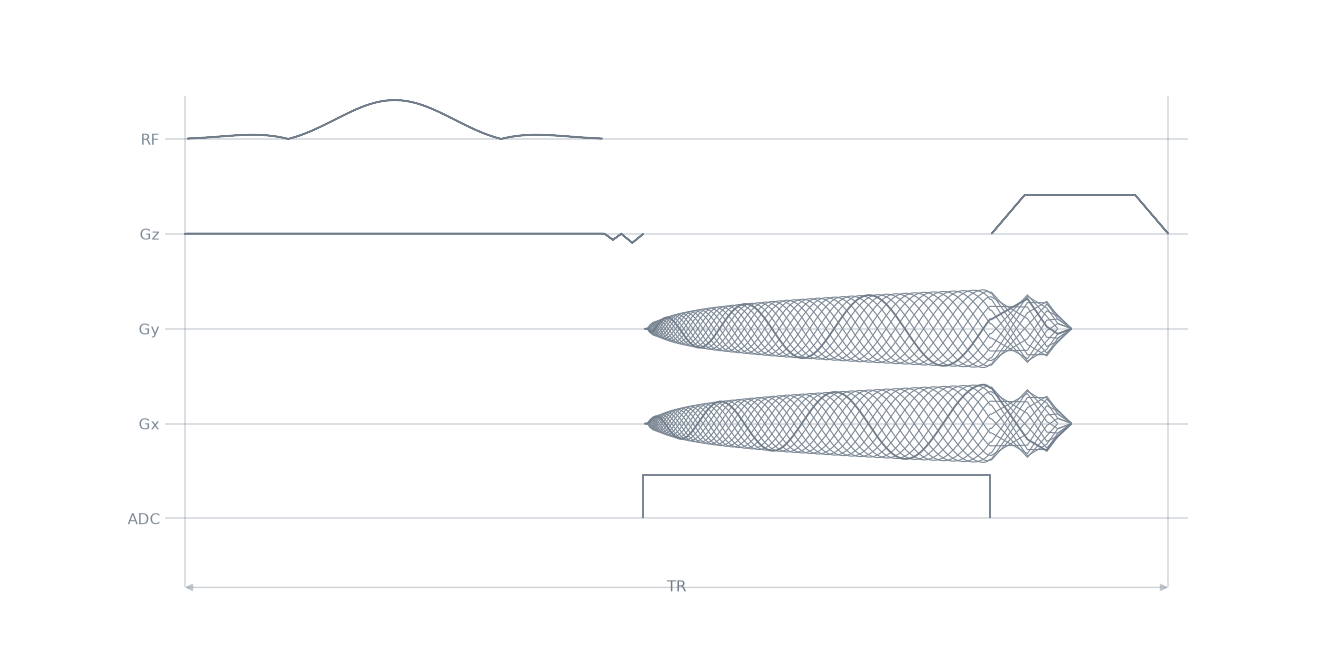
A slab-selective spoiled excitation is followed by one spiral interleaf with Cartesian partition encoding. Gradient and RF spoiling suppress residual transverse coherence between repetitions. TR, flip angle, and TE determine contrast. Stack-of-spirals SPGR supports rapid 3D structural and dynamic imaging.
Sixteen interleaves#
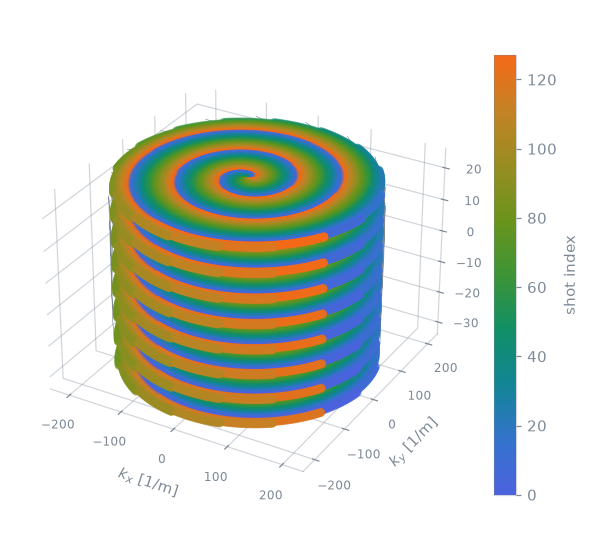
Sixteen interleaves at every partition.
import pypulseqpp as pp
from pypulseqpp.sequences import gre_stack_of_spirals3D_sequence

baseline = gre_stack_of_spirals3D_sequence(n=96, n_z=8, n_shots=16, tr=None, n_dummy=0)
print(f"{baseline.num_blocks} blocks, {baseline.duration()[0]:.2f} s")
512 blocks, 0.91 s
Sequence diagram#
Sampling order#
The interleaves of every partition, over the three k-space axes.
pp.plot.plot_kspace(baseline, color_by="shot")
Fewer interleaves#
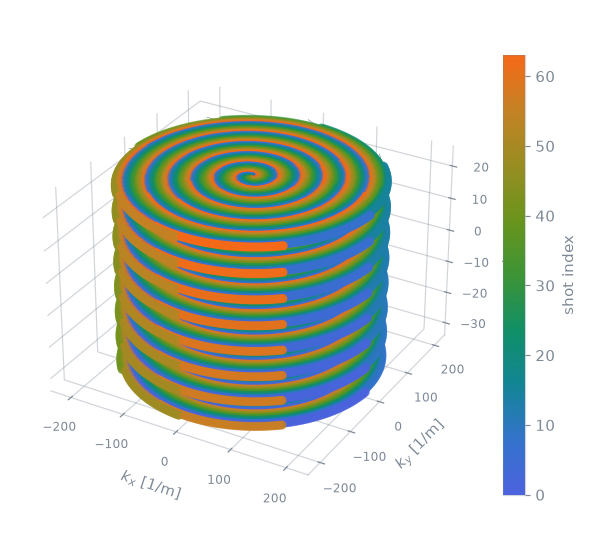
Halving the interleaf count halves the number of repetitions and doubles the spiral pitch. The resulting peripheral sampling is below the Nyquist rate.
alternative = gre_stack_of_spirals3D_sequence(
    n=96, n_z=8, n_shots=8, tr=None, n_dummy=0
)
                   blocks  duration (s)  acquisitions
16 interleaves        512          0.91           128
8 interleaves         256          0.61            64
pp.plot.plot_kspace(alternative, color_by="shot")
Total running time of the script: (0 minutes 3.157 seconds)