

3D Cartesian MPRAGE#
- Family:
MPRAGE
- Dimensionality:
3D, slab-selective
- Sampling:
Cartesian
- Readout:
One inversion per shot, followed by the phase-encode lines of one partition as a spoiled gradient-echo train
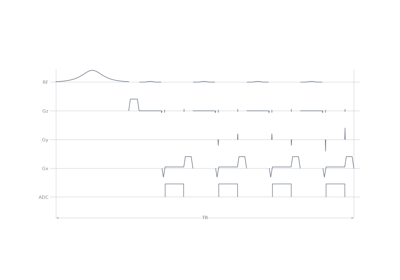
3D MPRAGE: one inversion per shot, then a train of spoiled low-flip views.
Each shot applies one inversion and then acquires every sampled in- plane view of a single partition, so the partition encode is constant within a shot and the number of shots equals the number of sampled partitions. The inversion time is measured from the centre of the inversion pulse to the centre of the first excitation of the train, and the repetition time is the interval between successive inversions.
Prescription#
- pypulseqpp.sequences.mprage3D_sequence()#
3D MPRAGE: one inversion per shot, then a train of spoiled low-flip views.
Each shot is the inversion, a wait that puts the first view’s excitation centre at TI, one
LineReadout3Drepetition per view of its train, and a recovery that makes every inversion-to-inversion interval the TR. Every train holdsceil(n_y / ry)ky-kz views: only views inside the inscribed ky-kz ellipse are sampled, and the unsampled views nearest the k-space centre are added until the views fill a whole number of trains, so every shot acquires the same number of views.orderingdeals the trains as angular wedges of the ky-kz plane, each played centre-out, so that the centre view’s excitation occurs at TI and its ADC echo at TI + TE, or with every train position a complementary Poisson-disc pattern, for a time-resolved reconstruction. Each acquisition carries its view asLINandPAR, and, shuffled, its place in the train, the time a time-resolved reconstruction resolves, asECO; calibration views are markedIMA, and under wave-CAIPI the calibration region is first acquired wave-free in trains of its own, markedREF.- Parameters:
system (pypulseqpp.Opts, default=None) – System limits, held under the module’s
MAX_GRAD(80 mT/m) andMAX_SLEW(200 T/m/s).Noneispypulseqpp.Opts().fov_x (float, default=0.256) – Field of view along the readout (m).
fov_y (float, default=0.256) – Field of view along the phase encode (m).
fov_z (float, default=0.176) – Field of view along the partition encode (m). The slab excited is
fov_zthick.n_x (int, default=256) – Matrix size along the readout.
n_y (int, default=256) – Matrix size along the phase encode.
n_z (int, default=176) – Matrix size along the partition encode.
flip_angle_deg (float, default=9.0) – Readout excitation flip angle (degrees).
te (float | None, default=None) – Echo time of every line (s).
Noneis as short as the readout admits.esp (float | None, default=None) – Spacing of successive line excitations (s).
Noneis as short as the readout admits.ti (float | None, default=0.9) – Inversion time (s), from the inversion pulse’s centre to the first line’s excitation.
Noneis as short as the inversion module admits.tr (float | None, default=5.0) – Inversion-to-inversion interval (s).
Noneleaves one raster of recovery after the train.readout_bandwidth_hz (float, default=250000.0) – Requested receiver bandwidth (Hz).
ry (int, default=1) – Undersampling along the phase and the partition encode.
rz (int, default=1) – Undersampling along the phase and the partition encode.
caipi_shift (int, default=0) – CAIPIRINHA shift: partitions by which the lattice is displaced per acquired line, in
[0, rz). Unused byshuffling.partial_fourier_x (float, default=1.0) – Fraction of the echo acquired, in
[0.75, 1]. Truncates the samples before the echo.partial_fourier_y (float, default=1.0) – Fraction of the phase- and partition-encode extent acquired, in
[0.75, 1].partial_fourier_z (float, default=1.0) – Fraction of the phase- and partition-encode extent acquired, in
[0.75, 1].n_dummy (int, default=1) – Whole shots played without acquiring before the first.
excitation ({'slab', 'nonselective', 'spsp'}, default='slab') – A slab-selective SLR pulse, a hard pulse, or a slab- and water-selective spectral-spatial pulse.
readout_oversampling (float, default=2.0) – Readout oversampling factor, at least one.
n_acs_y (int, default=24) – Extent of the fully sampled calibration region along the phase encode, acquired ahead of the rest when undersampled.
n_acs_z (int, default=16) – Extent of the fully sampled calibration region along the partition encode, acquired ahead of the rest when undersampled.
elliptical_acs (bool, default=False) – Make the calibration region the ellipse inscribed in the
n_acs_y x n_acs_zrectangle rather than the rectangle.ordering ({'radial', 'shuffling'}, default='radial') – Train order, and the support it is drawn from.
'radial': CAIPIRINHA lattice support, each train an angular wedge of the ky-kz plane acquired centre-out (make_radial_order()).'shuffling': variable-density Poisson-disc support (sampling='poisson'ofmake_cartesian_plane_sampling()), views assigned to train positions as complementary Poisson-disc patterns (make_complementary_order()).wave ({'phase', 'partition', 'both'}, default='both') – Wave-CAIPI channels: a sine on y, a cosine on z, or both. With wave-encoding gradients the calibration region is acquired again first without them, marked
REF, and no wave-encoded view is markedIMA.wave_cycles (int, default=8) – Wave periods across the sampling window; zero plays no wave.
wave_amplitude (float, default=0.0) – Requested peak wave-encoding gradient amplitude (T/m); zero, the default, plays no wave. The slew rate may lower it.
navigator (bool, default=False) – Play three-plane spiral navigators in the recovery after each shot, as many as it holds up to
NAVIGATOR_COUNTand at least one, which the shortest TR holds.
- Returns:
The designed sequence.
- Return type:
- Raises:
ValueError – If
excitationororderingis unknown, a partial Fourier fraction is outside[0.75, 1], an undersampling factor is below one,caipi_shiftis outside[0, rz),wavenames no wave mode, or the TE, the spacing, the TI or the TR is shorter than the shot takes.
Examples
>>> from pypulseqpp import sequences
>>> seq = sequences.mprage3D_sequence(
...     n_x=32, n_y=16, n_z=8, ti=100e-3, tr=300e-3
... )
>>> seq.check_timing()[0]
True
Designed and drawn#
See also#
Other mprage sequences: mprage_stack_of_stars3D_sequence, mprage_stack_of_spirals3D_sequence.
The same sampling in another family: gre2D_sequence, gre3D_sequence, gre_multiecho2D_sequence, gre_multiecho3D_sequence, se2D_sequence, se3D_sequence, fse3D_sequence, bssfp2D_sequence, bssfp3D_sequence, epi2D_sequence.
Every shipped sequence is listed in the catalogue.