

3D fast spin echo#
- Family:
Fast spin echo
- Dimensionality:
3D, slab-selective
- Sampling:
Cartesian
- Readout:
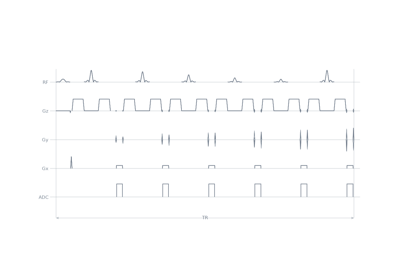
One CPMG train per excitation, one (line, partition) view per echo
3D Cartesian fast spin echo: one CPMG train per excitation over a (ky, kz) grid.
Prescription#
- pypulseqpp.sequences.fse3D_sequence()#
3D Cartesian fast spin echo: one CPMG train per excitation over a (ky, kz) grid.
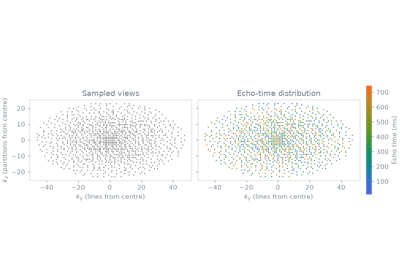
Only views inside the inscribed ky-kz ellipse are sampled.
radialselects PCLO for identical trains and Buonincontri joint ordering for a centre/periphery parameter transition.shufflingselects a variable-density Poisson-disc support and assigns its views to echoes withmake_complementary_order(), so that each echo is a Poisson-disc pattern of its own and neighbouring echoes complement each other (T2 Shuffling, Tamir et al., Magn Reson Med 2017;77:180-195, with complementary Poisson-disc sampling, Levine et al., Magn Reson Med 2017;77:1774-1785), for an echo-resolved reconstruction. Every acquisition carries its line and partition asLINandPAR, and, shuffled, its echo, the contrast an echo-resolved reconstruction resolves, asECO; calibration views are markedIMA; under wave-CAIPI the calibration region is first acquired wave-free in trains of its own, markedREF.The refocusing angle is constant, or, under
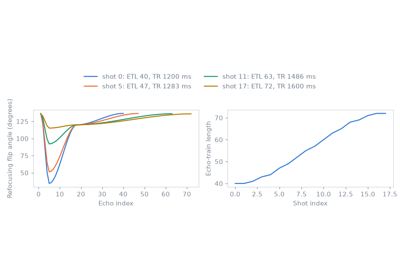
optimized, the angle at the TE echo of a traindesign_trains()shapes around it.busseusesmake_busse_schedule(): prescribed PSS coherence and inverse EPG, with six unacquired startup echoes by default. Its centre is halfway through the acquired train unless explicitly prescribed. Giving the periphery of k-space its own TR or train length individually parameterizes the trains (Buonincontri et al., ISMRM 2025, abstract 566-05-007): every shot moves from the centre values to the periphery ones alongshot_parameters(), and the view order is radial. Every shot plays the longest train; past its own length a shot’s refocusing pulses have zero amplitude and nothing is acquired, and its closing delay makes its TR, so the scan stays one repeating train. Trains that are not individually parameterized all acquireetlviews: the unsampled views nearest the k-space centre are added until the views fill a whole number of trains.- Parameters:
system (pypulseqpp.Opts, default=None) – System limits, held under the module’s
MAX_GRAD(80 mT/m) andMAX_SLEW(200 T/m/s).Noneispypulseqpp.Opts().fov_x (float, default=0.16) – Fields of view along the readout, the phase encode and the partition encode, in that order (m). The slab excited is
fov_zthick.fov_y (float, default=0.16) – Fields of view along the readout, the phase encode and the partition encode, in that order (m). The slab excited is
fov_zthick.fov_z (float, default=0.16) – Fields of view along the readout, the phase encode and the partition encode, in that order (m). The slab excited is
fov_zthick.n_x (int, default=320) – Matrix size along the readout.
n_y (int, default=240) – Matrix size along the phase encode.
n_z (int, default=240) – Matrix size along the partition encode.
te (float | None, default=0.028) – Effective echo time (s): the echo the centre of k-space is read at, rounded onto the echo grid.
Noneis the first echo. Meaningless undershuffling. Underbusse, passNoneand prescribe the centre withbusse_centre_echoinstead.tr (float, default=1.8) – Repetition time (s), one per train; at the centre of k-space when the trains are individually parameterized.
etl (int, default=45) – Echo train length; at the centre of k-space when the trains are individually parameterized. Under
bussethis counts acquired echoes; startup pulses are additional.refocusing_angle_deg (float, default=180.0) – Refocusing flip angle (degrees): of every pulse under
constant; at the TE echo, and the peak of the train, underoptimized. Unused underbusse.readout_bandwidth_hz (float, default=250000.0) – Requested receiver bandwidth (Hz).
ry (int, default=1) – Undersampling along the phase and the partition encode.
rz (int, default=1) – Undersampling along the phase and the partition encode.
caipi_shift (int, default=0) – CAIPIRINHA shift: partitions by which the lattice is displaced per acquired line, in
[0, rz). Unused byshuffling.partial_fourier_x (float, default=1.0) – Fraction of the echo acquired, in
[0.75, 1]. Truncates the samples before the echo.partial_fourier_y (float, default=1.0) – Fraction of the phase- and partition-encode extent acquired, in
[0.75, 1].partial_fourier_z (float, default=1.0) – Fraction of the phase- and partition-encode extent acquired, in
[0.75, 1].n_dummy (int | None, default=None) – Trains played without acquiring before the first.
Noneis as many as bring the longitudinal magnetisation to its steady state (steady_state_dummies()): the radial order reads the centre of k-space in the first train acquired.excitation ({'slab', 'nonselective'}, default='slab') – Slab-selective or hard excitation. The refocusing pulses are hard either way, crushed on the readout axis: spins outside the slab are never excited, and hard pulses keep the echo spacing short.
readout_oversampling (float, default=2.0) – Readout oversampling factor, at least one.
esp (float | None, default=None) – Echo spacing (s).
Noneis as short as the train admits.crusher_cycles (float, default=1.0) – Read-axis crusher area in cycles across one native readout voxel.
optimize_end_angle (bool, default=False) – Optimize the final refocusing angle under the starting profile’s RF energy budget. Requires optimized, shared trains.
n_acs_y (int, default=24) – Extent of the fully sampled calibration region along the phase encode, acquired ahead of the rest when undersampled.
n_acs_z (int, default=16) – Extent of the fully sampled calibration region along the partition encode, acquired ahead of the rest when undersampled.
elliptical_acs (bool, default=False) – Make the calibration region the ellipse inscribed in the
n_acs_y x n_acs_zrectangle rather than the rectangle.ordering ({'radial', 'shuffling', 'busse_radial', 'pclo', 'buonincontri'}, default='radial') –
'radial': choose PCLO for identical trains, or Buonincontri joint shot/echo assignment for a centre/periphery transition.'pclo'explicitly selects Rydén’s radius-band permutation for an arbitrary centre echo, with identical trains only; for a centre echo in the second half of the train the echoes after it take the outer bands in order instead of Rydén’s mirrored order.'busse_radial'uses the basic Busse radius-then-angle order (no sorting jitter/consolidation), with identical trains and centre echo 0; underbusse, explicitly setbusse_centre_echo=0.'buonincontri'requires a parameter transition and assigns shots and echoes jointly.'adaptive_radial'is accepted as an alias for'buonincontri'.'shuffling'uses complementary Poisson-disc echo assignment for identical trains.flip_modulation ({'constant', 'optimized', 'busse', 'pd'}, default='constant') – Constant refocusing angles, or variable trains designed by direct-angle optimization, prescribed-PSS Busse inverse EPG or relaxation-aware prescribed-signal PD inverse EPG. Every variable train is designed with blochsim, which the
designextra installs.busse_minimum_angle_deg (float, default=25.0) – Minimum actual refocusing angle (degrees), under
busse.busse_centre_angle_deg (float, default=70.0) – Actual refocusing angle at the centre echo (degrees), under
busse.busse_maximum_angle_deg (float, default=120.0) – Actual first and final angle (degrees), under
busse.busse_startup_echoes (int, default=6) – Leading unacquired refocusing pulses, additional to
etl, underbusseandpd. They play in imaging, calibration and dummy trains.busse_centre_echo (int | None, default=None) – Zero-based acquired echo index under
busseorpd. For Busse,Noneselects(etl - 1) // 2; PD uses the first acquired echo. An effective-TE request selects the nearest feasible echo. Startup precedes this index.busse_effective_te (float | None, default=None) – Requested contrast-equivalent TE (s) for Busse trains. Select the nearest feasible acquired centre echo by relaxed/relaxation-free EPG with reference T1/T2 of 1.0/0.1 s. The centre-angle constraint follows the selected echo.
Noneretains the midpoint prescription; an explicitbusse_centre_echotakes precedence. Control fitting preserves the selected reference effective TE within 0.1 ms. TheTEdefinition remains physical centre time; the achieved reference contrast time isEffectiveEchoTime. Requiresbusse.busse_initial_decay (float, default=1.3) – Initial exponential time constant, measured in echoes, under
busseandpd.busse_optimize (bool, default=False) – Optimize only the minimum and centre controls within five degrees of their prescription, using forward EPG over
DESIGN_T1_MS,DESIGN_T2_MSandDESIGN_B1_SCALES. Minimize the mean PSF RMS radius for the actual view order, allowing signed contrast to drop by at most 4.5% of its prescribed magnitude and bounding RF energy. The startup count, centre echo, maximum angle and initial decay stay fixed. Requiresbussetrains and thedesignextra. With varying train parameters, the centre endpoint maximizes model contrast and the periphery endpoint minimizes PSF radius. Each endpoint is fitted at its own TR/ETL over a representative complete-plane ordering; controls then follow the cubic shot transition. This is an endpoint design, not a joint optimization of the entire varying-TR acquisition.busse_minimum_angle_periphery_deg (float | None, default=None) – Minimum actual angle at the periphery (degrees).
Noneinheritsbusse_minimum_angle_deg. Requires adaptive radial ordering when the endpoints differ.busse_centre_angle_periphery_deg (float | None, default=None) – Actual centre angle at the periphery (degrees).
Noneinheritsbusse_centre_angle_deg.busse_maximum_angle_periphery_deg (float | None, default=None) – First/final angle at the periphery (degrees).
Noneinheritsbusse_maximum_angle_deg. Each shot’s controls interpolate cubically; inverse EPG constructs its complete train at its own ETL.pd_first_angle_deg (float, default=120.0) – First RF angle (degrees) under
pd, independently of peak/final.pd_maximum_angle_deg (float, default=140.0) – Maximum actual PD RF angle (degrees).
pd_final_angle_deg (float, default=100.0) – Final actual PD RF angle (degrees), at most the maximum. Equality allows the RF maximum to extend to the final pulse.
pd_plateau_fraction (float, default=0.7) – Acquired-train fraction before the PD signal tail begins. The resulting RF peak position follows from relaxation-aware inverse EPG.
pd_effective_te (float | None, default=None) – Requested reference contrast-equivalent TE (s) under
pd. Select the nearest acquired echo from the prescribed PD train’s reference EPG times;Noneselects its first acquired echo. An explicitbusse_centre_echooverrides this choice.TEremains physical centre time;EffectiveEchoTimerecords reference contrast time.pd_optimize (bool, default=False) – Fit tail onset within 0.1 of the acquired train using CPU forward EPG, retaining the prescribed first, peak and final angles. Bound RF energy and retain centre mean signal and signed contrast. Preserve a prescribed reference effective TE to 0.1 ms. Requires
pdand thedesignextra. As for Busse, fit endpoints separately and construct the cubic transition with batched inverse EPG.pd_first_angle_periphery_deg (float | None, default=None) – Peripheral first RF angle (degrees);
Noneinherits the centre.pd_maximum_angle_periphery_deg (float | None, default=None) – Peripheral maximum RF angle (degrees);
Noneinherits the centre.pd_final_angle_periphery_deg (float | None, default=None) – Peripheral final RF angle (degrees);
Noneinherits the centre.pd_plateau_fraction_periphery (float | None, default=None) – Peripheral signal-tail onset fraction;
Noneinherits the centre.tr_periphery (float | None, default=None) – Repetition time (s) at the periphery of k-space.
Noneistr.etl_periphery (int | None, default=None) – Echo train length at the periphery of k-space.
Noneisetl.wave ({'phase', 'partition', 'both'}, default='both') – Wave-CAIPI channels: a sine on y, a cosine on z, or both. With wave-encoding gradients the calibration region is acquired again first without them, marked
REF, and no wave-encoded view is markedIMA.wave_cycles (int, default=8) – Wave periods across the sampling window; zero plays no wave.
wave_amplitude (float, default=0.0) – Requested peak wave-encoding gradient amplitude (T/m); zero, the default, plays no wave. The slew rate may lower it.
navigator (bool, default=False) – Play three-plane spiral navigators after each train, as many as the shortest TR holds up to
NAVIGATOR_COUNTand at least one, which the shortest TR holds.
- Returns:
The designed sequence.
- Return type:
- Raises:
ValueError – If
excitation,orderingorflip_modulationis unknown, a partial Fourier fraction is outside[0.75, 1], a count is below one,caipi_shiftis outside[0, rz),wavenames no wave mode, individually parameterized trains are shuffled, a train ends before the TE echo, or a TR is shorter than the longest train.ImportError – If a variable train is asked for without blochsim.
Examples
>>> from pypulseqpp import sequences
>>> seq = sequences.fse3D_sequence(
...     n_x=32, n_y=16, n_z=8, etl=8, te=20e-3, tr=300e-3
... )
>>> seq.check_timing()[0]
True
>>> busse = sequences.fse3D_sequence(
...     n_x=32, n_y=16, n_z=8, etl=20, te=None, tr=0.5, n_dummy=0,
...     flip_modulation="busse", busse_optimize=False
... )
>>> busse.check_timing()[0]
True
Designed and drawn#
See also#
The same sampling in another family: gre2D_sequence, gre3D_sequence, gre_multiecho2D_sequence, gre_multiecho3D_sequence, se2D_sequence, se3D_sequence, mprage3D_sequence, bssfp2D_sequence, bssfp3D_sequence, epi2D_sequence.
Every shipped sequence is listed in the catalogue.