

Note
Go to the end to download the full example code.
Individually optimized 3D fast spin echo#

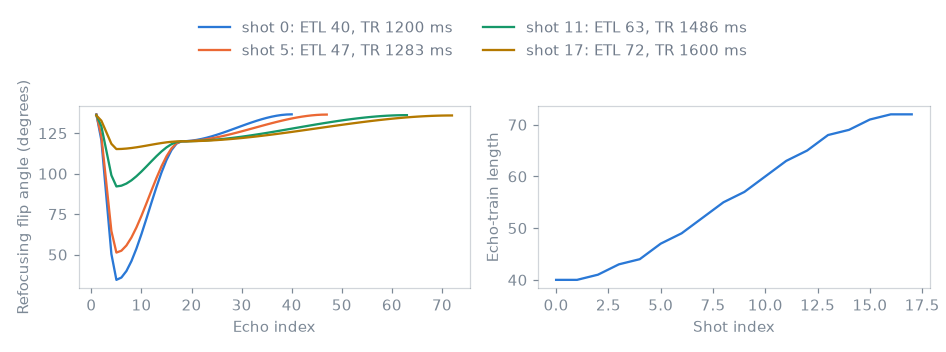
Individually parameterized 3D FSE assigns different echo-train lengths and repetition times to the shots that acquire central and peripheral k-space [BUO25]. From the central to the peripheral shots, TR and the minimum and centre angles of a prescribed-PSS refocusing schedule [BUS08b] follow a cubic smooth-step transition between their two limits; the echo-train length follows the same transition, rounded to integer values. The views are assigned by an adaptive radial order. Longer trains and a different TR at the periphery can reduce scan time, while the contrast at the centre of k-space is set by the parameters of the central shots.
from pypulseqpp import sequences

P = {
    "n_x": 96,
    "n_y": 64,
    "n_z": 20,
    "fov_x": 0.20,
    "fov_y": 0.20,
    "fov_z": 0.12,
    "etl": 40,
    "etl_periphery": 72,
    "te": None,
    "tr": 1.2,
    "tr_periphery": 1.6,
    "refocusing_angle_deg": 120.0,
    "n_dummy": 0,
    "ordering": "buonincontri",
    "flip_modulation": "busse",
    "busse_optimize": True,
    "wave_amplitude": 0.0,
}
seq = sequences.fse3D_sequence(**P)
n_shots = int(seq.get_definition("NumShots")[0])
Train parameters#
TR and the schedule’s minimum angle follow a cubic smooth-step transition, \(3u^2 - 2u^3\) with \(u\) from 0 at the first (central) shot to 1 at the last (peripheral) shot [BUO25]; the echo-train length follows the same transition rounded to integers. The two endpoint trains are optimized independently at their own TR and ETL. The central endpoint maximizes model contrast; the peripheral endpoint minimizes PSF radius. Inverse EPG constructs every intermediate schedule from its interpolated controls. All trains share one echo spacing, RF pulse width and centre echo; six startup pulses precede the acquired echoes. The first and final pulses have the prescribed 120-degree angle.
The schedules are read from the pulses the sequence plays. The flip angle of
each refocusing pulse is that of its pulse definition scaled by the relative
amplitude of the instance, which is zero past the shot’s own train length.
The TR of a shot is the interval from its excitation to the next; the last
shot’s is recorded as TRPeriphery.
instances, rf_times = seq.rf_instances(), seq.rf_times(compat=False)
use = np.asarray(rf_times.use)
flip = np.array([rf.flip_deg for rf in instances.definitions])[instances.definition]
angles = (flip * instances.amplitude)[use == "refocusing"].reshape(n_shots, -1)
rf_counts = np.count_nonzero(angles, axis=1)
lengths = rf_counts - 6
excitations = np.asarray(rf_times.t)[use == "excitation"]
tr = np.append(np.diff(excitations), seq.get_definition("TRPeriphery")[0])
Adaptive radial ordering#
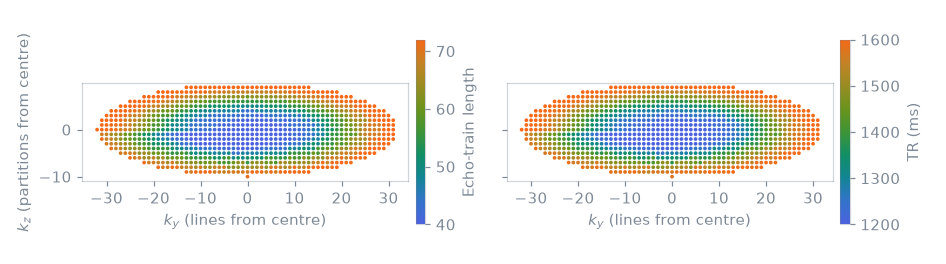
The ordering ranks (shot, echo) slots jointly by distance from the
effective-TE echo and by position in the central-to-peripheral transition
[BUO25]. Views are ranked by k-space radius; the innermost views fill the
slots nearest the effective-TE echo of the central shots, and within each group of one view per shot the views
are assigned to shots in order of angle. Colour gives the train length and
TR of the shot that acquired each view.
References#
Buonincontri G, et al. Proceedings of the International Society for Magnetic Resonance in Medicine. 2025; abstract 566-05-007.
Busse RF, Brau ACS, Vu A, Michelich CR, Bayram E, Kijowski R, Reeder SB, Rowley HA. Effects of refocusing flip angle modulation and view ordering in 3D fast spin echo. Magnetic Resonance in Medicine. 2008;60(3):640-649. https://doi.org/10.1002/mrm.21680
Total running time of the script: (0 minutes 4.538 seconds)