
Note
Go to the end to download the full example code.
Conventional 3D fast spin echo#

A slab-selective excitation is followed by a CPMG fast-spin-echo refocusing
train, with one Cartesian (line, partition) view acquired at each echo.
Refocusing angles below 180 degrees add stimulated-echo pathways to the echo
signal [HEN88], and variable refocusing angles modulate the T2-dependent
signal evolution along the train [BUS08a]. Radial view ordering maps this
evolution onto the (k_y, k_z) plane and therefore determines the
modulation transfer function and image blurring [BUS08a]. 3D FSE is used for
T2- and proton-density-weighted structural imaging.
from pypulseqpp import sequences

Fse3DApp = sequences.fse3D_sequence.Fse3DApp

DIAGRAM = {
    "n_x": 64,
    "n_y": 24,
    "n_z": 8,
    "fov_x": 0.20,
    "fov_y": 0.20,
    "fov_z": 0.12,
    "etl": 6,
    "te": None,
    "tr": None,
    "n_dummy": 0,
    "ordering": "radial",
    "flip_modulation": "optimized",
    "wave_amplitude": 0.0,
}
diagram_app = Fse3DApp(**DIAGRAM)
diagram = diagram_app.design()

ANALYSIS = {
    "n_x": 96,
    "n_y": 64,
    "n_z": 20,
    "fov_x": 0.20,
    "fov_y": 0.20,
    "fov_z": 0.12,
    "etl": 48,
    "te": 120e-3,
    "tr": 1.2,
    "n_dummy": 0,
    "ordering": "radial",
    "flip_modulation": "optimized",
    "wave_amplitude": 0.0,
}
app = Fse3DApp(**ANALYSIS)
seq = app.design()
print(
    f"{len(app.trains)} shots; {app.fse.esp * 1e3:.2f} ms echo spacing; "
    f"{seq.get_definition('TE')[0] * 1e3:.1f} ms effective TE"
)
21 shots; 10.84 ms echo spacing; 120.8 ms effective TE
Sequence diagram#
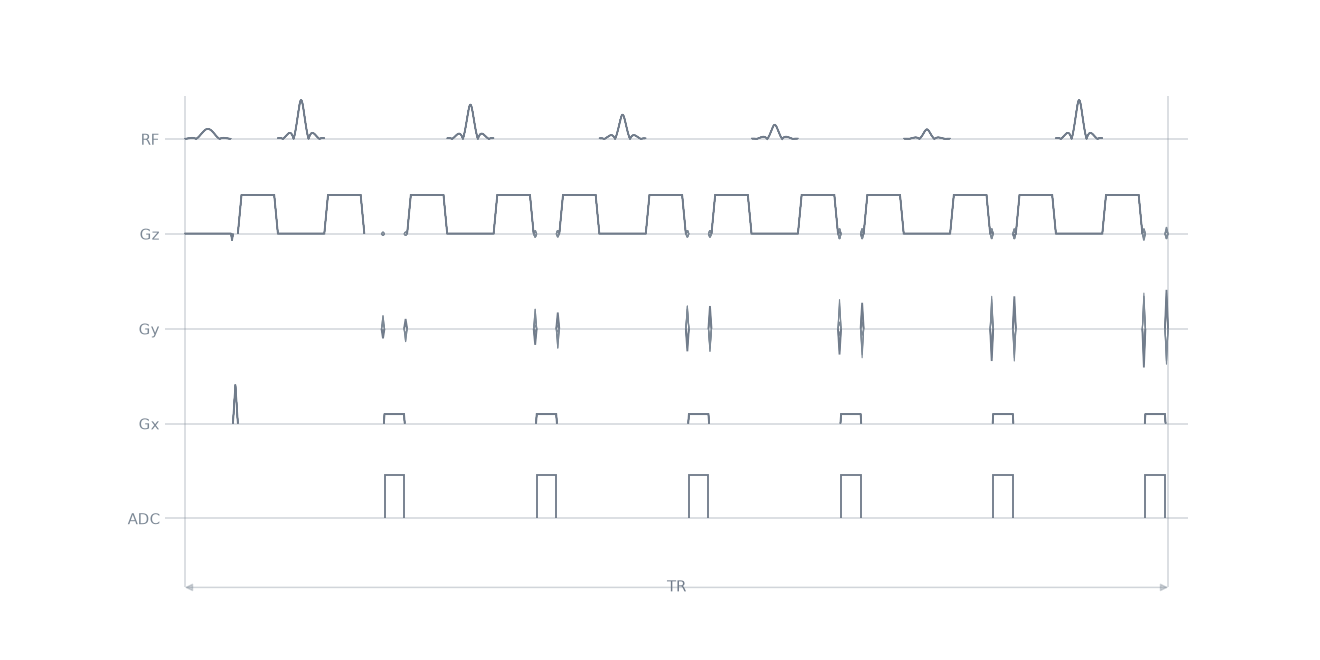
Each echo comprises a variable-angle refocusing pulse, phase and partition prephasing, one frequency-encoded ADC event, and rephasing. The effective TE is the echo assigned to k-space centre.
Refocusing schedule and echo signal#
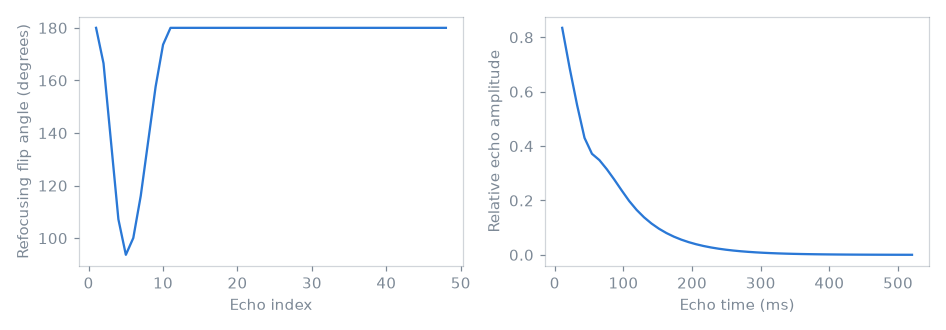
The refocusing schedule has the form of [BUS08a]: the angle decreases from
a maximum to a minimum over the first five echoes, increases to the
prescribed angle at the effective-TE echo and returns to the maximum at the
end of the train. The minimum and maximum angles, bounded by the prescribed
angle, are optimized with the extended phase graph (EPG) FSE simulator of torchsim [HEN88] [WEI15].
The cost combines an echo-to-echo signal-variation measure of blurring, the
contrast between two of the sequence’s design tissues at the effective-TE
echo, and a penalty on RF power above that of the initial schedule. The same
simulator evaluates the resulting T2-dependent echo envelope.
import torchsim

angles = np.asarray(app.flips[0, : app.lengths[0]])
signal = np.abs(
    np.asarray(torchsim.fse_sim(flip=angles, ESP=app.fse.esp * 1e3, T1=1200.0, T2=60.0))
)
Echo and shot order#
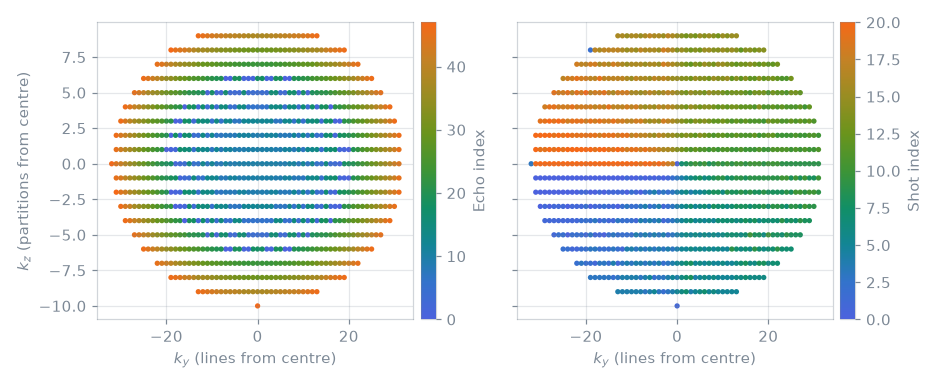
Radial ordering [BUS08a] assigns views near k-space centre to the effective-TE echo and progressively larger radii to echoes farther from it. Echo index records position within a train; shot index identifies views acquired after the same excitation.
K-space weighting#
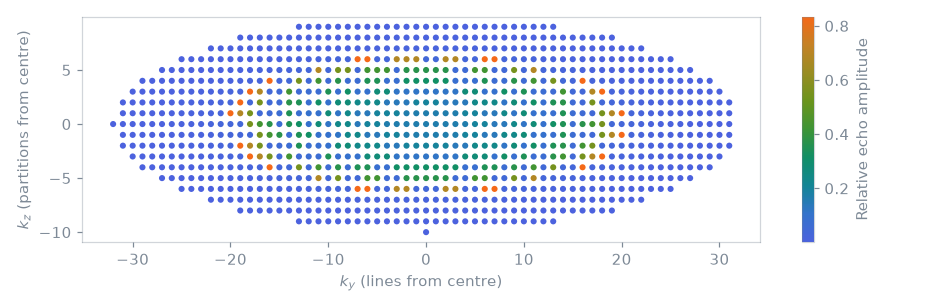
The echo envelope weights each acquired view according to its echo index. Radial assignment converts temporal signal evolution into a predominantly radial modulation transfer function; its Fourier transform contributes to image blurring along both phase-encode axes.
References#
Hennig J. Multiecho imaging sequences with low refocusing flip angles. Journal of Magnetic Resonance. 1988;78(3):397-407. https://doi.org/10.1016/0022-2364(88)90128-X
Weigel M. Extended phase graphs: dephasing, RF pulses, and echoes - pure and simple. Journal of Magnetic Resonance Imaging. 2015;41(2):266-295. https://doi.org/10.1002/jmri.24619
Busse RF, Brau ACS, Vu A, Michelich CR, Bayram E, Kijowski R, Reeder SB, Rowley HA. Effects of refocusing flip angle modulation and view ordering in 3D fast spin echo. Magnetic Resonance in Medicine. 2008;60(3):640-649. https://doi.org/10.1002/mrm.21680
Total running time of the script: (0 minutes 1.193 seconds)