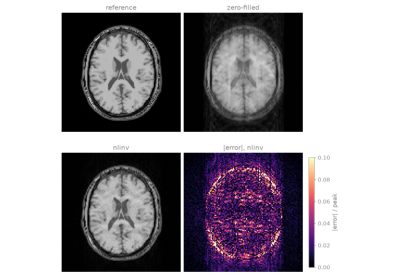

nlop.NonlinearSense#
- class bartorch.nlop.NonlinearSense#
Bases:
NonlinearOperatorJoint image and coil-sensitivity forward model, BART’s
noir.The operator has two inputs, the image and the coil representation, and one output, the data. Its derivative with respect to either input is a linear operator (
linearize()), and a Gauss-Newton step solves the linearized problem over both jointly.The coil unknown is not the sensitivity maps. It is a k-space representation \(\hat{s}\) of them, from which the maps follow by the Sobolev weighting
\[S = \mathcal{F}^{-1} \left[ \, \kappa \, (1 + a |k|^2)^{-b/2} \, \hat{s} \, \right]\]with
sobolevgiving \((a, b)\) andcthe scale \(\kappa\) (BART’snoir_calc_weights). The weighting is part of the model, so the estimated variable is smoothness-regularized by construction and the Gauss-Newton step needs no separate penalty on the coils.coilsis the linear operator mapping fitted coefficients to sensitivities.Off the grid the model is asymmetric, as BART builds it: it returns gridded coil images rather than samples, so a measurement must be gridded to match.
prepare()does that, and is a no-op on a grid, where the model returns k-space directly.- Parameters:
image_shape (tuple of int) – Coil-image shape,
(coils, *spatial), C order – the same shape the linear encodings take. The image itself is this with one coil.pattern (tensor, default=None) – Binary sampling mask, one at acquired positions and zero elsewhere, on a grid. Without one the acquisition is treated as fully sampled.
trajectory (tensor, default=None) – Trajectory
(..., samples, 3)in grid units,kx, ky, kz, asbartorch.tools.traj()produces. Giving one selects the non-Cartesian model.kspace_shape (tuple of int, default=None) – Sample shape. Off the grid it defaults to the trajectory’s with the image’s coil axes in front, as the NUFFT’s does; on the grid it is the coil-image shape.
coil_shape (tuple of int, default=None) – Where the sensitivities live and where their coefficients do; both default to the coil-image shape.
coefficient_shape (tuple of int, default=None) – Where the sensitivities live and where their coefficients do; both default to the coil-image shape.
weights (tensor, default=None) – Diagonal in k-space applied to the samples, off the grid; its conjugate is applied on the adjoint.
basis (tensor, default=None) – Temporal subspace basis
(coeffs, frames)over the last encoding axis, off the grid. The Cartesian model does not take one.mask (tensor, default=None) – A support the image is restricted to.
sobolev (tuple of float, default=(220.0, 32.0)) –
(a, b)of the coil weightingc (1 + a |k|^2)^(-b/2); BART’s220, 32.c (float, default=1.0) – The scale on that weighting, BART’s
1.real (bool, default=False) – Constrain the image to be real.
sos (bool, default=False) – BART’s sum-of-squares variant of the coil weighting.
oversampling_coils (float, default=None) – Fit the coils on a finer grid than the image. By default whichever
nlinvuses: two off the grid, one on it.oversampled_coils (bool, default=False) – Return them on that grid rather than on the image’s.
toeplitz (bool, default=True) – Apply the normal in closed form rather than as the forward and adjoint applications: a convolution with a point spread function, off the grid.
optimized (bool, default=False) – BART’s
noir2_noncart_optimized_create, off the grid.
Examples
>>> F = NonlinearSense((8, 128, 128), pattern=mask)
>>> F.ishapes
((1, 128, 128), (8, 128, 128))
>>> image, coefficients = nlop.IRGNM()(kspace, F)
- property coils#
the Sobolev weighting and the transform.
A fit returns coefficients; applying this operator gives the sensitivity maps they represent.
- Type:
Coil coefficients to sensitivities
- property image#
The image’s own linear part – the mask, and the real constraint if asked for.
- property data#
From what the model returns to the measurement.
Off the grid this is the NUFFT, whose adjoint grids a measurement into the coil images the model returns; on the grid it is the identity.
prepare()is the one call that matters.
- property transform#
The transform from coil images to k-space, without the model in front of it.
- prepare()#
The measurement in the shape the model returns.
Off the grid this is
nufft^H(kspace), asnoir2_reconapplies before the first Gauss-Newton step; on the grid the measurement is returned unchanged.
Also has the methods and properties of NonlinearOperator.