

Note
Go to the end to download the full example code.
Rigid head motion from navigators#

In this tour you measure how a head moves during a scan, from navigators. If the head moves, the anatomy is in a different place for the readouts that encode it, and the image is blurred and ghosted. Prospective correction moves the imaging field of view with the head before each readout, and for that it needs the rigid pose of the head, six degrees of freedom, measured again and again during the scan. A navigator is a short, low-resolution acquisition interleaved with the imaging readouts; registering it against the first navigator of the scan tells you how the head has moved since [1].
A 2D navigator plane, registered against its reference, measures three degrees of freedom: two shifts in the plane and one rotation about its normal. Three orthogonal planes give nine measurements of the six degrees of freedom of the pose, which a least-squares fit combines. Over a scan, a Kalman filter smooths the poses, as in PROMO [2], which tracks the head with three orthogonal spiral navigators.
Prerequisites: lesson 7, 7. Basics of non-Cartesian imaging.
Learning objectives
Relate each navigator plane to the three degrees of freedom it measures, and the rigid pose to the nine measurements of three orthogonal planes.
Reconstruct radial navigator planes with
reconstruct_navigator()and measure the pose withNavigatorMotionTracker.Check a measured pose by comparing the navigator of the moved head with the navigator of the head moved by that pose.
Set the filter’s process and measurement noise against the precision of the navigator and the dynamics of the motion.
The head#
Your head is the BrainWeb T1-weighted volume [3], downsampled to
2 mm isotropic and padded to \(112^3\). Array axis 0 runs inferior to
superior (S/I), axis 1 posterior to anterior (A/P) and axis 2 left to
right (L/R). You state poses in that frame: a rotation vector in radians
about the centre of the volume, printed in degrees, and a translation in
millimetres. move(rotvec, translation_mm), hidden on this page, returns
the volume after such a motion.
The navigator#
Each navigator is three central planes, axial, coronal and sagittal, each
acquired along 96 golden-angle radial spokes of 56 samples. The trajectory
is in grid units of a \(56^2\) matrix, so the spokes reach half the
imaging resolution and you reconstruct each plane at 4 mm over the full
field of view. reconstruct_navigator() grids a plane
by the density-compensated adjoint NUFFT, with weights from
bartorch.estimate_density().
import numpy as np
import torch

import bartorch
import bartorch.tools as bt

from scipy.spatial.transform import Rotation

NAV, SPOKES = 56, 96
golden = np.pi * (3 - np.sqrt(5))
angle = np.arange(SPOKES)[:, None] * golden
radius = np.arange(NAV) - NAV / 2
spokes = np.stack([np.cos(angle) * radius, np.sin(angle) * radius], axis=-1)
trajectory = torch.tensor(spokes.reshape(-1, 2), dtype=torch.float32)
density = bartorch.estimate_density(trajectory, (NAV, NAV))
AXES tells the tracker, for each plane, which direction in the volume
its image’s rows and columns run along. That is what relates each plane’s
in-plane measurement to the 3D pose.
AXES = [
    ((0, 1, 0), (0, 0, 1)),  # axial: rows A/P, columns L/R
    ((1, 0, 0), (0, 0, 1)),  # coronal: rows S/I, columns L/R
    ((1, 0, 0), (0, 1, 0)),  # sagittal: rows S/I, columns A/P
]
SPACING_MM = VOXEL_MM * SIZE / NAV


def navigator(head, noise=0.0, generator=None):
    """The three navigator planes of ``head``, with k-space noise."""
    middle = SIZE // 2
    traj = torch.nn.functional.pad(trajectory, (0, 1))[None]
    planes = []
    for plane in (head[middle], head[:, middle], head[:, :, middle]):
        plane = torch.tensor(plane, dtype=torch.complex64)
        samples = bartorch.nufft(plane, traj).reshape(1, -1)
        if noise:
            samples = samples + noise * torch.randn(
                samples.shape,
                dtype=torch.complex64,
                generator=generator,
            )
        nav = bt.reconstruct_navigator(
            samples,
            trajectory[None],
            (NAV, NAV),
            density=density,
        )
        planes.append(nav[0])
    return planes


reference = navigator(volume)
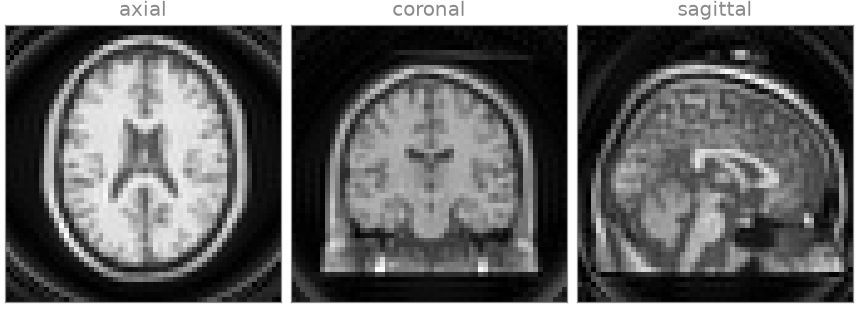
These are the three reference planes at 4 mm resolution. Rigid registration relies on the outline of the head and the large structures, which this resolution retains.
Pose estimation#
NavigatorMotionTracker takes the first navigator
you give it as the reference and returns the pose of every later one
relative to it. It registers each plane in 2D with
RigidRegistration, and solves for the pose that
fits the three planes in the least-squares sense. You move the head by a
few degrees and millimetres along every axis and see what the tracker
measures.
rotvec = np.array([0.02, -0.03, 0.05])  # rad
translation = np.array([3.0, -2.0, 4.0])  # mm

tracker = bt.NavigatorMotionTracker(measurement_noise=1e-3)
tracker.track(reference, AXES, spacing=SPACING_MM)
moved = navigator(move(rotvec, translation))
pose = tracker.track(moved, AXES, spacing=SPACING_MM)

rotation = Rotation.from_matrix(np.asarray(pose.matrix)[:3, :3])
measured_rotvec = rotation.as_rotvec()
measured_translation = np.asarray(pose.translation)
                 truth  measured
rotation   S/I   1.15°     1.46°
rotation   A/P  -1.72°    -1.45°
rotation   L/R   2.86°     2.51°
shift      S/I   3.0 mm   3.37 mm
shift      A/P  -2.0 mm  -2.66 mm
shift      L/R   4.0 mm   3.65 mm
In a real scan the true pose is unknown, so you check a measured pose on the navigator itself: move the head by the measured pose, acquire its navigator, and compare that with the navigator after the real motion. Without any correction, the difference is that of the motion; with the measured pose, what is left is the error of the pose.
realigned = navigator(move(measured_rotvec, measured_translation))
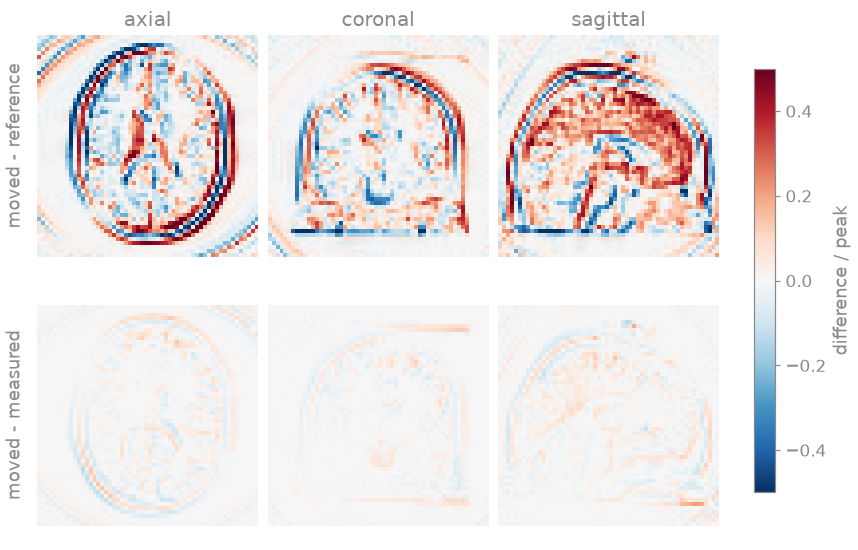
   axial: NRMSE against the moved navigator, reference 0.335, measured pose 0.051
 coronal: NRMSE against the moved navigator, reference 0.332, measured pose 0.049
sagittal: NRMSE against the moved navigator, reference 0.421, measured pose 0.067
The top row is the motion as the navigator sees it: strong edges all around the head. In the bottom row, after the measured pose, only a faint difference at the edges of the head is left. The pose is off by a fraction of a degree and of a millimetre, a small fraction of the 4 mm navigator voxel. That error has two sources: the coarse resolution of the navigator, and the through-plane motion, which each plane sees as a change of the anatomy in it rather than as a rigid motion within it.
Motion over a scan#
Over a scan, the head nods, a rotation about the left-right axis, by up to 2.3° with a period of 8 s, and drifts by 3 mm along the superior-inferior axis over 12 s. You acquire a navigator every 0.5 s, and each one carries complex Gaussian k-space noise, so each measured pose carries registration error.
DT, COUNT = 0.5, 24
seconds = DT * np.arange(1, COUNT + 1)
nod = 0.04 * np.sin(2 * np.pi * seconds / 8)  # rad, about L/R
drift = 3.0 * seconds / seconds[-1]  # mm, along S/I
truth = np.zeros((COUNT, 6))
truth[:, 2], truth[:, 3] = nod, drift

generator = torch.Generator().manual_seed(0)
scan = []
for a, d in zip(nod, drift):
    head = move((0.0, 0.0, a), (d, 0.0, 0.0))
    scan.append(navigator(head, noise=0.5, generator=generator))
The tracker filters the poses with a constant-velocity extended Kalman
filter, and two numbers set it. process_noise is the variance of the
acceleration the filter allows between navigators, per pose coordinate, in
rad²/s⁴ and mm²/s⁴. measurement_noise is the variance it assigns to
each measured coordinate. You filter the same scan with three values of
process_noise; the largest one leaves the filter at the measurements.
def track(process_noise):
    tracker = bt.NavigatorMotionTracker(
        process_noise=process_noise,
        measurement_noise=1e-4,
    )
    tracker.track(reference, AXES, spacing=SPACING_MM)
    poses = []
    for planes in scan:
        poses.append(tracker.track(planes, AXES, dt=DT, spacing=SPACING_MM))
    return poses


traces = {noise: track(noise) for noise in (1e2, 1e-3, 1e-4)}
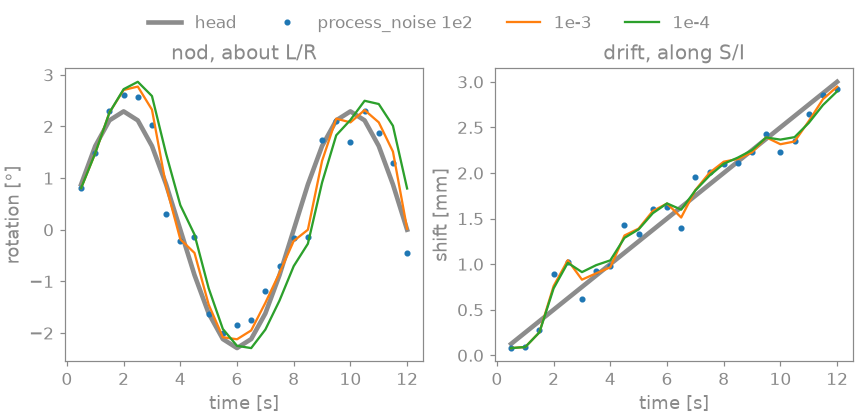
process_noise 100    rms error: rotation S/I 0.47°, A/P 0.36°, L/R 0.40°; shift S/I 0.19 mm, A/P 0.42 mm, L/R 0.19 mm
process_noise 0.001  rms error: rotation S/I 0.44°, A/P 0.29°, L/R 0.36°; shift S/I 0.16 mm, A/P 0.41 mm, L/R 0.15 mm
process_noise 0.0001 rms error: rotation S/I 0.43°, A/P 0.24°, L/R 0.60°; shift S/I 0.15 mm, A/P 0.42 mm, L/R 0.13 mm
A large process_noise leaves the filter at the measurements (the
dots). A small one makes it trust its constant-velocity prediction, which
smooths the registration error but lags a change of direction: at 1e-4
the error of the nod grows while that of the other coordinates falls. An
error common to every navigator, such as the offset of the A/P shift, is a
bias of the measurement, and no value of process_noise reduces it. The
value that gives the smallest error depends on the motion and on the
navigator’s precision, so you set it against a motion trace of your own
application.
As a spec#
What this tour built, stated the way you would ask an agent for it:
Track rigid head motion from navigators with bartorch. Each navigator
is three orthogonal central planes (axial, coronal, sagittal), each 96
golden-angle radial spokes of 56 samples, reconstructed on a 56^2 grid
with bt.reconstruct_navigator and bartorch.estimate_density weights.
Pass the plane orientations as row and column directions in the volume
(S/I, A/P, L/R) and the pixel spacing in mm to
bt.NavigatorMotionTracker; the first navigator is the reference.
Report each pose as a rotation vector and a translation in mm, check it
by re-navigating the head moved by the measured pose, and filter a
24-navigator scan (one every 0.5 s) with process_noise 1e2, 1e-3 and
1e-4, reporting the RMS error per coordinate against the true motion.
References#
Total running time of the script: (0 minutes 5.928 seconds)