

Execution model#
TL;DR
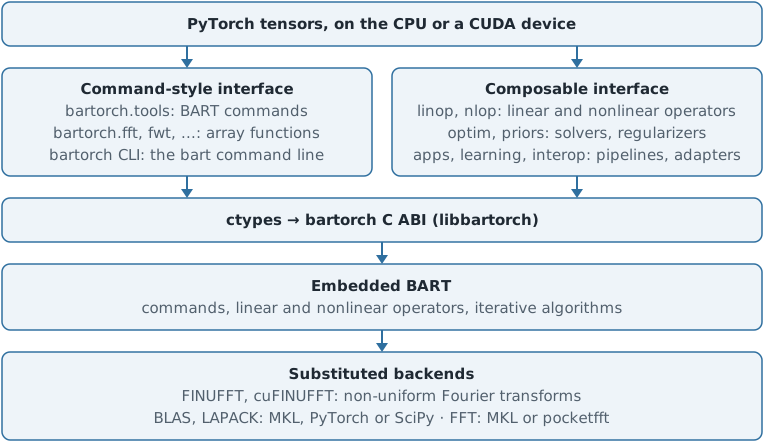
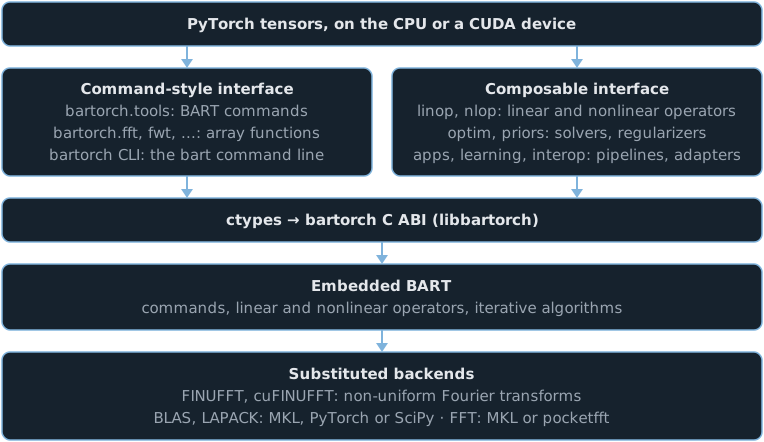
BART is compiled into the package and runs in your Python process, on your tensors, with no files and no subprocess.
You reach it through tools (BART’s commands), apps (its reconstructions) or operators and solvers (your own reconstruction), all over the same library.
An error inside BART raises
BartError, and your interpreter keeps running.
You call BART as you would call any PyTorch function: you pass tensors, on the
CPU or on a CUDA device, and you get tensors back. Choose the level that fits
the task. A standard reconstruction is one call to an app. An encoding BART has
no command for, a solver inside an outer loop, or a gradient through the
reconstruction needs the operators and solvers. Calibration, trajectories and
simulation are tools. Lesson 1 of the Course
calls a command on a tensor, and lesson 6 assembles pics by hand.
Capabilities#
Runs every BART command as a function of tensors, in this process.
Code:
bartorch.tools. Tests: every command is curated, derived or private (test_tools.py); fft matches numpy on two axes (test_core.py).Turns an error or a failed assertion inside BART into
BartError, with BART’s message, and leaves the library ready for the next call.Code:
bartorch_commandinsrc/csrc/abi/api.c. Tests: a failing tool raises with BART’s message; a failed assertion inside BART reaches the caller; a failed command leaves the next one free to run (test_core.py).Hands BART an operator’s tensors without copying them, and copies a command’s inputs because some commands write into theirs.
Code:
_dispatch.py,set_copy_inputs(). Tests: inputs are left untouched by a tool that writes into them; scratch inputs skip the copy (test_core.py).Runs an app with the same result as BART’s command: bit for bit on a Cartesian grid, to round-off along a trajectory.
Code:
pics(). Tests: the app is the tool to the last bit (test_apps.py); an assembled pics is the tool to the last bit (test_solve.py).Runs a solver as one call into BART, however many iterations it takes.
Code:
bartorch.optim. Tests: the solve is one call into the library; a BART operator is handed over as itself (test_solve.py).Keeps a CUDA tensor on its card, ordered against PyTorch’s stream without synchronising.
Code:
src/csrc/abi/cuda.c,_ON_DEVICEin_dispatch.py. Tests: work is ordered against torch’s stream without synchronising; every tool kept on the card answers there and agrees with the host; a tool that is not kept on the card still answers on it (test_cuda.py).Sets one thread count for BART, its FFT and FINUFFT, on the OpenMP runtime PyTorch has already loaded.
Code:
set_num_threads(),cmake/openmp.cmake. Tests: one thread count covers BART and the transform (test_finufft.py); threaded torch and threaded FINUFFT share one OpenMP runtime; loading modifies no installed file (test_openmp.py).Reads a
bartcommand line, so a BART script runs with the name changed.Code:
bartorch.cli. Tests: the app route answers what the command answers; an argument the reader cannot express goes to the command (test_cli.py).
Division of responsibility#
BART: the commands, operators and iterations, compiled from the pinned revision of
pulserver/bart.bartorch: the tensor boundary, error handling, device placement, and the substitutions, which change a result only within their own accuracy: FINUFFT for every non-uniform transform (Non-Cartesian transform), and the FFT, BLAS and LAPACK from MKL, PyTorch’s library or SciPy.
Method#
Tensor transfer#
A tensor crosses as its data pointer and its shape reversed into a BART dimension vector (Data layout). Arrays BART allocates come from PyTorch, on the device of the call. One Python thread calls into BART at a time; the parallelism is inside the call, on OpenMP threads.
GPU execution#
Operators and solvers work on device memory directly, with cuFFT, cuBLAS and cuFINUFFT. A few commands allocate host temporaries and mix them with their inputs; those are given host copies, and their results come back on the card.
OpenMP runtime#
BART and FINUFFT link the OpenMP runtime PyTorch ships, and the wheels carry none of their own, because LLVM’s runtime ends the process when a second copy starts. On Linux this needs PyTorch 2.7.1 or later.
Examples#
1. Your data as tensors: BART commands on tensors.
6. Custom encoding and solver:
picsassembled from an operator and a solver.Array functions and settings: threads, input copies and the CUDA settings.