

Performance#
TL;DR
BLAS, LAPACK and the FFT come from compiled libraries already in your process: MKL, then PyTorch’s library, then SciPy’s OpenBLAS.
One call,
bartorch.set_num_threads(), sets the threads of BART, its FFT and FINUFFT.Arithmetic is single precision complex (
complex64); the NUFFT is planned at a tolerance of \(10^{-3}\) on a grid oversampled by 1.25.
You meet these settings when you time a reconstruction, compare it with BART’s
bart executable, or share a machine with other work. The library underneath
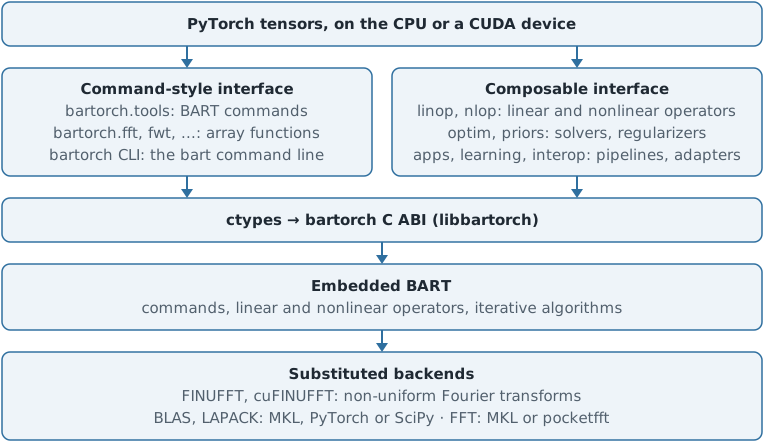
is BART’s, but the linear algebra, the FFT and the non-uniform transform are
served by optimized libraries that bartorch finds at import, and the accuracy
of the NUFFT is a setting. Execution model states which tools run on a
CUDA device and how they are ordered against PyTorch’s stream.
Capabilities#
Runs on the device of its tensors: OpenMP threads on the host, cuFFT, cuBLAS and cuFINUFFT on a CUDA card.
Code:
src/csrc/abi/cuda.c. Tests: a tool on a device tensor returns a device tensor; an operator applies on the device (test_cuda.py).Sets one thread count for BART, its FFT and FINUFFT’s host transforms.
Code:
set_num_threads(). Tests: one thread count covers bart and the transform (test_finufft.py).Takes every BLAS and LAPACK routine from a compiled library in the process, MKL first, and reports which one serves each.
Code:
_backend.py,backend_sources(). Tests: every blas and lapack routine comes from a compiled library; lapack is served by a library not by the built in reference; an installed mkl serves every routine (test_core.py).Executes BART’s FFT with MKL’s DFTI where a source has it, and with the transform compiled into the library otherwise.
Code:
src/csrc/substitute/fft.cpp. Tests: mkl and the built in transform agree; every plan a reconstruction makes goes to mkl; the fft reports where it came from (test_fft.py).Runs FINUFFT at the newest x86-64 instruction-set level the processor supports, or the one
BARTORCH_FINUFFT_SIMDnames.Code:
_finufft.py. Tests: the newest level the processor runs is the default; the environment names the level plans start at; every simd level matches an explicit dft; a plan keeps the level it was made at (test_finufft.py).Computes FINUFFT’s FFT with oneMKL where the process has it, loading no second MKL or OpenMP runtime.
Code:
src/csrc/substitute/fftw_bind.c. Tests: onemkl is the default fft where the process has it; finufft on onemkl loads no mkl or openmp runtime of its own (test_finufft.py).Plans the NUFFT at a tolerance of \(10^{-3}\) on a grid oversampled by 1.25, and calibrating tools at \(10^{-6}\) on a grid oversampled by 2.
Code:
_finufft.py,_CALIBRATESin_dispatch.py. Tests: precision can be traded for a transform that fits; a tool that calibrates gets the careful transform (test_finufft.py).Runs BART on one to eight CUDA streams, and keeps or returns freed device memory.
Code:
set_cuda_streams(),use_cuda_memcache(). Tests: more than one stream can be asked for; stream count is rejected outside barts range (test_cuda.py).
Division of responsibility#
BART: the parallel loops of its commands and operators, and cuFFT and cuBLAS on a device.
bartorch: which library serves each routine, the thread count, the FINUFFT instruction-set level and its tolerance and grid.
Other libraries: MKL (the
mklextra), PyTorch’s library and SciPy’s OpenBLAS for BLAS, LAPACK and the FFT; FINUFFT and cuFINUFFT for the NUFFT; PyTorch’s OpenMP runtime for the threads (OpenMP runtime).
Method#
Library order#
At import, each routine is taken from the first source that exports it: MKL
when the mkl extra is installed, then PyTorch’s libtorch_cpu (with
Accelerate on macOS), then SciPy’s cython_blas and cython_lapack.
BARTORCH_BLAS_LIBRARY set to mkl, torch, scipy or a library path puts
that source first, and the others still fill what it lacks. On a GPU, BART calls
cuBLAS; eigendecompositions and SVDs run on the host table, since BART has no
GPU LAPACK. Timings of each source are in
Backends and timings.
Precision#
Every array BART reads or writes is complex64, so a complex128 or real
input is converted, and the result is complex64. On the host, a NUFFT
tolerance below what single precision reaches at a given size is planned at the
tolerance it can reach.
NUFFT accuracy#
The default of \(10^{-3}\) on a grid oversampled by 1.25 suits a reconstruction,
whose error is set by its data rather than by its transform. oversampling and
width of NUFFT, and -o and -w of the tools, ask
for another grid or kernel width; on a CUDA device only 2 and 1.25 are
accepted. Non-Cartesian transform describes the transform.
Examples#
8. Radial SENSE: a radial SENSE reconstruction, where the NUFFT dominates the time.
Array functions and settings: threads, backend sources and the CUDA settings.