apps.mobafit#
- bartorch.apps.mobafit()#
Fit a signal model to reconstructed contrast images, voxel by voxel.
Levenberg-Marquardt over every voxel at once, each with its own damping and its own small linear system solved directly, over the model of a
ModelOperator. The model is BlochSim’s, in its bounded parameterization, so the result is named maps in physical units rather than BART’s coefficients, and no iterate leaves the bounds. The answer is a local minimum that depends on the starting point.- Parameters:
images (torch.Tensor) – Contrast images
(contrasts, *voxels), C order, in the order of the model’s acquisition, in any intensity units.model (bartorch.nlop.ModelOperator) – Signal model of the acquisition, on the voxel shape of
images:MultiEcho(),InversionRecovery()orBloch().iterations (int, default=20) – Levenberg-Marquardt steps; a voxel stops earlier once it has converged.
magnitude (bool, default=False) – Fit the model’s magnitude to the images’ magnitude (
-a).start (torch.Tensor, default=None) – Starting point in the model’s domain, as
initial()packs it, with the amplitude in the units ofimages; built from**valueswhenNone.**values – Starting values
name=valuein physical units, asinitial()takes them.
- Returns:
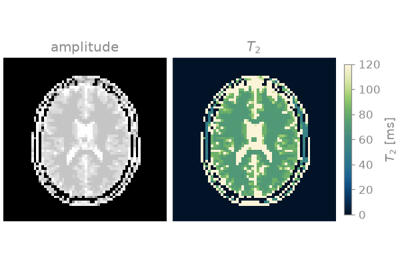
Fitted maps in physical units, keyed by unknown. Voxels whose data is zero in every contrast keep their starting values.
- Return type:
dict of str to torch.Tensor
Notes
For a model with an amplitude, the images are divided by their peak magnitude for the fit and the amplitude is scaled back.
Examples
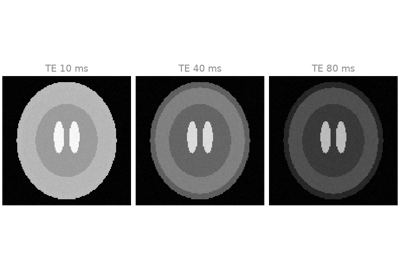
>>> M = nlop.MultiEcho([12.5 * (echo + 1) for echo in range(8)], (128, 128))
>>> maps = mobafit(images, M, T2=80.0)
>>> maps["T2"]