linop.CartesianSense#
- bartorch.linop.CartesianSense()#
Cartesian SENSE encoding operator.
\[A = P F S\]with \(S\) the coil sensitivities, \(F\) the centred unitary FFT over the spatial axes and \(P\) the sampling pattern. With a temporal basis \(\Phi\)
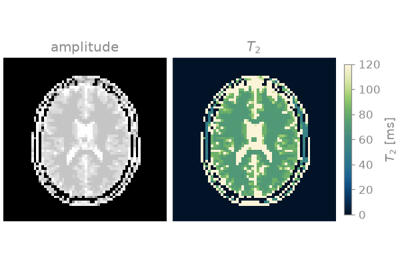
(coeffs, frames)the image holds subspace coefficients (T2 shuffling):\[y[c, t] = P[t] \odot \sum_a \Phi[a, t] \, F(S[c] \odot x[a])\]The pattern and the basis are applied inside the coil-slab loop of
NoncartesianSense, whose remaining keyword arguments are accepted.- Parameters:
sensitivities (tensor) – Coil sensitivities
([batch, sets,] coils, [z,] y, x), or k-space kernels withkernels=True.image_shape (tuple of int) –
(*batches, [batch,] [sets,] [coeffs,] [z,] y, x). The samples are(*batches, [batch,] coils, [frames,] [z,] y, x).pattern (tensor, default=None) – Binary sampling mask broadcast over one coil’s samples
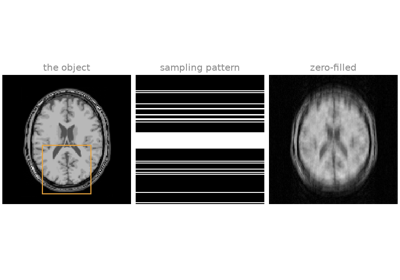
([frames,] [z,] y, x);(y, 1)samples whole readouts.positions (tensor, default=None) – Alternative to
pattern: integer indices of the acquired phase encodes,([frames,] shots, d)withdindexing(y,)in 2D or(z, y)in 3D, and-1padding frames with fewer shots. The samples are then(*batches, [batch,] coils, [frames,] shots, x).readout ({"kspace", "image"}, default='kspace') – With
positions, whether the samples are in k-space along the readout or already inverse-transformed along it (hybrid space).basis (tensor, default=None) – Temporal subspace basis
(coeffs, frames).toeplitz (bool, default=True) – With a pattern, positions or a basis, apply the normal in closed form (see Notes) rather than as the forward and adjoint applications.
kernels (bool, default=False) – Read
sensitivitiesas k-space kernels.coil_batch (int, default=1) – Coils per slab; 0 applies all coils at once.
modulated (bool, default=False) – Use BART’s uncentred sample convention (an
fftmodon the sample axes) instead of the centred onebartorch.fft()produces.device (torch.device or str, default=None) – Device the operator is built and computes on;
Nonetakes the sensitivities’.ndim (int, default=None) – Number of spatial axes (2 or 3) where the sensitivities and the image do not determine it.
kspace_shape (tuple of int, default=None) – Sample shape, which must be the default above.
fold_maps (bool, default=True) – Apply the sensitivities inside the normal’s transform where possible.
- Return type:
- Raises:
ValueError – When
trajis given, when bothpatternandpositionsare, or whenreadoutis"image"withoutpositions.NotImplementedError – For
positionswithmodulated=True.
Notes
The Toeplitz normal is
\[(A^H A x)[a'] = \sum_a \Big( \sum_t |P[t]|^2 \, \overline{\Phi[a', t]} \, \Phi[a, t] \Big) x[a]\]with the kernel in parentheses applied in k-space, between transforms along only the axes the pattern varies on. The sum over frames is computed once at build time, so iterations never form the frames, and a pattern constant along the readout is never transformed along it. The modulated convention differs by a unit-modulus phase on the samples and leaves the normal unchanged.
Examples
>>> A = CartesianSense(maps, (y, x), pattern=mask)          # mask (y, 1)
>>> x = bartorch.optim.CG(maxiter=30)(kspace, A)
>>> A = CartesianSense(maps, (4, y, x), pattern=mask, basis=phi)
>>> A.ishape, A.oshape                                       # phi (4, 64)
((4, y, x), (coils, 64, y, x))