tools.ecalib#
- bartorch.tools.ecalib()#
Coil sensitivities by ESPIRiT.
- Parameters:
kspace (torch.Tensor) – k-space with a fully sampled centre,
(coils, z, y, x), or(coils, y, x)for one slice.maps (int, default=None) – Number of sets of sensitivities (
-m); BART’s default is 2.calib_size (int or tuple of int, default=None) – Size of the calibration region (
-r), one for every axis or one per axis in C order; BART’s default is 24 on every axis.threshold (float, default=None) – Singular-value threshold of the calibration matrix, which sets the size of its null space (
-t); BART’s default is 0.001.crop (float, default=None) – Eigenvalue below which a sensitivity is set to zero (
-c); BART’s default is 0.8.kernel_size (int, default=None) – Size of the calibration kernel (
-k); BART’s default is 6.softsense (bool, default=False) – Weight the maps by a smooth function of the eigenvalue about
croprather than cropping them (Soft-SENSE,-S).intensity_correction (bool, default=False) – Normalise the maps to unit l1 norm over the coils, times the square root of the coil count, rather than unit l2 norm (
-I).return_eigenvalues (bool, default=False) – Also return the eigenvalue maps, BART’s optional second output.
**extra – Further BART
ecaliboptions, by name.e, the axis the second step is split along, takes an axis ofkspace.
- Returns:
The sensitivities,
(maps, coils, z, y, x)with themapsaxis dropped when it has size one, and the eigenvalue maps when asked for; without azaxis whenkspacehas none.- Return type:
torch.Tensor or tuple of torch.Tensor
Examples
>>> maps = ecalib(kspace, maps=1, crop=0.8)
Examples using ecalib#
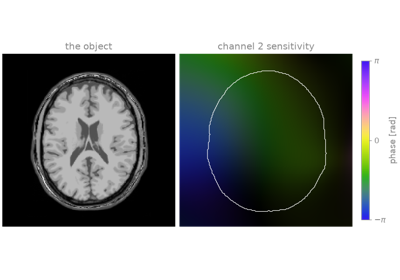
4. Joint reconstruction of image and sensitivity maps