tools.traj#
- bartorch.tools.traj()#
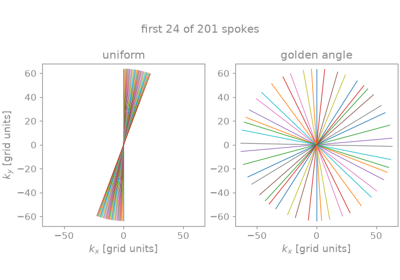
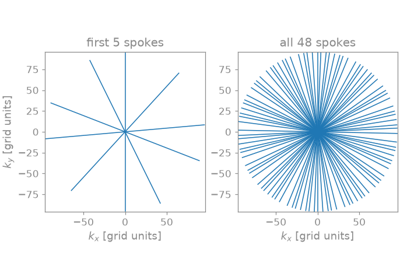
k-space trajectory in grid units, Cartesian or radial.
- Parameters:
readout (int, default=None) – Samples per readout (
-x); BART’s default is 128.spokes (int, default=None) – Readouts per frame (
-y); BART’s default is 128.frames (int, default=None) – Number of frames along BART’s time axis, each rotated by a fraction of the angular increment (
-t, BART’sturns); radial only.radial (bool, default=False) – Radial spokes rather than Cartesian lines (
-r).golden (bool, default=False) – Golden-angle increment between spokes (
-G); impliesradial.turns (int, default=None) – Simultaneous multi-slice factor: partitions along BART’s slice axis (
-m); radial only.oversampling (bool, default=False) – Correct the transverse gradient error of a radial trajectory (
-O). Readout oversampling istraj -o, passed aso=factor.**extra – Further BART
trajoptions, by name.
- Returns:
Coordinates
(..., spokes, readout, 3),kx, ky, kzin grid units, with leading axes forframesandturnswhen they exceed one. The layout every non-Cartesian transform in this package takes.- Return type:
torch.Tensor
Examples
>>> trajectory = traj(readout=256, spokes=64, radial=True, golden=True)